Engineering Mechanics: Statics and Dynamics, 14th Edition
Authors: Russell C. Hibbeler
ISBN-13: 978-0133915426
See our solution for Question 104P from Chapter 10 from Hibbeler's Engineering Mechanics.
Problem 104P
Step-by-Step Solution
We are given the mass per unit area of a thin plate as $m' = 10\;{{{\rm{kg}}} \mathord{\left/ {\vphantom {{{\rm{kg}}} {{{\rm{m}}^2}}}} \right. } {{{\rm{m}}^2}}}$.
We are asked to determine the mass moment of inertial about the y-axis.
Step 2
To calculate the mass of each plate, we have:
\[{m_p} = m' \times {a^2}\]Here, a is the side of thin plate.
Substitute the values in the above expression, we get:
\[\begin{array}{c} {m_p} = m' \times {\left( {400\;{\rm{mm}}} \right)^2}\\ {m_p} = \left( {10\;{{{\rm{kg}}} \mathord{\left/ {\vphantom {{{\rm{kg}}} {{{\rm{m}}^2}}}} \right. } {{{\rm{m}}^2}}}} \right) \times \left( {160000\;{\rm{m}}{{\rm{m}}^2} \times \frac{{{{10}^{ - 6}}\;{{\rm{m}}^2}}}{{1\;{\rm{m}}{{\rm{m}}^2}}}} \right)\\ {m_p} = 1.6\;{\rm{kg}} \end{array}\]To calculate the mass of each circular part, we have:
\[{m_c} = m'\pi {r^2}\]Here, r is the radius of a circular section.
Substitute the values in the above expression, we get:
\[\begin{array}{c} {m_c} = m' \times \pi \times {\left( {100\;{\rm{mm}} \times \frac{{{{10}^{ - 3}}\;{\rm{m}}}}{{1\;{\rm{mm}}}}} \right)^2}\\ {m_c} = \left( {10\;{{{\rm{kg}}} \mathord{\left/ {\vphantom {{{\rm{kg}}} {{{\rm{m}}^3}}}} \right. } {{{\rm{m}}^3}}}} \right) \times \pi \times \left( {0.01\;{{\rm{m}}^2}} \right)\\ {m_c} = 0.314\;{\rm{kg}} \end{array}\]Step 3
Now, to calculate the mass moment of inertial about the y-axis, we need to divide the thin plate and circular part into two segments as shown below,
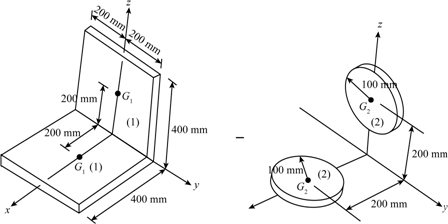
To calculate the moment of inertia of segment 1 about its centroid, we have:
\[{I_{{G_1}}} = 2 \times \frac{1}{{12}}{m_p}{a^2}\]Substitute the values in the above expression, we get:
\[\begin{array}{c} {I_{{G_1}}} = 2 \times \frac{1}{{12}} \times \left( {1.6\;{\rm{kg}}} \right) \times {\left( {400\;{\rm{mm}} \times \frac{{{{10}^{ - 3}}\;{\rm{m}}}}{{1\;{\rm{mm}}}}} \right)^2}\\ {I_{{G_1}}} = 0.0427\;{\rm{kg}} \cdot {{\rm{m}}^2} \end{array}\]The product of the mass and the perpendicular distance from the axis for segment 1 can be calculated as:
\[\begin{array}{c} {m_p}d_1^2 = 2 \times \left( {1.6\;{\rm{kg}}} \right) \times {\left( {200\;{\rm{mm}} \times \frac{{{{10}^{ - 3}}\;{\rm{m}}}}{{1\;{\rm{mm}}}}} \right)^2}\\ {m_p}d_1^2 = 0.128\;{\rm{kg}} \cdot {{\rm{m}}^2} \end{array}\]Here, d is the distance between the centroid to the reference axis.
To calculate the moment of inertia of segment 2 about its centroid, we have:
\[{I_{{G_2}}} = - 2 \times \frac{1}{4}{m_c}{r^2}\]Substitute the values in the above expression, we get:
\[\begin{array}{c} {I_{{G_2}}} = - 2 \times \frac{1}{4} \times \left( {0.314\;{\rm{kg}}} \right) \times {\left( {100\;{\rm{mm}} \times \frac{{{{10}^{ - 3}}\;{\rm{m}}}}{{1\;{\rm{mm}}}}} \right)^2}\\ {I_{{G_2}}} = - 0.00157\;{\rm{kg}} \cdot {{\rm{m}}^2} \end{array}\]The product of the mass and the perpendicular distance from the axis for segment 2 can be calculated as:
\[\begin{array}{c} {m_c}d_2^2 = - 2 \times \left( {0.314\;{\rm{kg}}} \right) \times {\left( {200\;{\rm{mm}} \times \frac{{{{10}^{ - 3}}\;{\rm{m}}}}{{1\;{\rm{mm}}}}} \right)^2}\\ {m_c}d_2^2 = 0.02512\;{\rm{kg}} \cdot {{\rm{m}}^2} \end{array}\]Step 4
To calculate the mass moment of inertia of the plate about the y-axis, we have:
\[\begin{array}{c} {I_y} = \sum {I_G} + \sum m{d^2}\\ {I_y} = \left( {{I_{{G_1}}} + {I_{{G_2}}}} \right) + \left( {{m_p}d_1^2 + {m_c}d_2^2} \right) \end{array}\]Substitute the values in the above expression, we get:
\[\begin{array}{c} {I_y} = \left[ {\left( {0.0427\;{\rm{kg}} \cdot {{\rm{m}}^2}} \right) + \left( { - 0.00157\;{\rm{kg}} \cdot {{\rm{m}}^2}} \right)} \right] + \left[ {\left( {0.128\;{\rm{kg}} \cdot {{\rm{m}}^2}} \right) + \left( { - 0.02512\;{\rm{kg}} \cdot {{\rm{m}}^2}} \right)} \right]\\ {I_y} = \left( {0.04113\;{\rm{kg}} \cdot {{\rm{m}}^2}} \right) + \left( {0.10288\;{\rm{kg}} \cdot {{\rm{m}}^2}} \right)\\ {I_y} = 0.144\;{\rm{kg}} \cdot {{\rm{m}}^2} \end{array}\]