Engineering Mechanics: Statics and Dynamics, 14th Edition
Authors: Russell C. Hibbeler
ISBN-13: 978-0133915426
See our solution for Question 47P from Chapter 10 from Hibbeler's Engineering Mechanics.
Problem 47P
Step-by-Step Solution
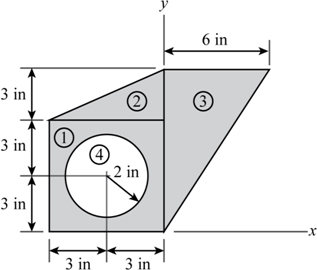
We are given a shaded area of a composite section in the diagram showing all of its dimensions.
We are required to determine the moment of inertia for the shaded area about the $y$ axis.
Step 2
Consider the given composite section and divide it into four sections represented by 1, 2, 3 and 4 in the diagram. The diagrammatic representation of the shaded composite area is shown below:
Step 3
For solid section 1:
Using the parallel axis theorem, the expression for moment of inertia of the solid rectangular section 1 about the $y$ axis is given by,
\[\begin{array}{l} {\left( {{{\overline I }_y}} \right)_1} = {I_1} + {A_1}{x_1}^2\\ {\left( {{{\overline I }_y}} \right)_1} = \frac{{{\rm{6 in}} \times {{\left( {{\rm{6 in}}} \right)}^3}}}{{12}} + \left( {6 \times 6} \right){\rm{ i}}{{\rm{n}}^2} \times {\left( {\frac{{{\rm{6 in}}}}{2}} \right)^2}\\ {\left( {{{\overline I }_y}} \right)_1} = 108{\rm{ i}}{{\rm{n}}^4} + 324{\rm{ i}}{{\rm{n}}^4}\\ {\left( {{{\overline I }_y}} \right)_1} = 432{\rm{ i}}{{\rm{n}}^4} \end{array}\]Step 4
For solid section 2:
Similarly, the expression for the moment of inertia of the solid triangular section 2 about the $y$ axis is given by,
\[\begin{array}{l} {\left( {{{\overline I }_y}} \right)_2} = {I_2} + {A_2}{x_2}^2\\ {\left( {{{\overline I }_y}} \right)_2} = \frac{{{\rm{3 in}} \times {{\left( {{\rm{6 in}}} \right)}^3}}}{{36}} + \left( {\frac{1}{2} \times 6 \times 3} \right){\rm{ i}}{{\rm{n}}^2} \times {\left( {\frac{{{\rm{6 in}}}}{3}} \right)^2}\\ {\left( {{{\overline I }_y}} \right)_2} = 18{\rm{ i}}{{\rm{n}}^4} + 36{\rm{ i}}{{\rm{n}}^4}\\ {\left( {{{\overline I }_y}} \right)_2} = 54{\rm{ i}}{{\rm{n}}^4} \end{array}\]Step 5
For solid section 3:
The expression for the moment of inertia of the solid triangular section 3 about the $x$ axis is given by,
\[\begin{array}{l} {\left( {{{\overline I }_y}} \right)_3} = {I_3} + {A_3}{x_3}^2\\ {\left( {{{\overline I }_y}} \right)_3} = \frac{{{\rm{9 in}} \times {{\left( {{\rm{6 in}}} \right)}^3}}}{{36}} + \left( {\frac{1}{2} \times 9 \times 6} \right){\rm{ i}}{{\rm{n}}^2} \times {\left( {\frac{{{\rm{6 in}}}}{3}} \right)^2}\\ {\left( {{{\overline I }_y}} \right)_3} = 54{\rm{ i}}{{\rm{n}}^4} + 108{\rm{ i}}{{\rm{n}}^4}\\ {\left( {{{\overline I }_y}} \right)_3} = 162{\rm{ i}}{{\rm{n}}^4} \end{array}\]Step 6
For hollow section 4:
The expression for the moment of inertia of the circular hollow section 4 about the $x$ axis is given by,
\[\begin{array}{l} {\left( {{{\overline I }_y}} \right)_4} = {I_4} + {A_4}{x_4}^2\\ {\left( {{{\overline I }_y}} \right)_4} = \frac{{\pi \times {{\left( {{\rm{2 in}}} \right)}^4}}}{4} + \left( {\pi \times {{\left( {{\rm{2 in}}} \right)}^2}} \right){\rm{ i}}{{\rm{n}}^2} \times {\left( {{\rm{3 in}}} \right)^2}\\ {\left( {{{\overline I }_y}} \right)_4} = 12.57{\rm{ i}}{{\rm{n}}^4} + 113.097{\rm{ i}}{{\rm{n}}^4}\\ {\left( {{{\overline I }_y}} \right)_4} = 125.66{\rm{ i}}{{\rm{n}}^4} \end{array}\]Step 7
The expression for the moment of inertia ${\overline I _y}$ of the beam about the $y$ axis is given by,
\[\begin{array}{l} {\overline I _y} = {\left( {{{\overline I }_y}} \right)_1} + {\left( {{{\overline I }_y}} \right)_2} + {\left( {{{\overline I }_y}} \right)_3} - {\left( {{{\overline I }_y}} \right)_4}\\ {\overline I _y} = 432{\rm{ i}}{{\rm{n}}^4} + 54{\rm{ i}}{{\rm{n}}^4} + 162{\rm{ i}}{{\rm{n}}^4} - 125.66{\rm{ i}}{{\rm{n}}^4}\\ {\overline I _y} = 522.34{\rm{ i}}{{\rm{n}}^4} \end{array}\]