Engineering Mechanics: Statics and Dynamics, 14th Edition
Authors: Russell C. Hibbeler
ISBN-13: 978-0133915426
See our solution for Question 75P from Chapter 10 from Hibbeler's Engineering Mechanics.
Problem 75P
Step-by-Step Solution
We are given the thickness of flange and web as $t = {\rm{10}}\;{\rm{mm}}$, and the height of flange as $h = 100\;{\rm{mm}}$.
We are asked to determine orientation of the principal axes and the principal moment of inertia of the cross section by using Mohr’s circle.
Step 2
We will draw a schematic diagram of the cross section.
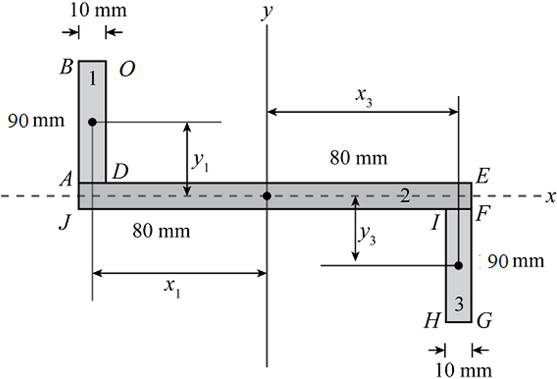
The length $AB$ and $FG$ is $AB = FG = 90\;{\rm{mm}}$.
The length $AE$ and $JF$ is $AE = JF = 160\;{\rm{mm}}$.
The length $BO$ $HG$, and $AJ$ is $BO = HG = 10\;{\rm{mm}}$.
Step 3
We will find the area of the rectangle 1.
\[{A_1} = AB \times BO\]Substitute the given value in the above equation.
\[\begin{array}{c} {A_1} = \left( {{\rm{90}}\;{\rm{mm}}} \right) \times \left( {{\rm{10}}\;{\rm{mm}}} \right)\\ {A_1} = 900\;{\rm{m}}{{\rm{m}}^{\rm{2}}} \end{array}\]Step 4
We will find the area of the rectangle 2.
\[{A_2} = AE \times AJ\]Substitute the given value in the above equation.
\[\begin{array}{c} {A_2} = \left( {{\rm{160}}\;{\rm{mm}}} \right) \times \left( {{\rm{10}}\;{\rm{mm}}} \right)\\ {A_2} = \left( {{\rm{160}}\;{\rm{mm}}} \right) \times \left( {{\rm{10}}\;{\rm{mm}}} \right)\\ {A_2} = 1600\;{\rm{m}}{{\rm{m}}^{\rm{2}}} \end{array}\]Step 5
We will find the area of the rectangle 2.
\[{A_3} = FG \times HG\]Substitute the given value in the above equation.
\[\begin{array}{c} {A_3} = \left( {{\rm{90}}\;{\rm{mm}}} \right) \times \left( {{\rm{10}}\;{\rm{mm}}} \right)\\ {A_3} = 900\;{\rm{m}}{{\rm{m}}^{\rm{2}}} \end{array}\]Step 6
We will find the centroid of the cross section the $x$-axis.
\[\begin{array}{c} {d_x} = \frac{{{A_1}\left( { - {x_1}} \right) + {A_2}{x_2} + {A_3}{x_3}}}{{{A_1} + {A_2} + {A_3}}}\\ {d_x} = \frac{{ - {A_1}\left( {\frac{{AE}}{2} - \frac{{BO}}{2}} \right) + {A_2}{x_2} + {A_3}\left( {\frac{{AE}}{2} - \frac{{HG}}{2}} \right)}}{{{A_1} + {A_2} + {A_3}}} \end{array}\]Here, ${x_2} = 0\;{\rm{mm}}$ is the centroid of rectangle 2.
Substitute the given value in the above equation.
\[\begin{array}{c} {d_x} = \frac{{\left[ \begin{array}{l} - \left( {900\;{\rm{m}}{{\rm{m}}^{\rm{2}}}} \right)\left( {\frac{{{\rm{160}}\;{\rm{mm}}}}{2} - \frac{{{\rm{10}}\;{\rm{mm}}}}{2}} \right) + \left( {1600\;{\rm{m}}{{\rm{m}}^{\rm{2}}}} \right)\left( {{\rm{0}}\;{\rm{mm}}} \right) + \\ \left( {900\;{\rm{m}}{{\rm{m}}^{\rm{2}}}} \right)\left( {\frac{{{\rm{160}}\;{\rm{mm}}}}{2} - \frac{{{\rm{10}}\;{\rm{mm}}}}{2}} \right) \end{array} \right]}}{{\left[ {1000\;{\rm{m}}{{\rm{m}}^{\rm{2}}} + 1600\;{\rm{m}}{{\rm{m}}^{\rm{2}}} + 1000\;{\rm{m}}{{\rm{m}}^{\rm{2}}}} \right]}}\\ {d_x} = \left[ {\frac{{ - \left( {900\;{\rm{m}}{{\rm{m}}^{\rm{2}}}} \right)\left( {\frac{{{\rm{160}}\;{\rm{mm}}}}{2} - \frac{{{\rm{10}}\;{\rm{mm}}}}{2}} \right) + \left( {900\;{\rm{m}}{{\rm{m}}^{\rm{2}}}} \right)\left( {\frac{{{\rm{160}}\;{\rm{mm}}}}{2} - \frac{{{\rm{10}}\;{\rm{mm}}}}{2}} \right)}}{{3600\;{\rm{m}}{{\rm{m}}^{\rm{2}}}}}} \right]\\ {d_x} = 0\;{\rm{mm}} \end{array}\]Step 7
We will find the centroid of the cross section the $y$-axis.
\[\begin{array}{l} {d_y} = \frac{{{A_1}\left( {{y_1}} \right) + {A_2}{y_2} + {A_3}\left( { - {y_3}} \right)}}{{{A_1} + {A_2} + {A_3}}}\\ {d_y} = \frac{{{A_1}\left( {\frac{{AJ}}{2} + \frac{{AB}}{2}} \right) + {A_2}{y_2} - {A_3}\left( {\frac{{EF}}{2} + \frac{{FG}}{2}} \right)}}{{{A_1} + {A_2} + {A_3}}} \end{array}\]Here, ${y_2} = 0\;{\rm{mm}}$ is the centroid of rectangle 2.
Substitute the given value in the above equation.
\[\begin{array}{c} {d_y} = \frac{{\left[ \begin{array}{l} \left( {900\;{\rm{m}}{{\rm{m}}^{\rm{2}}}} \right)\left( {\frac{{{\rm{10}}\;{\rm{mm}}}}{2} + \frac{{{\rm{100}}\;{\rm{mm}}}}{2}} \right) + \left( {1600\;{\rm{m}}{{\rm{m}}^{\rm{2}}}} \right)\left( {{\rm{0}}\;{\rm{mm}}} \right) - \\ \left( {900\;{\rm{m}}{{\rm{m}}^{\rm{2}}}} \right)\left( {\frac{{{\rm{10}}\;{\rm{mm}}}}{2} + \frac{{{\rm{100}}\;{\rm{mm}}}}{2}} \right) \end{array} \right]}}{{\left[ {1000\;{\rm{m}}{{\rm{m}}^{\rm{2}}} + 1600\;{\rm{m}}{{\rm{m}}^{\rm{2}}} + 1000\;{\rm{m}}{{\rm{m}}^{\rm{2}}}} \right]}}\\ {d_y} = \left[ {\frac{{\left( {900\;{\rm{m}}{{\rm{m}}^{\rm{2}}}} \right)\left( {\frac{{{\rm{10}}\;{\rm{mm}}}}{2} + \frac{{{\rm{100}}\;{\rm{mm}}}}{2}} \right) - \left( {900\;{\rm{m}}{{\rm{m}}^{\rm{2}}}} \right)\left( {\frac{{{\rm{10}}\;{\rm{mm}}}}{2} + \frac{{{\rm{100}}\;{\rm{mm}}}}{2}} \right)}}{{3600\;{\rm{m}}{{\rm{m}}^{\rm{2}}}}}} \right]\\ {d_y} = 0\;{\rm{mm}} \end{array}\]Step 8
We will find the moment of inertia of the cross section about the $x$-axis by using Parallel axis theorem.
\[\begin{array}{c} {I_x} = {I_{1x}} + {I_{2x}} + {I_{3x}}\\ {I_x} = \left[ {\frac{{AD \times A{B^3}}}{{12}} + {A_1}y_1^2} \right] + \left[ {\frac{{AE \times A{J^3}}}{{12}}} \right] + \left[ {\frac{{HG \times F{G^3}}}{{12}} + {A_3}y_3^2} \right]\\ {I_x} = \left[ {\frac{{AD \times A{B^3}}}{{12}} + {A_1}{{\left( {\frac{{AJ}}{2} + \frac{{AB}}{2}} \right)}^2}} \right] + \left[ {\frac{{AE \times A{J^3}}}{{12}}} \right] + \left[ {\frac{{HG \times F{G^3}}}{{12}} + {A_3}{{\left( {\frac{{EF}}{2} + \frac{{FG}}{2}} \right)}^2}} \right] \end{array}\]Here, ${I_{1x}}$ is the moment of inertia of rectangle 1, ${I_{2x}}$ is the moment of inertia of rectangle 2, ${I_{3x}}$ is the moment of inertia of rectangle 3.
Substitute the given value in the above equation.
\[\begin{array}{c} {I_x} = \left[ \begin{array}{l} \left[ {\frac{{\left( {{\rm{10}}\;{\rm{mm}}} \right) \times {{\left( {{\rm{90}}\;{\rm{mm}}} \right)}^3}}}{{12}} + \left( {{\rm{900}}\;{\rm{m}}{{\rm{m}}^{\rm{2}}}} \right){{\left( {\frac{{{\rm{10}}\;{\rm{mm}}}}{2} + \frac{{{\rm{90}}\;{\rm{mm}}}}{2}} \right)}^2}} \right] + \\ \left[ {\frac{{\left( {{\rm{160}}\;{\rm{mm}}} \right) \times {{\left( {{\rm{10}}\;{\rm{mm}}} \right)}^3}}}{{12}}} \right] + \\ \left[ {\frac{{\left( {{\rm{10}}\;{\rm{mm}}} \right) \times {{\left( {{\rm{90}}\;{\rm{mm}}} \right)}^3}}}{{12}} + \left( {{\rm{900}}\;{\rm{m}}{{\rm{m}}^{\rm{2}}}} \right){{\left( {\frac{{{\rm{10}}\;{\rm{mm}}}}{2} + \frac{{{\rm{90}}\;{\rm{mm}}}}{2}} \right)}^2}} \right] \end{array} \right]\\ {I_x} = \left[ \begin{array}{l} \left[ {\frac{{\left( {{\rm{10}}\;{\rm{mm}}} \right) \times {{\left( {{\rm{90}}\;{\rm{mm}}} \right)}^3}}}{{12}} + \left( {{\rm{900}}\;{\rm{m}}{{\rm{m}}^{\rm{2}}}} \right){{\left( {{\rm{50}}\;{\rm{mm}}} \right)}^2}} \right] + \\ \left[ {\frac{{\left( {{\rm{160}}\;{\rm{mm}}} \right) \times {{\left( {{\rm{10}}\;{\rm{mm}}} \right)}^3}}}{{12}}} \right] + \\ \left[ {\frac{{\left( {{\rm{10}}\;{\rm{mm}}} \right) \times {{\left( {{\rm{90}}\;{\rm{mm}}} \right)}^3}}}{{12}} + \left( {{\rm{900}}\;{\rm{m}}{{\rm{m}}^{\rm{2}}}} \right){{\left( {{\rm{50}}\;{\rm{mm}}} \right)}^2}} \right] \end{array} \right]\\ {I_x} = 5.73 \times {10^6}\;{\rm{m}}{{\rm{m}}^{\rm{4}}} \end{array}\]Step 9
We will find the moment of inertia of the cross section about the $y$-axis by using Parallel axis theorem.
\[\begin{array}{c} {I_y} = {I_{1y}} + {I_{2y}} + {I_{3y}}\\ {I_y} = \left[ {\frac{{AB \times A{D^3}}}{{12}} + {A_1}x_1^2} \right] + \left[ {\frac{{AJ \times A{E^3}}}{{12}}} \right] + \left[ {\frac{{FG \times H{G^3}}}{{12}} + {A_3}x_3^2} \right]\\ {I_y} = \left[ {\frac{{AD \times A{B^3}}}{{12}} + {A_1}{{\left( {\frac{{AE}}{2} - \frac{{BO}}{2}} \right)}^2}} \right] + \left[ {\frac{{AE \times A{J^3}}}{{12}}} \right] + \left[ {\frac{{HG \times F{G^3}}}{{12}} + {A_3}{{\left( {\frac{{AE}}{2} - \frac{{HG}}{2}} \right)}^2}} \right] \end{array}\]Here, ${I_{1y}}$ is the moment of inertia of rectangle 1, ${I_{2y}}$ is the moment of inertia of rectangle 2, ${I_{3y}}$ is the moment of inertia of rectangle 3.
Substitute the given value in the above equation.
\[\begin{array}{c} {I_y} = \left[ \begin{array}{l} \left[ {\frac{{\left( {{\rm{90}}\;{\rm{mm}}} \right) \times {{\left( {{\rm{10}}\;{\rm{mm}}} \right)}^3}}}{{12}} + \left( {{\rm{900}}\;{\rm{m}}{{\rm{m}}^{\rm{2}}}} \right){{\left( {\frac{{{\rm{160}}\;{\rm{mm}}}}{2} - \frac{{{\rm{10}}\;{\rm{mm}}}}{2}} \right)}^2}} \right] + \\ \left[ {\frac{{\left( {{\rm{10}}\;{\rm{mm}}} \right) \times {{\left( {{\rm{160}}\;{\rm{mm}}} \right)}^3}}}{{12}}} \right] + \\ \left[ {\frac{{\left( {{\rm{90}}\;{\rm{mm}}} \right) \times {{\left( {{\rm{10}}\;{\rm{mm}}} \right)}^3}}}{{12}} + \left( {{\rm{900}}\;{\rm{m}}{{\rm{m}}^{\rm{2}}}} \right){{\left( {\frac{{{\rm{160}}\;{\rm{mm}}}}{2} - \frac{{{\rm{10}}\;{\rm{mm}}}}{2}} \right)}^2}} \right] \end{array} \right]\\ {I_y} = \left[ \begin{array}{l} \left[ {\frac{{\left( {{\rm{90}}\;{\rm{mm}}} \right) \times {{\left( {{\rm{10}}\;{\rm{mm}}} \right)}^3}}}{{12}} + \left( {{\rm{900}}\;{\rm{m}}{{\rm{m}}^{\rm{2}}}} \right){{\left( {75\;{\rm{mm}}} \right)}^2}} \right] + \\ \left[ {\frac{{\left( {{\rm{10}}\;{\rm{mm}}} \right) \times {{\left( {{\rm{160}}\;{\rm{mm}}} \right)}^3}}}{{12}}} \right] + \\ \left[ {\frac{{\left( {{\rm{90}}\;{\rm{mm}}} \right) \times {{\left( {{\rm{10}}\;{\rm{mm}}} \right)}^3}}}{{12}} + \left( {{\rm{900}}\;{\rm{m}}{{\rm{m}}^{\rm{2}}}} \right){{\left( {75\;{\rm{mm}}} \right)}^2}} \right] \end{array} \right]\\ {I_y} = 13.55 \times {10^6}\;{\rm{m}}{{\rm{m}}^{\rm{4}}} \end{array}\]Step 10
We will find the moment of inertia of the cross section about the $xy$ plane,
\[{I_{xy}} = \overline {{I_{x'y'}}} + {A_1}{x_1}{y_1} + {A_2}{x_2}{y_2} + {A_3}{x_3}{y_3}\]Here, $\overline {{I_{x'y'}}} = 0$ is the product of inertia of the rectangle about the centroid.
Substitute the given value in the above equation.
\[\begin{array}{c} {I_{xy}} = \left\{ \begin{array}{l} 0 + \left[ {\left( {{\rm{900}}\;{\rm{m}}{{\rm{m}}^{\rm{2}}}} \right)\left( { - 75\;{\rm{mm}}} \right)\left( {{\rm{50}}\;{\rm{mm}}} \right)} \right] + \left[ {\left( {{\rm{1600}}\;{\rm{m}}{{\rm{m}}^{\rm{2}}}} \right)\left( {0\;{\rm{mm}}} \right)\left( {{\rm{0}}\;{\rm{mm}}} \right)} \right] + \\ \left[ {\left( {{\rm{900}}\;{\rm{m}}{{\rm{m}}^{\rm{2}}}} \right)\left( {75\;{\rm{mm}}} \right)\left( { - {\rm{50}}\;{\rm{mm}}} \right)} \right] \end{array} \right\}\\ {I_{xy}} = \left[ { - 3375000 + 0 - 3375000} \right]\;{\rm{m}}{{\rm{m}}^4}\\ {I_{xy}} = - 6.75 \times {10^6}\;{\rm{m}}{{\rm{m}}^{\rm{4}}} \end{array}\]Step 11
The expression to calculate the center of the Mohr’s circle is given by,
\[O\left( {x,y} \right) = O\left( {\frac{{{I_x} + {I_y}}}{2},0} \right)\]Substitute the given value in the above equation.
\[\begin{array}{c} O\left( {x,y} \right) = O\left[ {\left( {\frac{{5.73 \times {{10}^6}\;{\rm{m}}{{\rm{m}}^{\rm{4}}} + 13.55 \times {{10}^6}\;{\rm{m}}{{\rm{m}}^{\rm{4}}}}}{2}} \right),0} \right] \times {10^6}\\ O\left( {x,y} \right) = O\left[ {9.64,0} \right]\left( {{{10}^6}} \right)\;{\rm{m}}{{\rm{m}}^{\rm{4}}} \end{array}\]Step 12
We will mark a point $A\left( {{I_x},{I_{xy}}} \right)$then, make a full circle and marked the point where the circle intersects the ${I_x}$ axis.
The coordinate of the point $A$ can be represented as,
\[\begin{array}{c} A\left( {{I_x},{I_{xy}}} \right) = A\left[ {5.73 \times {{10}^6}\;{\rm{m}}{{\rm{m}}^{\rm{4}}}, - 6.75 \times {{10}^6}\;{\rm{m}}{{\rm{m}}^{\rm{4}}}} \right]\\ A\left( {{I_x},{I_{xy}}} \right) = A\left[ {5.73, - 6.75} \right] \times \left( {{{10}^6}} \right)\;{\rm{m}}{{\rm{m}}^{\rm{4}}} \end{array}\]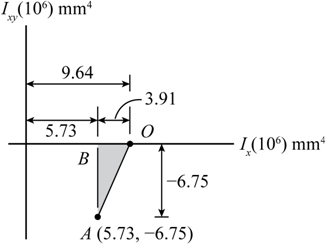
Step 13
We will find the radius of the circle.
\[AO = \sqrt {O{B^2} + A{B^2}} \]Substitute the given value in the above equation.
\[\begin{array}{c} AO = \sqrt {{{\left( {3.91 \times {{10}^6}\;{\rm{m}}{{\rm{m}}^{\rm{4}}}} \right)}^2} + {{\left( { - 6.75 \times {{10}^6}\;{\rm{m}}{{\rm{m}}^{\rm{4}}}} \right)}^2}} \\ AO = 7.8\left( {{{10}^6}} \right)\;{\rm{m}}{{\rm{m}}^{\rm{4}}} \end{array}\]Step 14
We will find the maximum principal moments of inertia of the cross section.
\[{I_{\max }} = OO' + AO\]Substitute the given value in the above equation.
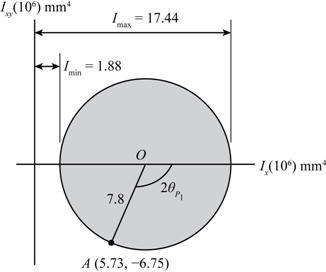
\[\begin{array}{c} {I_{\max }} = \left( {9.64 \times {{10}^6}\;{\rm{m}}{{\rm{m}}^{\rm{4}}}} \right) + \left( {7.8 \times {{10}^6}\;{\rm{m}}{{\rm{m}}^{\rm{4}}}} \right)\\ {I_{\max }} = 17.44 \times {10^6}\;{\rm{m}}{{\rm{m}}^{\rm{4}}} \end{array}\]Step 15
We will find the minimum principal moments of inertia of the cross section.
\[{I_{\min }} = OO' - AO\]Substitute the given value in the above equation.
\[\begin{array}{c} {I_{\min }} = \left( {9.64 \times {{10}^6}\;{\rm{m}}{{\rm{m}}^{\rm{4}}}} \right) - \left( {7.8 \times {{10}^6}\;{\rm{m}}{{\rm{m}}^{\rm{4}}}} \right)\\ {I_{\min }} = 1.844 \times {10^6}\;{\rm{m}}{{\rm{m}}^{\rm{4}}} \end{array}\]Step 16
We will draw the Mohr’s circle by using the known values.
Step 17
We will find the direction of the maximum principal axis from the positive $x$-axis.
\[2{\theta _P} = 180^\circ - {\sin ^{ - 1}}\left( {\frac{{\left| {BA} \right|}}{{\left| {AO} \right|}}} \right)\]Substitute the given value in the above equation.
\[\begin{array}{c} 2{\theta _{{P_1}}} = 180^\circ - {\sin ^{ - 1}}\left( {\frac{{\left| { - 6.75 \times {{10}^6}\;{\rm{m}}{{\rm{m}}^{\rm{4}}}} \right|}}{{\left| {7.8 \times {{10}^6}\;{\rm{m}}{{\rm{m}}^{\rm{4}}}} \right|}}} \right)\\ 2{\theta _{{P_1}}} = 120^\circ \\ {\theta _{{P_1}}} = 60^\circ \end{array}\]Step 18
We will find the direction of the minimum principal axis from the positive $x$-axis.
\[{\theta _{{P_2}}} = {\theta _{{P_1}}} - 90^\circ \]Substitute the given value in the above equation.
\[\begin{array}{c} {\theta _{{P_2}}} = 60^\circ - 90^\circ \\ {\theta _{{P_2}}} = - 30^\circ \end{array}\]So, the orientations of the principal axis are ${\theta _{{P_2}}} = 30^\circ $ in clockwise direction, and ${\theta _{{P_1}}} = 60^\circ $ in anticlockwise direction.