Engineering Mechanics: Statics and Dynamics, 14th Edition
Authors: Russell C. Hibbeler
ISBN-13: 978-0133915426
See our solution for Question 86P from Chapter 10 from Hibbeler's Engineering Mechanics.
Problem 86P
Step-by-Step Solution
We are given the paraboloid ${y^2} = 50x$ with density of the material as $\rho = 5\,{\rm{Mg/}}{{\rm{m}}^{\rm{3}}}$ covers distance along $x$-axis as $a = 200\,{\rm{mm}}$ and along $y$-axis as $b = 100\,{\rm{mm}}$.
We are asked to determine the radius of gyration ${k_x}$.
Step 2
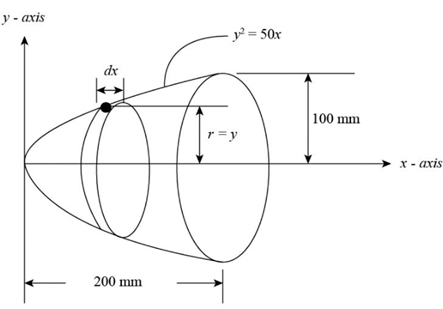
Consider the smallest element of ellipsoid of thickness $dx$ and radius $r = y$ is at $x$ distance from $y$-axis.
First draw the diagram representing the smallest element elementary disc of the paraboloid.
Step 3
Find the volume of the element using the following relation.
\[dV = \pi {y^2}dx\]Substitute $50x$ for ${y^2}$ in the above expression.
\[\begin{array}{c} dV = \pi \left( {50x} \right)dx\\ = 50\pi xdx\,......\left( 1 \right) \end{array}\]Step 4
Find the mass of the selected element using the following relation.
\[dm = \rho dV\]On substituting the value of equation (1) in the above equation we get,
\[\begin{array}{c} dm = \rho \left( {50\pi xdx} \right)\\ = 50\pi \rho xdx\,......\left( 2 \right) \end{array}\]Step 5
Find the mass of the entire paraboloid using the following relation.
\[m = \int\limits_{x = 0}^{x = 200} {dm} \]On substituting the value of equation (2) in the above equation we get,
\[\begin{array}{c} m = \int\limits_{x = 0}^{x = 200} {50\pi \rho xdx} \\ = 50\pi \rho \int\limits_{x = 0}^{x = 200} {xdx} \\ = 50\pi \rho \left[ {\frac{{{x^2}}}{2}} \right]_0^{200} \end{array}\]Substitute the limits in the above expression.
\[\begin{array}{c} m = 50\pi \rho \left[ {\frac{{{x^2}}}{2}} \right]_0^{200}\\ = 50\pi \rho \left[ {\frac{{{{\left( {200} \right)}^2}}}{2} - 0} \right]\\ = {10^6}\rho \pi \,......\left( 3 \right) \end{array}\]Step 6
Find the mass moment of inertia of the element about $x$-axis using the following relation.
\[d\left( {{I_{mx}}} \right) = \frac{{{y^2}dm}}{2}\]On substituting the value of equation (2) in the above equation we get,
\[d\left( {{I_{mx}}} \right) = \frac{{{y^2}\left( {50\pi \rho xdx} \right)}}{2}\]Substitute $50x$ for ${y^2}$ in the above expression.
\[\begin{array}{c} d\left( {{I_{mx}}} \right) = \frac{{\left( {50x} \right)\left( {50\pi \rho xdx} \right)}}{2}\\ = \frac{{\left( {50x} \right)\left( {50\pi \rho xdx} \right)}}{2}\\ = 1250\pi \rho {x^2}dx\,......\left( 4 \right) \end{array}\]Step 7
Find the mass moment of inertia of the paraboloid about $x$-axis using the following relation.
\[{I_{mx}} = \int\limits_0^a {d\left( {{I_{mx}}} \right)} \]On substituting the value of equation (4) in the above equation we get,
\[\begin{array}{c} {I_{mx}} = \int\limits_0^{200} {1250\pi \rho {x^2}dx} \\ = \left( {1250\pi \rho } \right)\int\limits_0^{200} {{x^2}dx} \\ = \left( {1250\pi \rho } \right)\left[ {\frac{{{x^3}}}{3}} \right]_0^{200} \end{array}\]Substitute the limits in the above expression.
\[\begin{array}{c} {I_{mx}} = \left( {1250\pi \rho } \right)\left[ {\frac{{{x^3}}}{3}} \right]_0^{200}\\ = \left( {1250\pi \rho } \right)\left[ {\frac{{{{\left( {200} \right)}^3}}}{3} - 0} \right]\\ = 3.333 \times {10^9}\pi \rho \,......\left( 5 \right) \end{array}\]Step 8
To find the radius of gyration ${k_x}$ use the following relation.
\[{k_x} = \sqrt {\frac{{{I_{mx}}}}{m}} \]On substituting the values of equation (3) and equation (5) in the above equation we get,
\[\begin{array}{c} {k_x} = \sqrt {\frac{{3.333 \times {{10}^9}\pi \rho }}{{{{10}^6}\pi \rho }}} \\ = 57.73\,{\rm{mm}} \end{array}\]