Engineering Mechanics: Statics and Dynamics, 14th Edition
Authors: Russell C. Hibbeler
ISBN-13: 978-0133915426
See our solution for Question 97P from Chapter 10 from Hibbeler's Engineering Mechanics.
Problem 97P
Step-by-Step Solution
We are provided with the following data:
The smaller radius of cone is ${r_s} = 0.2{\rm{ m}}$.
The larger radius of cone is ${r_l} = 0.4{\rm{ m}}$.
The height of the centroid of cone is ${h_3} = 0.6{\rm{ m}}$.
The height of the frustum of cone is ${h_2} = 0.8{\rm{ m}}$.
The density of the material is $\rho = 200{\rm{ kg/}}{{\rm{m}}^3}$.
We are required to determine the moment of inertia of the frustum of cone.
Step 2
The diagram can be represented as,
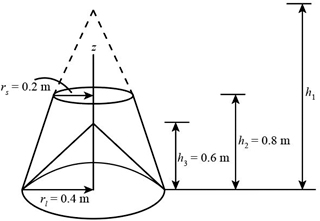
Here, ${r_s}\,{\rm{and}}\;{r_l}$ represents the radius of smaller circle and radius of larger circle, ${h_1}$ represents the total height of the cone, ${h_2}$ represent the height of frustum of cone and ${h_3}$ represents the height of centroid of the cone.
Step 3
To find the total height of the cone, we use basic proportionality theorem of similar triangles.
Consider the unknown length of the cone as x.
\[\frac{x}{{{h_2} + x}} = \frac{{{r_s}}}{{{r_l}}}\]Step 4
On plugging the values in the above relation, we get,
\[\begin{array}{c} \frac{x}{{0.8{\rm{ m}} + x}} = \frac{{0.2{\rm{ m}}}}{{0.4\;{\rm{m}}}}\\ \frac{x}{{0.8{\rm{ m}} + x}} = 0.5{\rm{ m}}\\ x = 0.5{\rm{ m}}\left( {0.8{\rm{ m}} + x} \right)\\ x = 0.4{\rm{ m}} + \left( {0.5{\rm{ m}}} \right)x \end{array}\]Step 5
On further solving the above equation,
\[\begin{array}{c} x - \left( {0.5{\rm{ m}}} \right)x = 0.4\,{\rm{m}}\\ \left( {0.5{\rm{ m}}} \right)x = 0.4\,{\rm{m}}\\ x = \frac{{0.4{\rm{ m}}}}{{0.5{\rm{ m}}}}\\ x = 0.8{\rm{ m}} \end{array}\]Step 6
To find the total height of the cone, we will use the relation.
\[{h_1} = {h_2} + x\]On plugging the values in the above relation, we get,
\[\begin{array}{l} {h_1} = 0.8{\rm{ m}} + {\rm{0}}{\rm{.8 m}}\\ {h_1} = 1.6{\rm{ m}} \end{array}\]Step 7
To find the moment of inertia of frustum of cone about z-axis, we will use the relationship,
\[\begin{array}{l} {I_z} = \frac{3}{{10}}\left[ {\frac{1}{3}\pi r_l^2{h_1}\rho } \right]r_l^2 - \frac{3}{{10}}\left[ {\frac{1}{3}\pi r_s^2{h_2}\rho } \right]r_s^2 - \frac{3}{{10}}\left[ {\frac{1}{3}\pi r_l^2{h_3}\rho } \right]r_l^2\\ {I_z} = \frac{3}{{10}}\left( {\frac{1}{3}} \right)\pi \rho \left[ {r_l^4{h_1} - r_s^4{h_2} - r_l^4{h_3}} \right] \end{array}\]On plugging the values in the above relation, we get,
\[\begin{array}{l} {I_z} = \frac{3}{{10}}\left( {\frac{1}{3}} \right)\left( {200{\rm{ }}\frac{{{\rm{kg}}}}{{{{\rm{m}}^{\rm{3}}}}}} \right)\pi \left[ {{{\left( {0.4{\rm{ m}}} \right)}^4}\left( {1.6{\rm{ m}}} \right) - {{\left( {0.2{\rm{ m}}} \right)}^4}\left( {0.8{\rm{ m}}} \right) - {{\left( {0.4{\rm{ m}}} \right)}^4}\left( {0.6{\rm{ m}}} \right)} \right]\\ {I_z} = 20\pi \frac{{{\rm{kg}}}}{{{{\rm{m}}^{\rm{3}}}}}\left[ {0.0256\left( {1.6} \right){\rm{ }}{{\rm{m}}^5} - 0.0016\left( {0.8} \right){\rm{ }}{{\rm{m}}^5} - 0.0256\left( {0.6} \right){\rm{ }}{{\rm{m}}^5}} \right]\\ {I_z} = 20\pi \frac{{{\rm{kg}}}}{{{{\rm{m}}^{\rm{3}}}}}\left[ {0.04096{\rm{ }}{{\rm{m}}^5} - 0.00128{\rm{ }}{{\rm{m}}^5} - 0.01536{\rm{ }}{{\rm{m}}^5}} \right]\\ {I_z} = 20\pi \frac{{{\rm{kg}}}}{{{{\rm{m}}^{\rm{3}}}}}\left[ {0.02432{\rm{ }}{{\rm{m}}^5}} \right]\\ {I_z} = 1.528{\rm{ kg}} \cdot {{\rm{m}}^2} \end{array}\]