Engineering Mechanics: Statics and Dynamics, 14th Edition
Authors: Russell C. Hibbeler
ISBN-13: 978-0133915426
See our solution for Question 99P from Chapter 10 from Hibbeler's Engineering Mechanics.
Problem 99P
Step-by-Step Solution
We are given the following data:
The sides of the square plate are ${a_p} = 400{\rm{ mm}}$.
The radius of circular holes is ${r_h} = 50{\rm{ mm}}$.
The mass per unit area of the material is ${m_A} = 20{\rm{ kg/}}{{\rm{m}}^2}$.
We are required to find the mass moment of inertia of the thin plate about an axis perpendicular to the page.
Step 2
To find the mass of the plate, we will use the relation,
\[{m_p} = {a_p} \times {a_p} \times {m_A}\]On plugging the values in the above relation, we get,
\[\begin{array}{l} {m_p} = 400{\rm{ mm}} \times \frac{{1{\rm{ m}}}}{{1000{\rm{ mm}}}} \times 400{\rm{ mm}} \times \frac{{1{\rm{ m}}}}{{1000{\rm{ mm}}}} \times 20{\rm{ kg/}}{{\rm{m}}^2}\\ {m_p} = 0.4{\rm{ m}} \times 0.4{\rm{ m}} \times 20{\rm{ kg/}}{{\rm{m}}^2}\\ {m_p} = 3.2{\rm{ kg}} \end{array}\]Step 3
To find the mass of one hole, we will use the relation,
\[{m_h} = \left( {\pi {r^2}} \right){m_A}\]On plugging the values in the above relation, we get,
\[\begin{array}{l} {m_h} = \left( {\pi {{\left( {50{\rm{ mm}}} \right)}^2}} \right)20{\rm{ kg/}}{{\rm{m}}^2}\\ {m_h} = \left( {\pi {{\left( {\frac{{50}}{{1000}}{\rm{ m}}} \right)}^2}} \right)20{\rm{ kg/}}{{\rm{m}}^2}\\ {m_h} = \left( {\pi \left( {0.05{\rm{ m}}} \right)\left( {0.05{\rm{ m}}} \right)} \right)20{\rm{ kg/}}{{\rm{m}}^2}\\ {m_h} = 0.05\pi {\rm{ kg}} \end{array}\]Step 4
To find the location of center of mass of plate, we use the relation,
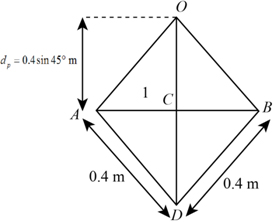
From the given figure, the side of the square plate is ${a_p} = 0.4{\rm{ m}}$. The value of ${d_p}$ represents the distance between the point O and center of the plate C.
\[\begin{array}{c} \sin 45^\circ = \frac{{{d_p}}}{{OA}}\\ \sin 45^\circ = \frac{{{d_p}}}{{0.4{\rm{ m}}}}\\ {d_p} = 0.4\sin 45^\circ {\rm{ m}} \end{array}\]Step 5
To find the location of center of mass of holes, consider the given figure.
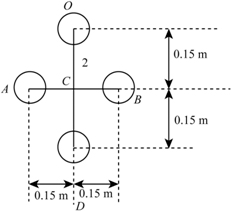
From the given figure, the distance between the center of each hole is ${d_h} = 0.15{\rm{ m}}$.
Step 6
To find the mass moment of inertia of thin plateabout an axis perpendicular to the page and passing through point O, we use parallel axis theorem.
\[\begin{array}{l} {I_O} = {I_C} + md_p^2\\ {I_O} = \frac{1}{{12}} \times {m_p} \times \left[ {{{\left( {{a_p}} \right)}^2} + {{\left( {{a_p}} \right)}^2}} \right] - 4\left( {\frac{1}{2} \times {m_h} \times r_h^2 + {m_h} \times d_h^2} \right) + \left( {{m_p} - 4{m_h}} \right){\left( {{d_p}} \right)^2} \end{array}\]Step 7
On plugging the values in the above relation, we get,
\[\begin{array}{c} {I_O} = \frac{1}{{12}} \times 3.2{\rm{ kg}} \times \left[ {{{\left( {0.4\,{\rm{m}}} \right)}^2} + {{\left( {0.4\,{\rm{m}}} \right)}^2}} \right]\\ - 4\left[ {\left( {\frac{1}{2} \times 0.05\pi {\rm{ kg}} \times {{\left( {0.05{\rm{ m}}} \right)}^2} + 0.05\pi {\rm{ kg}} \times {{\left( {0.15{\rm{ m}}} \right)}^2}} \right)} \right]\\ + \left( {3.2{\rm{ kg}} - 4\left( {0.05\pi } \right){\rm{ kg}}} \right) \times {\left( {0.4\sin 45^\circ {\rm{ m}}} \right)^2}\\ {I_O} = \frac{1}{{12}} \times 3.2{\rm{ kg}} \times \left[ {0.16{\rm{ }}{{\rm{m}}^2} + 0.16{\rm{ }}{{\rm{m}}^2}} \right]\\ - 4\left[ {\left( {0.0002{\rm{ kg}} \cdot {{\rm{m}}^2} + 0.0035{\rm{ kg}} \cdot {{\rm{m}}^2}} \right)} \right] + \left( {2.572\,{\rm{kg}}} \right){\left( {0.4\sin 45^\circ {\rm{ m}}} \right)^2} \end{array}\]Now, we will further solve above equation.
\[\begin{array}{l} {I_O} = \frac{1}{{12}} \times 3.2{\rm{ kg}} \times \left[ {0.32{\rm{ }}{{\rm{m}}^2}} \right] - 4\left[ {\left( {0.0037{\rm{ kg}} \cdot {{\rm{m}}^2}} \right)} \right] + \left( {2.572\,{\rm{kg}}} \right){\left( {0.4\sin 45^\circ {\rm{ m}}} \right)^2}\\ {I_O} = \frac{1}{{12}} \times 3.2{\rm{ kg}} \times \left[ {0.32{\rm{ }}{{\rm{m}}^2}} \right] - 4\left[ {\left( {0.0037{\rm{ kg}} \cdot {{\rm{m}}^2}} \right)} \right] + \left( {2.572\,{\rm{kg}}} \right)\left( {0.08{\rm{ }}{{\rm{m}}^2}} \right)\\ {I_O} = 0.276{\rm{ kg}} \cdot {{\rm{m}}^2} \end{array}\]