Engineering Mechanics: Statics and Dynamics, 14th Edition
Authors: Russell C. Hibbeler
ISBN-13: 978-0133915426
See our solution for Question 41P from Chapter 11 from Hibbeler's Engineering Mechanics.
Problem 41P
Step-by-Step Solution
We are given the mass of a uniform rod as $m = 100\;{\rm{kg}}$ and the angle $\theta $ as $\theta = 60^\circ $.
We are asked to determine the angle $\theta $ for equilibrium and also to investigate the stability at the equilibrium position.
Step 2
The free-body diagram of the rod can be drawn as:
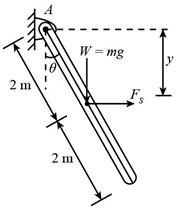
Here, ${F_s}$ is the force in the spring.
From the above figure, we have:
\[\begin{array}{c} \cos \theta = \frac{y}{{2\;{\rm{m}}}}\\ y = \left( {2\;{\rm{m}}} \right)\cos \theta \end{array}\]The stretch of the spring can be given as:
\[x = 2\sin 60^\circ - 2\sin \theta \]Now, to calculate the potential energy of the rod and the spring, we have:
\[\begin{array}{c} V = {V_s} + {V_r}\\ V = \frac{1}{2}k{x^2} + Wy\\ V = \frac{1}{2}k{x^2} + mgy \end{array}\]Here, k is the stiffness of the spring, g is the acceleration due to gravity and y is the distance from point A to the centroid.
Substitute the known values in the above expression, we get:
\[\begin{array}{c} V = \left[ {\frac{1}{2} \times \left( {500\;{{\rm{N}} \mathord{\left/ {\vphantom {{\rm{N}} {\rm{m}}}} \right. } {\rm{m}}}} \right) \times {{\left( {2\sin 60^\circ - 2\sin \theta } \right)}^2}} \right] + \left[ {\left( {100\;{\rm{kg}}} \right) \times \left( { - 9.81\;{{{{\rm{m}} \mathord{\left/ {\vphantom {{\rm{m}} {\rm{s}}}} \right. } {\rm{s}}}}^2}} \right) \times \left( {2\;{\rm{m}}} \right)\cos \theta } \right]\\ V = \left[ {\frac{1}{2} \times \left( {500\;{{\rm{N}} \mathord{\left/ {\vphantom {{\rm{N}} {\rm{m}}}} \right. } {\rm{m}}}} \right) \times \left( {4{{\sin }^2}60^\circ + 4{{\sin }^2}\theta - 8\sin 60^\circ \sin \theta } \right)} \right] + \left( { - 1962\cos \theta } \right)\\ V = \left( {750 + 1000{{\sin }^2}\theta - 1732.05\sin \theta - 1962\cos \theta } \right) \end{array}\]On differentiating the above expression with respect to $\theta $ , we get:
\[\frac{{dV}}{{d\theta }} = 2000\sin \theta \cos \theta - 1732.05\cos \theta + 1962\sin \theta \] ... (1)Step 3
For equilibrium, we have:
\[\frac{{dV}}{{d\theta }} = 0\]Hence,
\[2000\sin \theta \cos \theta - 1732.05\cos \theta + 1962\sin \theta = 0\] … (2)Here,
\[\begin{array}{c} \sin \theta = \left( {\frac{{2\tan \left( {\frac{\theta }{2}} \right)}}{{1 + {{\tan }^2}\left( {\frac{\theta }{2}} \right)}}} \right)\\ \cos \theta = \left( {\frac{{1 - {{\tan }^2}\left( {\frac{\theta }{2}} \right)}}{{1 + {{\tan }^2}\left( {\frac{\theta }{2}} \right)}}} \right) \end{array}\]Substitute the values in equation (2), we get:
\[2000 \times \left( {\frac{{2\tan \left( {\frac{\theta }{2}} \right)}}{{1 + {{\tan }^2}\left( {\frac{\theta }{2}} \right)}}} \right)\left( {\frac{{1 - {{\tan }^2}\left( {\frac{\theta }{2}} \right)}}{{1 + {{\tan }^2}\left( {\frac{\theta }{2}} \right)}}} \right) - 1732.05\left( {\frac{{1 - {{\tan }^2}\left( {\frac{\theta }{2}} \right)}}{{1 + {{\tan }^2}\left( {\frac{\theta }{2}} \right)}}} \right) + 1962\left( {\frac{{2\tan \left( {\frac{\theta }{2}} \right)}}{{1 + {{\tan }^2}\left( {\frac{\theta }{2}} \right)}}} \right) = 0\]Assume, $\tan \left( {\frac{\theta }{2}} \right) = x$. Hence, the above equation will be:
\[\begin{array}{c} 2000 \times \left( {\frac{{2x}}{{1 + {x^2}}}} \right)\left( {\frac{{1 - {x^2}}}{{1 + {x^2}}}} \right) - 1732.05\left( {\frac{{1 - {x^2}}}{{1 + {x^2}}}} \right) + 1962\left( {\frac{{2x}}{{1 + {x^2}}}} \right) = 0\\ 2000\left( {2x} \right)\left( {1 - {x^2}} \right) - 1732.05\left( {1 - {x^2}} \right) + 1962\left( {2x} \right) = 0\\ 4000x - 4000{x^3} - 1732.05 + 1732.05{x^2} + 3924x = 0\\ - 4000{x^3} + 1732.02{x^2} + 7924x = 1732.05 \end{array}\]On further solving the above equation, we get:
\[\begin{array}{c} x = 0.218\\ \tan \left( {\frac{\theta }{2}} \right) = 0.218\\ \theta = 24.6^\circ \end{array}\]On again differentiating the equation (1) with respect to $\theta $, we get:
\[\begin{array}{c} {\left( {\frac{{{d^2}V}}{{d{\theta ^2}}}} \right)_{\theta = 24.6^\circ }} = 200\cos 2\theta + 1732.05\sin \theta + 1962\cos \theta \\ {\left( {\frac{{{d^2}V}}{{d{\theta ^2}}}} \right)_{\theta = 24.6^\circ }} = 200\cos 2\left( {24.6^\circ } \right) + 1732.05\sin \left( {24.6^\circ } \right) + 1962\cos \left( {24.6^\circ } \right)\\ {\left( {\frac{{{d^2}V}}{{d{\theta ^2}}}} \right)_{\theta = 24.6^\circ }} = 3811.12 > 0 \end{array}\]Therefore, the bar is in stable equilibrium.