Engineering Mechanics: Statics and Dynamics, 14th Edition
Authors: Russell C. Hibbeler
ISBN-13: 978-0133915426
See our solution for Question 101P from Chapter 12 from Hibbeler's Engineering Mechanics.
Problem 101P
Step-by-Step Solution
We are given the angle of the water ejected from the fountain is $\theta = 40^\circ $.
We are asked to determine the maximum and minimum speed at which water can be ejected from the nozzle so that it does not splash over the sides of the basin at B and C.
Step 2
The diagram of the system is shown as:
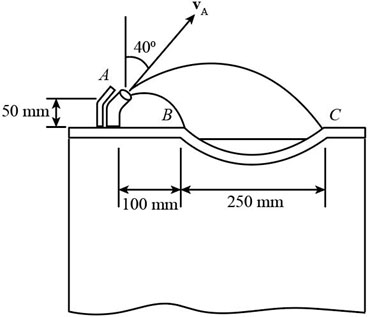
We have the distance between nozzle and point B is ${x_1} = 100\;{\rm{mm}} \times \left( {\frac{{1\;{\rm{m}}}}{{1000\;{\rm{mm}}}}} \right) = 0.1\;{\rm{m}}$.
We have the distance between nozzle and point C is ${x_2} = 100\;{\rm{mm}} + 250\;{\rm{mm}} = 350\;{\rm{mm}}\left( {\frac{{1\;{\rm{m}}}}{{1000\;{\rm{mm}}}}} \right) = 0.35\;{\rm{m}}$.
We have the vertical displacement of water is $y = 50\;{\rm{mm}}$.
Step 3
The formula to calculate the range of water ejected by nozzle is,
\[R = \left( {{v_A}\sin \theta } \right)t\]Step 4
Substitute the values in the above expression.
\[\begin{array}{c} R = \left( {{v_A}\sin 40^\circ } \right)t\\ R = 0.643{v_A}t\\ t = \frac{R}{{0.64{v_A}}} \end{array}\]Step 5
The formula to calculate the vertical displacement of the ejected water is,
\[y = \left( {{v_A}\cos \theta } \right)t + \frac{1}{2}g{t^2}\]Here, g is the gravitational acceleration, and its standard value is $9.81\;{\rm{m/}}{{\rm{s}}^2}$
Step 6
Substitute the value of t in the above expression.
\[\begin{array}{c} - 50\;{\rm{mm}} \times \left( {\frac{{1\;{\rm{m}}}}{{1000\;{\rm{mm}}}}} \right) = \left( {{v_A}\cos 40^\circ } \right)\left( {\frac{R}{{0.64{v_A}}}} \right) + \frac{1}{2}\left( { - 9.81\;{\rm{m/}}{{\rm{s}}^2}} \right){\left( {\frac{R}{{0.64{v_A}}}} \right)^2}\\ {\left( {{v_A}} \right)^2} = \frac{{4.905{R^2}}}{{0.64\left[ {0.76R + 0.05\left( {0.64} \right)} \right]}}\\ {v_A} = \sqrt {\frac{{4.905{R^2}}}{{0.48R + 0.0205}}} \end{array}\]Step 7
Substitute the value $R = {x_1} = 0.1\;{\rm{m}}$ in above expression to obtain minimum velocity.
\[\begin{array}{l} {\left( {{v_A}} \right)_{\min }} = \sqrt {\frac{{4.905{{\left( {0.1} \right)}^2}}}{{0.48\left( {0.1} \right) + 0.0205}}} \\ {\left( {{v_A}} \right)_{\min }} = \sqrt {0.716} \\ {\left( {{v_A}} \right)_{\min }} = 0.84\;{\rm{m/s}} \end{array}\]Step 8
Substitute the value $R = {x_2} = 0.35\;{\rm{m}}$ in above expression to obtain maximum velocity.
\[\begin{array}{l} {\left( {{v_A}} \right)_{\max }} = \sqrt {\frac{{4.905{{\left( {0.35} \right)}^2}}}{{0.48\left( {0.35} \right) + 0.0205}}} \\ {\left( {{v_A}} \right)_{\max }} = \sqrt {3.1876} \\ {\left( {{v_A}} \right)_{\max }} = 1.78\;{\rm{m/s}} \end{array}\]