Engineering Mechanics: Statics and Dynamics, 14th Edition
Authors: Russell C. Hibbeler
ISBN-13: 978-0133915426
See our solution for Question 102P from Chapter 12 from Hibbeler's Engineering Mechanics.
Problem 102P
Step-by-Step Solution
We are given a dart that is thrown with a certain speed and strikes the target.
The speed of the dart is ${v_A} = 10{\rm{ m/s}}$.
We are asked to determine theshortest possible time before the dart strikes the target, the angle ${\theta _A}$ at which it should be thrown, and also to determine the velocity of the dart when it strikes the target.
Step 2
The motion of the dart is represented by the following diagram:
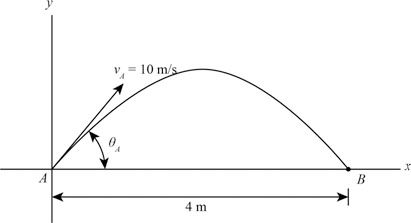
For horizontal motion of the dart,
The distance of point $A$ is given by,
\[{\left( {{s_A}} \right)_x} = 0\]The distance of point $B$ is given by,
\[{\left( {{s_B}} \right)_x} = 4\;{\rm{m}}\]Step 3
The horizontal component of dart velocity is given by,
\[{\left( {{v_A}} \right)_x} = 10 \times {\rm{cos}}{\theta _A}\]The horizontal displacement of the dart from point $A$ to point $B$ is given by,
\[\begin{array}{l} {\left( {{s_B}} \right)_x} - {\left( {{s_A}} \right)_x} = 4 - 0\\ {\left( {{s_B}} \right)_x} - {\left( {{s_A}} \right)_x} = 4{\rm{ m}} \end{array}\]Step 4
The time taken by the dart to travel from point $A$ to point $B$ is given by,
\[\begin{array}{c} t = \frac{{{{\left( {{s_B}} \right)}_x} - {{\left( {{s_A}} \right)}_x}}}{{{{\left( {{v_A}} \right)}_x}}}\\ t = \frac{{4\;{\rm{m}}}}{{10 \times {\rm{cos}}{\theta _A}}} \end{array}\] … (1)Since the velocity of the dart remains constant throughout the motion. So, the horizontal velocity of point $A$ is equal to the horizontal velocity of point $B$.
\[\begin{array}{c} {\left( {{v_B}} \right)_x} = {\left( {{v_A}} \right)_x}\\ {\left( {{v_B}} \right)_x} = 10 \times {\rm{cos}}{\theta _A} \end{array}\]Step 5
For vertical motion of the dart,
The distance of the dart at point $A$ and $B$ is given by,
\[{\left( {{s_A}} \right)_y} = {\left( {{s_B}} \right)_y} = 0\]The vertical component of dart velocity is given by,
\[{\left( {{v_A}} \right)_y} = 10 \times \sin {\theta _A}\]Step 6
Using Newton’s third equation of motion, the vertical component of velocity of dart at point $B$ is given by,
\[\begin{array}{c} {\left( {{v_B}} \right)_y}^2 = {\left( {{v_A}} \right)_y}^2 - 2{a_y}\left[ {{{\left( {{s_B}} \right)}_y} - {{\left( {{s_A}} \right)}_y}} \right]\\ {\left( {{v_B}} \right)_y}^2 = {\left( {10{\rm{ m/s}} \times \sin {\theta _A}} \right)^2} - 2\left( {9.81{\rm{ m/}}{{\rm{s}}^2}} \right)\left( 0 \right)\\ {\left( {{v_B}} \right)_y}^2 = {\left( {10{\rm{ m/s}} \times \sin {\theta _A}} \right)^2}\\ {\left( {{v_B}} \right)_y} = \left( {10{\rm{ m/s}} \times \sin {\theta _A}} \right) \end{array}\]The vertical displacement of the dart from point $A$ to point $B$ is given by,
\[\begin{array}{c} {\left( {{s_B}} \right)_y} - {\left( {{s_A}} \right)_y} = {\left( {{v_A}} \right)_y}t - \frac{1}{2}g{t^2}\\ 0 = \left( {10 \times \sin {\theta _A}} \right)t - \frac{1}{2}\left( {9.81} \right){t^2}\\ 0 = \left( {{\rm{4}}{\rm{.905}}} \right){t^2} - \left( {10 \times \sin {\theta _A}} \right)t\\ t\left( {{\rm{4}}{\rm{.905}}t - 10 \times \sin {\theta _A}} \right) = 0 \end{array}\]Solving the above equation, we get,
\[\left( {{\rm{4}}{\rm{.905}}t - 10 \times \sin {\theta _A}} \right) = 0\]Step 7
Substituting the value of $t$from equation (1) in the above expression, we get,
\[\begin{array}{c} {\rm{4}}{\rm{.905}} \times \left( {\frac{{4{\rm{ m}}}}{{10 \times {\rm{cos}}{\theta _A}}}} \right) - 10 \times \sin {\theta _A} = 0\\ 1.962 - 10 \times \sin {\theta _A}{\rm{cos}}{\theta _A} = 0\\ 1.962 - 5 \times \left( {2\sin {\theta _A}{\rm{cos}}{\theta _A}} \right) = 0\\ 1.962 - 5 \times \left( {\sin 2{\theta _A}} \right) = 0 \end{array}\]Solving the above equation, we get,
\[\begin{array}{c} 1.962 = 5 \times \left( {\sin 2{\theta _A}} \right)\\ \sin 2{\theta _A} = 0.3924\\ {\theta _A} = \frac{1}{2} \times {\sin ^{ - 1}}\left( {0.3924} \right)\\ {\theta _A} = 11.55^\circ {\rm{ or 78}}{\rm{.45}}^\circ \end{array}\]For the shortest possible time for the dart, the value of ${\theta _A}$ taken should also be less. So, taking the smaller value of ${\theta _A}$, we have,
\[{\theta _A} = 11.55^\circ \]Step 8
From equation (1), the shortest time taken by the dart to travel from point $A$ to point $B$ is given by,
\[\begin{array}{c} t = \frac{4}{{10 \times {\rm{cos}}\left( {11.55^\circ } \right)}}\\ t = 0.408{\rm{ s}} \end{array}\]Then, the horizontal component of velocity of dart at point $B$ is given by,
\[\begin{array}{c} {\left( {{v_B}} \right)_x} = 10 \times {\rm{cos}}{\theta _A}\\ {\left( {{v_B}} \right)_x} = 10 \times {\rm{cos}}\left( {11.55^\circ } \right)\\ {\left( {{v_B}} \right)_x} = 9.797{\rm{ m/s}} \end{array}\]And, the vertical component of velocity of dart at point $B$ is given by,
\[\begin{array}{c} {\left( {{v_B}} \right)_y} = 10 \times \sin {\theta _A}\\ {\left( {{v_B}} \right)_y} = 10 \times \sin \left( {11.55^\circ } \right)\\ {\left( {{v_B}} \right)_y} = 2.0{\rm{ m/s}} \end{array}\]Step 9
The magnitude of the velocity of the dart when it strikes the target at point $B$ is given by,
\[\begin{array}{c} {v_B} = \sqrt {{{\left( {{v_B}} \right)}_x}^2 + {{\left( {{v_B}} \right)}_y}^2} \\ {v_B} = \sqrt {{{\left( {9.797{\rm{ m/s}}} \right)}^2} + {{\left( {{\rm{2}}{\rm{.0 m/s}}} \right)}^2}} \\ {v_B} = 10{\rm{ m/s}} \end{array}\]And, the angle at which the dart strikes at point $B$ is given by,
\[\begin{array}{c} {\theta _B} = {\tan ^{ - 1}}\left[ {\frac{{{{\left( {{v_B}} \right)}_y}}}{{{{\left( {{v_B}} \right)}_x}}}} \right]\\ {\theta _B} = {\tan ^{ - 1}}\left( {\frac{{2.0\;{\rm{m/s}}}}{{9.797\;{\rm{m/s}}}}} \right)\\ {\theta _B} = 11.55^\circ \end{array}\]