Engineering Mechanics: Statics and Dynamics, 14th Edition
Authors: Russell C. Hibbeler
ISBN-13: 978-0133915426
See our solution for Question 107P from Chapter 12 from Hibbeler's Engineering Mechanics.
Problem 107P
Step-by-Step Solution
We are given a fireman wishes to direct the flow of water from his hose to the fire at point $B$.
The water flow velocity from the hose at $A$ is ${v_A} = 80{\rm{ ft/s}}$.
We are asked to determine two possible angles ${\theta _1}$ and ${\theta _2}$ at which this can be done.
Step 2
The motion of the water from the hose can be shown in the diagram below:
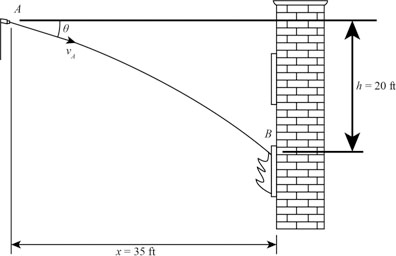
Here, $\theta $ represents the angle of water hose from the horizontal.
Step 3
The horizontal component of initial velocity of water is given by,
\[\begin{array}{c} {\left( {{v_A}} \right)_x} = {v_A}\cos \theta \\ {\left( {{v_A}} \right)_x} = \left( {80\cos \theta } \right){\rm{ ft/s}} \end{array}\]The vertical component of initial velocity of water is given by,
\[\begin{array}{c} {\left( {{v_A}} \right)_y} = - {v_A}\sin \theta \\ {\left( {{v_A}} \right)_y} = - \left( {80\sin \theta } \right){\rm{ ft/s}} \end{array}\]Step 4
Using the relation between distance and velocity, the distance between point $A$ and $B$ is given by,
\[\begin{array}{c} x = {\left( {{v_A}} \right)_x}t\\ 35 = \left( {80t \cdot \cos \theta } \right)\\ t = \frac{{35}}{{80 \cdot \cos \theta }}\\ t = \frac{{0.4375}}{{\cos \theta }} \end{array}\]Using the second equation motion, the vertical distance between point $A$ and $B$ is given by,
\[h = {\left( {{v_A}} \right)_y}t - \frac{1}{2}g{t^2}\]Here, $g$ is the acceleration due gravity and its value is $g = 32.2{\rm{ ft/}}{{\rm{s}}^2}$.
Step 5
Substituting the values of $t$ in the above expression, we get,
\[\begin{array}{c} - 20 = - \left( {80\sin \theta } \right)t - \frac{1}{2}\left( {32.2} \right){t^2}\\ \left( {16.1} \right){t^2} + \left( {80\sin \theta } \right)t = 20 \end{array}\]Substituting the value of $t$ in the above expression, we get,
\[\begin{array}{c} \left( {16.1} \right){\left( {\frac{{0.4375}}{{\cos \theta }}} \right)^2} + \left( {80\sin \theta } \right)\left( {\frac{{0.4375}}{{\cos \theta }}} \right) = 20\\ \frac{{3.082}}{{{{\cos }^2}\theta }} + \frac{{35\sin \theta \cos \theta }}{{{{\cos }^2}\theta }} = 20\\ 3.082 + 17.5 \times \left( {2\sin \theta \cos \theta } \right) = 20{\cos ^2}\theta \\ 3.082 + 17.5\sin 2\theta = 20{\cos ^2}\theta \end{array}\]Solving the above expression, using the trial-and-error method, we get the two possible angles,
\[\begin{array}{c} {\theta _1} = 24.9^\circ \\ {\theta _2} = 85.2^\circ \end{array}\]