Engineering Mechanics: Statics and Dynamics, 14th Edition
Authors: Russell C. Hibbeler
ISBN-13: 978-0133915426
See our solution for Question 136P from Chapter 12 from Hibbeler's Engineering Mechanics.
Problem 136P
Step-by-Step Solution
We are given the speed of a jet plane as $v = 550\;{\rm{m/s}}$ and the acceleration as $a = 50\;{\rm{m/}}{{\rm{s}}^2}$.
We are asked to determine the rate of increase in the plane’s speed and also the radius of curvature $\rho $ of the path.
Step 2
The free-body diagram of the jet plane can be drawn as:
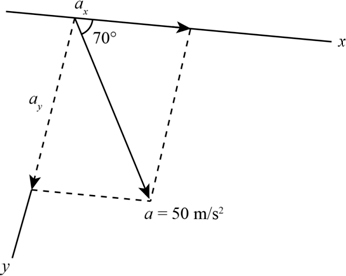
Here, ${a_x}$ is the acceleration in the horizontal direction and ${a_y}$ is the acceleration in the vertical direction.
Step 3
The acceleration in the horizontal direction (tangential acceleration) can be calculated as:
\[\begin{array}{c} {a_x} = a\cos \theta \\ {a_x} = \left( {50\;{\rm{m/}}{{\rm{s}}^2}} \right) \times \cos \left( {70^\circ } \right)\\ {a_x} = 17.1\;{\rm{m/}}{{\rm{s}}^2} \end{array}\]The acceleration in the vertical direction (normal acceleration) can be calculated as:
\[\begin{array}{c} {a_y} = a\sin \theta \\ {a_y} = \left( {50\;{\rm{m/}}{{\rm{s}}^2}} \right) \times \sin \left( {70^\circ } \right)\\ {a_y} = 46.98\;{\rm{m/}}{{\rm{s}}^2} \end{array}\]Step 4
To calculate the radius of curvature $\rho $ of the path, we have:
\[{a_y} = \frac{{{v^2}}}{\rho }\]On substituting the values in the above expression, we get:
\[\begin{array}{c} \left( {46.98\;{\rm{m/}}{{\rm{s}}^2}} \right) = \frac{{{{\left( {550\;{\rm{m/s}}} \right)}^2}}}{\rho }\\ \rho = \frac{{{{\left( {550\;{\rm{m/s}}} \right)}^2}}}{{\left( {46.98\;{\rm{m/}}{{\rm{s}}^2}} \right)}}\\ \rho = 6.44 \times {10^3}\;{\rm{m}} \times \left( {\frac{{{{10}^{ - 3}}\;{\rm{km}}}}{{1\;{\rm{m}}}}} \right)\\ \rho = 6.44\;{\rm{km}} \end{array}\]