Engineering Mechanics: Statics and Dynamics, 14th Edition
Authors: Russell C. Hibbeler
ISBN-13: 978-0133915426
See our solution for Question 7PP from Chapter 12 from Hibbeler's Engineering Mechanics.
Problem 7PP
Step-by-Step Solution
Part (a)
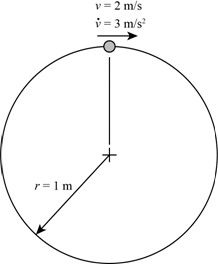
We are given a particle moving in the circular path. The following data is given:
The velocity of the particle is $v = 2{\rm{ m/s}}$.
The radius of the circular path is $r = 1{\rm{ m}}$.
The tangential acceleration of the particle is $\dot v = 3{\rm{ m/}}{{\rm{s}}^2}$.
We are asked to determine the acceleration at the instant shown.
Step 2
The diagram showing the motion of the particle is given below:
The normal component of the acceleration of the particle is given by,
\[\begin{array}{l} {a_n} = \frac{{{v^2}}}{r}\\ {a_n} = \frac{{{{\left( {2{\rm{ m/s}}} \right)}^2}}}{{1{\rm{ m}}}}\\ {a_n} = 4{\rm{ m/}}{{\rm{s}}^2} \end{array}\]The acceleration of the particle at the instant is given by,
\[\begin{array}{c} a = \sqrt {{{\dot v}^2} + {a_n}^2} \\ a = \sqrt {{{\left( {3{\rm{ m/}}{{\rm{s}}^2}} \right)}^2} + {{\left( {{\rm{4 m/}}{{\rm{s}}^2}} \right)}^2}} \\ a = \sqrt {25} {\rm{ m/}}{{\rm{s}}^2}\\ a = 5{\rm{ m/}}{{\rm{s}}^2} \end{array}\]Step 3
Part (b)
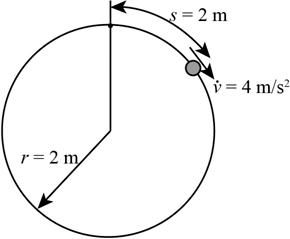
We are given a particle moving in a circular path. The following data is given:
The radius of the circular path is $r = 2{\rm{ m}}$.
At initial condition ${s_0} = 0$, the velocity of the particle is ${v_0} = 0$.
We are asked to determine the increase in speed and the normal component of acceleration at $s = 2{\rm{ m}}$.
Step 4
The diagram showing the motion of the particle is given below:
The tangential acceleration of the particle is given by,
\[\begin{array}{c} {a_t} = \dot v\\ {a_t} = 4{\rm{ m/}}{{\rm{s}}^2} \end{array}\]Using the third equation of motion, the increase in the speed of the particle at the instant shown is given by,
\[\begin{array}{c} {v^2} = {v_0}^2 + 2{a_t}\left( {s - {s_0}} \right)\\ {v^2} = 0 + 2\left( {4{\rm{ m/}}{{\rm{s}}^2}} \right)\left( {2{\rm{ m}} - 0} \right)\\ v = \sqrt {16} {\rm{ m/s}}\\ v = 4{\rm{ m/s}} \end{array}\]The normal component of the acceleration of the particle is given by,
\[\begin{array}{c} {a_n} = \frac{{{v^2}}}{r}\\ {a_n} = \frac{{{{\left( {4{\rm{ m/s}}} \right)}^2}}}{{2{\rm{ m}}}}\\ {a_n} = 8{\rm{ m/}}{{\rm{s}}^2} \end{array}\]Step 5
Part (c)
We are given a particle moving in a parabolic path. The following data is given:
The constant horizontal speed of the particle at the instant is $v = 2{\rm{ m/s}}$.
The motion of the path of the particle is described by the following curve,
\[y = 2{x^2}\]We are asked to determine the acceleration at the instant shown.
Step 6
The diagram showing the motion of the particle is given below:
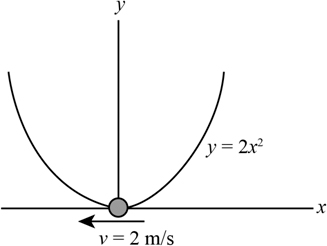
At the instant shown in the diagram, the particle is moving in the horizontal direction, so the tangential acceleration of the particle at this instant will be zero.
\[{a_t} = 0\]Differentiating the given equation for the path of the particle with respect to the $x$ axis, we get,
\[\begin{array}{l} \frac{{dy}}{{dx}} = \frac{d}{{dx}}\left( {2{x^2}} \right)\\ \frac{{dy}}{{dx}} = 4x \end{array}\]Differentiating the given equation again with respect to the $x$ axis, we get
\[\begin{array}{l} \frac{{{d^2}y}}{{d{x^2}}} = \frac{d}{{dx}}\left( {4x} \right)\\ \frac{{{d^2}y}}{{d{x^2}}} = 4 \end{array}\]The equation describing of radius of curvature of the particle is given by,
\[r = \frac{{{{\left[ {1 + {{\left( {\frac{{dy}}{{dx}}} \right)}^2}} \right]}^{\frac{3}{2}}}}}{{\left( {\frac{{{d^2}y}}{{d{x^2}}}} \right)}}\]When the particle is at $x = 0$, then the slope of the curve is zero. So, substituting $\frac{{dy}}{{dx}} = 0$ and $\frac{{{d^2}y}}{{d{x^2}}} = 4$ in the above expression, we get,
\[\begin{array}{c} r = \frac{{\left[ {1 + 0} \right]}}{4}\\ r = \frac{1}{4}{\rm{ m}} \end{array}\]The normal component of the acceleration of the particle is given by,
\[\begin{array}{c} {a_n} = \frac{{{v^2}}}{r}\\ {a_n} = \frac{{{{\left( {2{\rm{ m/s}}} \right)}^2}}}{{\left( {\frac{1}{4}{\rm{ m}}} \right)}}\\ {a_n} = 16{\rm{ m/}}{{\rm{s}}^2} \end{array}\]Then, the acceleration of the particle at this instant is given by,
\[\begin{array}{c} a = \sqrt {{a_t}^2 + {a_n}^2} \\ a = \sqrt {{{\left( 0 \right)}^2} + {{\left( {16{\rm{ m/}}{{\rm{s}}^2}} \right)}^2}} \\ a = 16{\rm{ m/}}{{\rm{s}}^2} \end{array}\]Step 7
Part (d)
We are given a particle moving in a circular path. The following data is given:
The radius of the circular path is $r = 2{\rm{ m}}$.
The velocity of the particle is given by,
\[v = \left( {4s + 1} \right){\rm{ m/s}}\]Here, $s$ is the displacement in meters.
We are asked to determine normal and tangential components of acceleration at $s = 0{\rm{ m}}$.
Step 8
The diagram showing the motion of the particle is given below:
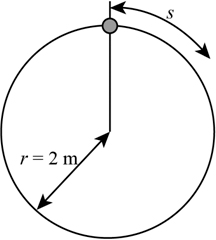
The derivative form of the given equation for the velocity of the particle is given by,
\[\begin{array}{l} dv = \left( {4ds + 0} \right)\\ dv = 4ds \end{array}\]The relation between the tangential acceleration and velocity of the particle is given by,
\[{a_t} \cdot ds = v \cdot dv\]Substituting the values in the above expression, we get,
\[\begin{array}{c} {a_t} \cdot ds = \left( {4s + 1} \right)\left( {4ds} \right)\\ {a_t} = \left( {16s + 4} \right) \end{array}\]When $s = 0$, the value of tangential acceleration will be,
\[\begin{array}{c} {a_t} = 16 \times 0 + 4\\ {a_t} = 4{\rm{ m/}}{{\rm{s}}^2} \end{array}\]The expression for the normal acceleration of the particle is given by,
\[\begin{array}{c} {a_n} = \frac{{{v^2}}}{r}\\ {a_n} = \frac{{{{\left( {4s + 1} \right)}^2}}}{r} \end{array}\]When $s = 0$, the value of normal acceleration will be,
\[\begin{array}{c} {a_n} = \frac{{{{\left( {4 \times 0 + 1} \right)}^2}}}{2}\\ {a_n} = 0.5{\rm{ m/}}{{\rm{s}}^2} \end{array}\]Step 9
Part (e)
We are given a particle moving in a circular path. The following data is given:
The radius of the circular path is $r = 3{\rm{ m}}$.
The tangential acceleration of the particle is $\dot v = \left( {2s} \right){\rm{ m/}}{{\rm{s}}^2}$.
At initial condition ${s_0} = 0$, the velocity of the particle is ${v_0} = 1{\rm{ m/s}}$.
We are required to determine the acceleration at $s = 2{\rm{ m}}$.
Step 10
The diagram showing the motion of the particle is given below:
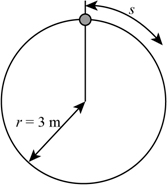
The tangential acceleration of the particle is given by,
\[\begin{array}{l} {a_t} = \dot v\\ {a_t} = \left( {2s} \right){\rm{ m/}}{{\rm{s}}^2} \end{array}.\]The relation between the tangential acceleration and velocity of the particle is given by,
\[\begin{array}{c} {a_t} \cdot ds = v \cdot dv\\ 2s \cdot ds = v \cdot dv \end{array}\]Integrating the above equation between the limits starting from $s = 0$ to $s$, we get,
\[\begin{array}{c} \int_{s = 0}^s {2s \cdot ds} = \int_{v = 1}^v {v \cdot dv} \\ 2\left[ {\frac{{{s^2}}}{2}} \right]_{s = 0}^s = \left[ {\frac{{{v^2}}}{2}} \right]_{v = 1}^v\\ {s^2} - 0 = \frac{1}{2}\left( {{v^2} - 1} \right)\\ v = \sqrt {2{s^2} + 1} \end{array}\]At the instant $s = 2{\rm{ m}}$, the velocity of the particle is given by,
\[\begin{array}{c} v = \sqrt {2{{\left( 2 \right)}^2} + 1} \\ v = 3{\rm{ m/s}} \end{array}\]Then, the tangential acceleration of the particle at the instant $s = 2{\rm{ m}}$, is given by,
\[\begin{array}{c} {a_t} = \dot v\\ {a_t} = 2\left( 2 \right)\\ {a_t} = 4{\rm{ m/}}{{\rm{s}}^2} \end{array}\]And, the normal acceleration of the particle at the instant $s = 2{\rm{ m}}$, is given by,
\[\begin{array}{c} {a_n} = \frac{{{v^2}}}{r}\\ {a_n} = \frac{{{{\left( {3{\rm{ m/s}}} \right)}^2}}}{{3{\rm{ m}}}}\\ {a_n} = 3{\rm{ m/}}{{\rm{s}}^2} \end{array}\]Then, the acceleration of the particle at this instant is given by,
\[\begin{array}{c} a = \sqrt {{a_t}^2 + {a_n}^2} \\ a = \sqrt {{{\left( {4\;{\rm{m/}}{{\rm{s}}^2}} \right)}^2} + {{\left( {{\rm{3 m/}}{{\rm{s}}^2}} \right)}^2}} \\ a = \sqrt {25} \;{\rm{m/}}{{\rm{s}}^2}\\ a = 5{\rm{ m/}}{{\rm{s}}^2} \end{array}\]Step 11
Part (f)
We are given a particle moving in a circular path. The following data is given:
The radius of the circular path is $r = 6{\rm{ m}}$.
The tangential velocity of the particle is given by,
\[v = \left( {4{t^2} + 2} \right){\rm{ m/s}}\]Here, $t$ is in seconds.
We are asked to determine the acceleration of the particle when $t = 1{\rm{ s}}$.
Step 12
The diagram showing the motion of the particle is given below:
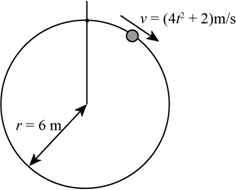
The tangential acceleration of the particle is given by,
\[\begin{array}{c} {a_t} = \frac{{dv}}{{dt}}\\ {a_t} = \frac{d}{{dt}}\left( {4{t^2} + 2} \right)\\ {a_t} = 8t \end{array}\]At the instant $t = 1{\rm{ s}}$, the tangential acceleration of the particle is given by,
\[\begin{array}{l} {a_t} = 8\left( 1 \right)\\ {a_t} = 8{\rm{ m/}}{{\rm{s}}^2} \end{array}\]The normal acceleration of the particle is given by,
\[\begin{array}{c} {a_n} = \frac{{{v^2}}}{r}\\ {a_n} = \frac{{{{\left( {4{t^2} + 2} \right)}^2}}}{r} \end{array}\]At the instant $t = 1{\rm{ s}}$, the normal acceleration of the particle is given by,
\[\begin{array}{c} {a_n} = \frac{{{{\left[ {4{{\left( 1 \right)}^2} + 2} \right]}^2}}}{6}\\ {a_n} = \frac{{{{\left( 6 \right)}^2}}}{6}\\ {a_n} = 6{\rm{ m/}}{{\rm{s}}^2} \end{array}\]Then, the acceleration of the particle at the instant is given by,
\[\begin{array}{c} a = \sqrt {{a_t}^2 + {a_n}^2} \\ a = \sqrt {{{\left( {8{\rm{ m/}}{{\rm{s}}^2}} \right)}^2} + {{\left( {6{\rm{ m/}}{{\rm{s}}^2}} \right)}^2}} \\ a = \sqrt {100} {\rm{ m/}}{{\rm{s}}^2}\\ a = 10{\rm{ m/}}{{\rm{s}}^2} \end{array}\]