Engineering Mechanics: Statics and Dynamics, 14th Edition
Authors: Russell C. Hibbeler
ISBN-13: 978-0133915426
See our solution for Question 1FP from Chapter 13 from Hibbeler's Engineering Mechanics.
Problem 1FP
Step-by-Step Solution
We are given the following data:
The mass of the crate is ${m_c} = 20{\rm{ kg}}$.
The distance moved is $s = 6{\rm{ m}}$.
The time taken to move the crate is $t = 3{\rm{ s}}$.
The coefficient of friction between the crate and the plane is ${\mu _k} = 0.3$.
We are required to determine the tension developed in the cable.
Step 2
To find the acceleration of the crate moved, we use second equation of motion.
\[s = ut + \frac{1}{2}a{t^2}\]Consider the initial velocity of the crate as $u = 0{\rm{ m/s}}$.
Step 3
On plugging the values in the above relation, we get,
\[\begin{array}{c} 6{\rm{ m}} = 0{\rm{ m/s}}\left( 3 \right){\rm{ s}} + \frac{1}{2}a{\left( {3\;{\rm{s}}} \right)^2}\\ 6{\rm{ m}} = 0 + \frac{1}{2}a\left( {9{\rm{ }}{{\rm{s}}^{\rm{2}}}} \right)\\ a\left( {9{\rm{ }}{{\rm{s}}^2}} \right) = 6\left( 2 \right){\rm{ m}}\\ a = \frac{{12{\rm{ m}}}}{{9{\rm{ }}{{\rm{s}}^2}}}\\ a = 1.333{\rm{ m/}}{{\rm{s}}^2} \end{array}\]Step 4
The free body diagram is shown below:
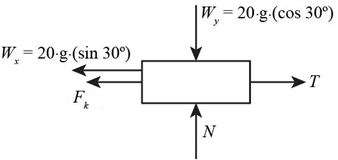
To find the force, we will equate all the forces in vertical direction by using the relation,
\[\begin{array}{c} \sum {{F_y}} = 0\\ N = 20{\rm{ kg}} \times 9.81{\rm{ m/}}{{\rm{s}}^2} \times \left( {\cos 30^\circ } \right)\\ N = 169.914{\rm{ kg}} \cdot {\rm{m/}}{{\rm{s}}^2} \times \frac{{1{\rm{ N}}}}{{1{\rm{ kg}} \cdot {\rm{m/}}{{\rm{s}}^2}}}\\ N = 169.914{\rm{ N}} \end{array}\]Step 5
To find the tension of string, we will equate all the forces in horizontal direction by using the relation
\[\begin{array}{c} \sum {{F_x}} = ma\\ T - m \times g \times \sin 30^\circ - {F_k} = ma\\ T - m \times g \times \sin 30^\circ - {\mu _k} \times N = ma \end{array}\]Step 6
On plugging the values in the above relation, we get,
\[\begin{array}{c} T - 20{\rm{ kg}} \times 9.81{\rm{ m/}}{{\rm{s}}^2} \times \sin 30^\circ - 0.3 \times 169.9{\rm{ N}} = 20{\rm{ kg}} \times 1.33{\rm{ m/}}{{\rm{s}}^2}\\ T - 98.1{\rm{ kg}} \cdot {\rm{m/}}{{\rm{s}}^2} - 0.3 \times 169.9{\rm{ N}} = 20{\rm{ kg}} \times 1.33{\rm{ m/}}{{\rm{s}}^2}\\ T - 98.1{\rm{ N}} - 50.97{\rm{ N}} = 26.6{\rm{ kg}} \cdot {\rm{m/}}{{\rm{s}}^2} \times \frac{{1{\rm{ N}}}}{{1{\rm{ kg}} \cdot {\rm{m/}}{{\rm{s}}^2}}}\\ T = 26.6{\rm{ N}} + 98.1{\rm{ N}} + 50.97{\rm{ N}}\\ T = 175.67{\rm{ N}} \end{array}\]