Engineering Mechanics: Statics and Dynamics, 14th Edition
Authors: Russell C. Hibbeler
ISBN-13: 978-0133915426
See our solution for Question 28P from Chapter 13 from Hibbeler's Engineering Mechanics.
Problem 28P
Step-by-Step Solution
We are given the weight of block $A$ ${W_A} = 100\;{\rm{lb}}$, the velocity of the block $A$ as ${u_A} = 5\;{\rm{ft/s}}$, the weight of block $B$ as ${W_B} = 50\;{\rm{lb}}$, and the kinetic friction as ${\mu _k} = 0.2$.
We are asked to determine acceleration of the block $A$ and the distance $A$ slide before rest.
Step 2
We will draw a free body diagram of the block $A$.
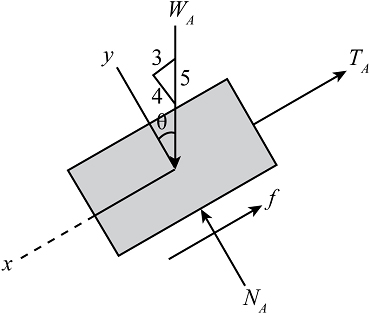
Here, ${N_A}$ is the normal force, ${T_A}$ is the tension in the cable, and $f = {\mu _k}{N_A}$ is the friction force.
Step 3
We will find the angle $\theta $.
\[\begin{array}{c} \cos \theta = \frac{4}{5}\\ \theta = {\cos ^{ - 1}}\left( {\frac{4}{5}} \right)\\ \theta \approx 37^\circ \end{array}\]Step 4
We will resolve the force along the $y$-axis.
\[\begin{array}{c} \sum {{F_y}} = 0\\ {N_A} - {W_A}\cos \theta = 0\\ {N_A} = {W_A}\cos \theta \end{array}\]Substitute the given value in the above equation.
\[\begin{array}{c} {N_A} = \left( {{\rm{100}}\;{\rm{lb}}} \right)\cos 37^\circ \\ = 8{\rm{0}}\;{\rm{lb}} \end{array}\]Step 5
We will apply the force equilibrium along the $x$-axis.
\[\begin{array}{c} \sum {{F_x}} = {m_A}{a_A}\\ - {T_A} - f + {W_A}\sin \theta = \frac{{{W_A}}}{g}{a_A}\\ - {T_A} - {\mu _k}{N_A} + {W_A}\sin \theta = \frac{{{W_A}}}{g}{a_A} \end{array}\]Here, $g = {\rm{32}}{\rm{.2}}\;{\rm{ft/}}{{\rm{s}}^{\rm{2}}}$ is the gravitational acceleration and ${a_A}$ is the acceleration of the block $A$ along $x$-axis.
Substitute the given value in the above equation.
\[\begin{array}{c} - {T_A} - 0.2\left( {8{\rm{0}}\;{\rm{lb}}} \right) + \left( {{\rm{100}}\;{\rm{lb}}} \right)\sin 37^\circ = \frac{{\left( {{\rm{100}}\;{\rm{lb}}} \right)}}{{{\rm{32}}{\rm{.2}}\;{\rm{ft/}}{{\rm{s}}^{\rm{2}}}}} \times {a_A}\\ - {T_A} - 16\;{\rm{lb}} + {\rm{60}}{\rm{.2}}\;{\rm{lb}} = \frac{{\left( {{\rm{100}}\;{\rm{lb}}} \right)}}{{{\rm{32}}{\rm{.2}}\;{\rm{ft/}}{{\rm{s}}^{\rm{2}}}}} \times {a_A}\\ {T_A} = \left( {44.2 - 3.1{a_A}} \right){\rm{lb}}\;\;\;\;\;\;\;...\left( 1 \right) \end{array}\]Step 6
We will draw a free body diagram of the block $B$.

Here, ${T_B}$ is the tension in the cable.
Step 7
We will apply the force equilibrium along the $y$-axis.
\[\begin{array}{c} \sum {{F_y}} = {m_B}{a_B}\\ {T_B} - {W_B} = \left( {\frac{{{W_B}}}{g}} \right){a_B} \end{array}\]Substitute the given value in the above equation.
\[\begin{array}{c} {T_B} - \left( {50\;{\rm{lb}}} \right) = \left( {\frac{{50\;{\rm{lb}}}}{{{\rm{32}}{\rm{.2}}\;{\rm{ft/}}{{\rm{s}}^{\rm{2}}}}}} \right){a_B}\\ {T_B} = \left( {1.55{a_B} + 5{\rm{0}}} \right)\;{\rm{lb}}\;\;\;\;\;\;\;\;...\left( 2 \right) \end{array}\]Step 8
We will draw a free body diagram of the pulley $C$ and $D$.
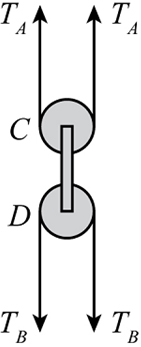
Step 9
We will resolve the forces in vertical direction.
\[\begin{array}{c} \sum {{F_y}} = 0\\ 2{T_A} - 2{T_B} = 0 \end{array}\]Substitute the given value in the above equation.
\[\begin{array}{c} 2\left( {44.2 - 3.1{a_A}} \right){\rm{lb}} - 2\left( {1.55{a_B} + 5{\rm{0}}} \right)\;{\rm{lb}} = 0\\ 44.2 - 3.1{a_A} = 1.55{a_B} + 5{\rm{0}}\\ {a_B} = \frac{{ - 5.8 - 3.1{a_A}}}{{1.55}}\\ {a_B} \approx - 3.7 - 2{a_A}\;\;\;\;\;\;\;\;\;\;\;\;...\left( 3 \right) \end{array}\]Step 10
We will draw a free body diagram of the pulley system.
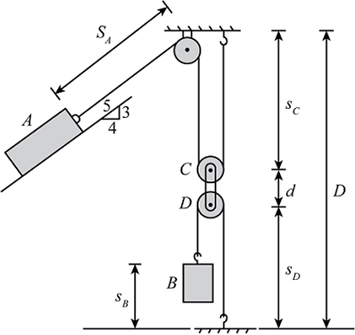
Here, ${s_A}$, ${s_B}$, ${s_C}$ and ${s_D}$ are the length of cables, $d$ is the distance between the pulley $C$ and $D$.
Step 11
We will find the length of the first cable.
\[l = {s_A} + 2{s_C}\]Step 12
Differentiate the above equation with respect to time.
\[\begin{array}{c} \frac{{dl}}{{dt}} = \frac{d}{{dt}}\left( {{s_A}} \right) + \frac{d}{{dt}}\left( {2{s_C}} \right)\\ 0 = {v_A} + 2{v_C}\\ {v_A} = - 2{v_C} \end{array}\]Here, ${v_A}$ is the velocity of the block $A$ and ${v_A}$ is the velocity of the pulley $C$.
Step 13
Differentiate the above equation with respect to time.
\[\begin{array}{c} \frac{d}{{dt}}\left( {{v_A}} \right) = \frac{d}{{dt}}\left( { - 2{v_C}} \right)\\ {a_A} = - 2{a_C}\\ {a_C} = - \frac{{{a_A}}}{2} \end{array}\]Step 14
We will find the length of the second cable.
\[\begin{array}{l} L = {s_D} + \left( {{s_D} - {s_B}} \right)\\ L = 2{s_D} - {s_B} \end{array}\]Step 15
Differentiate the above equation with respect to time.
\[\begin{array}{c} \frac{{dL}}{{dt}} = \frac{d}{{dt}}\left( {2{s_D}} \right) - \frac{d}{{dt}}\left( {{s_B}} \right)\\ 0 = 2{v_D} - {v_B}\\ {v_B} = 2{v_D} \end{array}\]Step 16
Differentiate the above equation with respect to time.
\[\begin{array}{c} \frac{d}{{dt}}\left( {{v_B}} \right) = \frac{d}{{dt}}\left( {2{v_D}} \right)\\ {a_B} = 2{a_D}\\ {a_D} = \frac{{{a_B}}}{2} \end{array}\]Step 17
We will find the distance equation between the supports.
\[D = {s_C} + d + {s_D}\]Step 18
Differentiate the above equation with respect to time.
\[\begin{array}{c} \frac{{dD}}{{dt}} = \frac{d}{{dt}}\left( {{s_C}} \right) + \frac{d}{{dt}}\left( d \right) + \frac{d}{{dt}}\left( {{s_D}} \right)\\ 0 = {v_C} + 0 + {v_D}\\ {v_C} = - {v_D} \end{array}\]Differentiate the above equation with respect to time.
\[\begin{array}{c} \frac{d}{{dt}}\left( {{v_C}} \right) = \frac{d}{{dt}}\left( { - {v_D}} \right)\\ {a_C} = - {a_D} \end{array}\]Step 19
Substitute the given value in the above equation.
\[\begin{array}{c} {a_C} = - {a_D}\\ - \frac{{{a_A}}}{2} = - \frac{{{a_B}}}{2}\\ {a_A} = {a_B} \end{array}\]Step 20
Substitute the given value in equation (3) to find the acceleration of the block $A$.
\[\begin{array}{c} {a_A} = - 3.7 - 2{a_A}\\ {a_A} + 2{a_A} = - 3.7\\ {a_A} = - 1.23\;{\rm{ft/}}{{\rm{s}}^{\rm{2}}} \end{array}\]Here, negative sign indicates the block decelerates.
So, the acceleration of the block $A$ is $1.23\;{\rm{ft/}}{{\rm{s}}^{\rm{2}}}$.
Step 21
We will find the distance of the block $A$ moves before coming to rest.
\[{v^2} = {u^2} + 2{a_A}S\]Here, ${v_A} = 0\;{\rm{ft/s}}$ is the final velocity of the block $A$ and $S$ is the distance moved by the block $A$.
Substitute the given value in the above equation.
\[\begin{array}{c} {\left( {0\;{\rm{ft/s}}} \right)^2} = {\left( {5\;{\rm{ft/s}}} \right)^2} + 2\left( { - 1.23\;{\rm{ft/}}{{\rm{s}}^{\rm{2}}}} \right)S\\ 2\left( { - 1.23\;{\rm{ft/}}{{\rm{s}}^{\rm{2}}}} \right)S = - {\left( {5\;{\rm{ft/s}}} \right)^2}\\ S \approx 10.2\;{\rm{ft}} \end{array}\]