Engineering Mechanics: Statics and Dynamics, 14th Edition
Authors: Russell C. Hibbeler
ISBN-13: 978-0133915426
See our solution for Question 2P from Chapter 14 from Hibbeler's Engineering Mechanics.
Problem 2P
Step-by-Step Solution
We are given the relation between force and the deflection of the barrier as $F = \left( {90\left( {{{10}^3}} \right){x^{{1 \mathord{\left/ {\vphantom {1 2}} \right. } 2}}}} \right)\;{\rm{lb}}$, the weight of a car as $W = 4000\;{\rm{lb}}$ and the speed of a car just before it hit the barrier as $v = 75\;{{{\rm{ft}}} \mathord{\left/ {\vphantom {{{\rm{ft}}} {\rm{s}}}} \right. } {\rm{s}}}$.
We are asked to determine the car’s maximum penetration in the barrier.
Step 2
Let’s assume x be the maximum penetration of the car into the barrier which can be represented as:
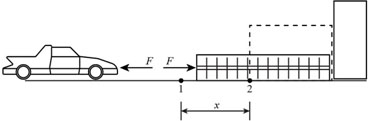
Here, point 1 represents the initial position of the barrier and point 2 represents the final position of the barrier after the car hits it.
Step 3
To calculate the car’s maximum penetration in the barrier, we need to apply the principle of work and energy as:
\[\begin{array}{c} {K_1} + {U_{1 - 2}} = {K_2}\\ \frac{1}{2}mv_1^2 + {U_{1 - 2}} = \frac{1}{2}mv_2^2\\ \frac{1}{2}\left( {\frac{W}{g}} \right)v_1^2 + {U_{1 - 2}} = \frac{1}{2}\left( {\frac{W}{g}} \right)v_2^2 \end{array}\] ...... (1)Here, ${v_1}$ is the initial speed of a car at point 1, ${v_2}$ is the final speed of a car at point 2 $\left( {{v_2} = 0\;{{{\rm{ft}}} \mathord{\left/ {\vphantom {{{\rm{ft}}} {\rm{s}}}} \right. } {\rm{s}}}} \right)$ and ${U_{1 - 2}}$ is the work done by the car in compressing the barrier.
Step 4
To calculate the work done by the car in compressing the barrier, we have:
\[{U_{1 - 2}} = - \int_0^x {Fdx} \]Here, a negative sign indicates that the resistive force exerted by the barrier on the car is opposite to the displacement of the barrier.
Substitute the values in the above expression, we get:
\[\begin{array}{c} {U_{1 - 2}} = - \int_0^x {\left( {90\left( {{{10}^3}} \right){x^{{1 \mathord{\left/ {\vphantom {1 2}} \right. } 2}}}} \right) \cdot dx} \\ {U_{1 - 2}} = - \left( {90 \times {{10}^3}} \right)\int_0^x {{x^{{1 \mathord{\left/ {\vphantom {1 2}} \right. } 2}}} \cdot dx} \\ {U_{1 - 2}} = - \left( {90 \times {{10}^3}} \right)\left( {\frac{2}{3}{x^{{3 \mathord{\left/ {\vphantom {3 2}} \right. } 2}}}} \right)_0^x \end{array}\]Substitute the limits in x, we get:
\[\begin{array}{c} {U_{1 - 2}} = - \left( {90 \times {{10}^3}} \right)\left[ {\left( {\frac{2}{3}{x^{{3 \mathord{\left/ {\vphantom {3 2}} \right. } 2}}}} \right) - \left( {\frac{2}{3} \times {{\left( 0 \right)}^{{3 \mathord{\left/ {\vphantom {3 2}} \right. } 2}}}} \right)} \right]\\ {U_{1 - 2}} = - \left( {60000} \right){x^{{3 \mathord{\left/ {\vphantom {3 2}} \right. } 2}}}\;{\rm{lb}} \cdot {\rm{ft}} \end{array}\]Step 5
Substitute the values in equation (1), we get:
\[\begin{array}{c} \frac{1}{2}\left( {\frac{{4000\;{\rm{lb}}}}{{32.2\;{{{\rm{ft}}} \mathord{\left/ {\vphantom {{{\rm{ft}}} {{{\rm{s}}^2}}}} \right. } {{{\rm{s}}^2}}}}}} \right) \times {\left( {75\;{{{\rm{ft}}} \mathord{\left/ {\vphantom {{{\rm{ft}}} {\rm{s}}}} \right. } {\rm{s}}}} \right)^2} + \left( { - 60000{x^{{{\rm{3}} \mathord{\left/ {\vphantom {{\rm{3}} 2}} \right. } 2}}}} \right)\;{\rm{lb}} \cdot {\rm{ft}} = \frac{1}{2}\left( {\frac{{4000\;{\rm{lb}}}}{{32.2\;{{{\rm{ft}}} \mathord{\left/ {\vphantom {{{\rm{ft}}} {{{\rm{s}}^2}}}} \right. } {{{\rm{s}}^2}}}}}} \right) \times {\left( 0 \right)^2}\\ \left( {349378.9\;{\rm{lb}}} \right) - \left( {60000{x^{{{\rm{3}} \mathord{\left/ {\vphantom {{\rm{3}} 2}} \right. } 2}}}} \right)\;{\rm{lb}} \cdot {\rm{ft}} = 0\\ \left( {349378.9\;{\rm{lb}}} \right) = \left( {60000{x^{{{\rm{3}} \mathord{\left/ {\vphantom {{\rm{3}} 2}} \right. } 2}}}} \right)\;{\rm{lb}} \cdot {\rm{ft}}\\ x = 3.24\;{\rm{ft}} \end{array}\]