Engineering Mechanics: Statics and Dynamics, 14th Edition
Authors: Russell C. Hibbeler
ISBN-13: 978-0133915426
See our solution for Question 92P from Chapter 14 from Hibbeler's Engineering Mechanics.
Problem 92P
Step-by-Step Solution
We have given the following values:
The velocity of roller coaster at point A is ${v_A} = 15\;{\rm{ft}}/{\rm{s}}$.
The total weight of car and the passengers is $W = 350\;{\rm{lb}}$.
The equation of the curved surface is $y = \frac{1}{{200}}\left( {40000 - {x^2}} \right)$.
We are asked to calculate the velocity and normal force that the box exerts on the surface at point B.
Step 2
Consider the datum line coincide with the y-axis.
Apply equation of conservation of energy at point A and B:
\[\begin{array}{c} {T_A} + {V_A} = {T_B} + {V_B}\\ \frac{1}{2}m{v_A}^2 + mg{h_A} = \frac{1}{2}m{v_B}^2 - mg{h_B}\\ \frac{1}{2}{v_A}^2 + g{h_A} = \frac{1}{2}{v_B}^2 - g{h_B} \end{array}\] ......(1)Here, ${h_A}$ and ${h_B}$ is the height of point A and B from the datum line.
Substitute $15\;{\rm{ft}}/{\rm{s}}$ for ${v_A}$, 0 ft for ${h_A}$, and $200\;{\rm{ft}}$ for ${h_B}$ in equation (1):
\[\begin{array}{c} \frac{1}{2}{\left( {15\;{\rm{ft}}/{\rm{s}}} \right)^2} + \left( {32.2\;{\rm{ft}}/{{\rm{s}}^2}} \right)\left( {0\;{\rm{ft}}} \right) = \frac{1}{2}{v_B}^2 - \left( {32.2\;{\rm{ft}}/{{\rm{s}}^2}} \right)\left( {200\;{\rm{ft}}} \right)\\ \frac{1}{2}{v_B}^2 = 6552.5\;{\rm{f}}{{\rm{t}}^2}/{{\rm{s}}^2}\\ {v_B} = 114.48\;{\rm{ft}}/{\rm{s}} \end{array}\]Step 3
The equation of the curved surface is:
\[y = \frac{1}{{200}}\left( {40000 - {x^2}} \right)\]Differentiate the above equation with respect to x:
\[\begin{array}{c} \frac{{dy}}{{dx}} = \frac{d}{{dx}}\left( {\frac{1}{{200}}\left( {40000 - {x^2}} \right)} \right)\\ \frac{{dy}}{{dx}} = - \frac{{2x}}{{200}}\\ \frac{{dy}}{{dx}} = - \frac{x}{{100}} \end{array}\] ......(2)Substitute $x = 200\;{\rm{ft}}$ for point B in equation (2):
\[\begin{array}{c} {\left. {\frac{{dy}}{{dx}}} \right|_{x = 200}} = - \frac{{\left( {200} \right)}}{{100}}\\ {\left. {\frac{{dy}}{{dx}}} \right|_{x = 200}} = - 2 \end{array}\] ......(3)Step 6
Differentiate equation (2) with respect to x:
\[\frac{{{d^2}y}}{{d{x^2}}} = - \frac{1}{{100}}\] ......(4)Substitute $x = 200\;{\rm{ft}}$ for point B in equation (4):
\[{\left. {\frac{{{d^2}y}}{{d{x^2}}}} \right|_{x = 200}} = - \frac{1}{{100}}\] ......(5)Step 7
The radius of curvature at point B is given by:
\[{\rho _B} = \frac{{{{\left[ {1 + {{\left( {\frac{{dy}}{{dx}}} \right)}^2}} \right]}^{\frac{3}{2}}}}}{{\left| {\frac{{{d^2}y}}{{d{x^2}}}} \right|}}\]Substitute equation (3) and (5) in the above equation:
\[\begin{array}{c} {\rho _B} = \frac{{{{\left[ {1 + {{\left( { - 2} \right)}^2}} \right]}^{\frac{3}{2}}}}}{{\left| { - \frac{1}{{100}}} \right|}}\\ = 1118.0\;{\rm{ft}} \end{array}\]Step 8
The angle made the normal axis of the box at point B with the vertical can be calculated as:
\[{\theta _B} = {\tan ^{ - 1}}\left( {{{\left( {\frac{{dy}}{{dx}}} \right)}_{x = 200}}} \right)\]Substitute the equation (3) in the above equation:
\[\begin{array}{c} {\theta _B} = {\tan ^{ - 1}}\left( { - 2} \right)\\ = - 63.43^\circ \end{array}\]Step 9
Draw a free-body diagram of the box at point B.
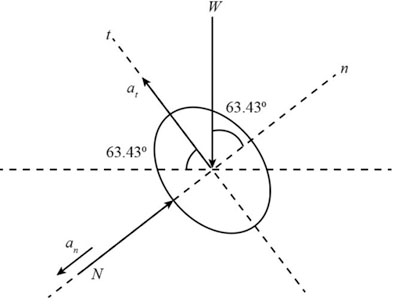
Here, ${a_t}$ is the tangential acceleration, ${a_n}$ is the normal acceleration, and $N$ is the normal force.
Step 10
Apply equilibrium equation for motion of the box in the normal n-axis:
\[\begin{array}{c} \sum {{F_n}} = m{a_n}\\ W\cos \left( { - 63.43^\circ } \right) - N = \frac{W}{g}\frac{{{{\left( {{v_B}} \right)}^2}}}{{{\rho _B}}}\\ N = W\cos 63.43^\circ - \frac{W}{g}\frac{{{{\left( {{v_B}} \right)}^2}}}{{{\rho _B}}} \end{array}\]Substitute the value of $W$, ${\left( {{v_B}} \right)^2}$ and ${\rho _B}$ in the above equation:
\[\begin{array}{c} N = \left( {350\;{\rm{lb}}} \right) \times \cos 63.43^\circ - \frac{{\left( {350\;{\rm{lb}}} \right)}}{{32.2\;{\rm{ft}}/{{\rm{s}}^2}}}\frac{{{{\left( {114.48\;{\rm{ft}}/{\rm{s}}} \right)}^2}}}{{\left( {1118.0\;{\rm{ft}}} \right)}}\\ = 29.1\;{\rm{lb}} \end{array}\]