Engineering Mechanics: Statics and Dynamics, 14th Edition
Authors: Russell C. Hibbeler
ISBN-13: 978-0133915426
See our solution for Question 97P from Chapter 14 from Hibbeler's Engineering Mechanics.
Problem 97P
Step-by-Step Solution
We are provided with the following data:
The mass of a cylinder is $m = 10{\rm{ kg}}$.
The stiffness of the spring is $k = 250{\rm{ N/m}}$.
The unstretched length of the spring is ${l_1} = 1{\rm{ m}}$.
Initial tension of each spring is, $T = 50N$.
Initial height of the object above the spring is $x = 0.5\,{\rm{ m}}$.
We are required to find the maximum displacement of the cylinder from the initial height of $x = 0.5{\rm{ m}}$ above the spring.
Step 2
The diagram can be represented as,
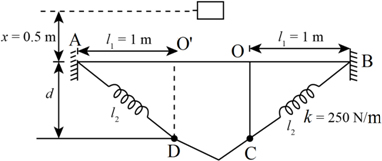
From the figure, ${l_1}$ represents the initial length of the spring, ${l_2}$ represents the stretched length of the string. If the initial height of the cylinder above the spring is $x = 0.5{\rm{ m}}$, then the initial speed of the cylinder will be ${v_1} = 0{\rm{ m/s}}$.
Step 3
To find the stretched length of the spring, we will use Pythagorean theorem.
\[B{C^2} = O{C^2} + O{B^2}\]On plugging the values in the above relation, we get,
\[\begin{array}{c} l_2^2 = {d^2} + {\left( {{\rm{1 m}}} \right)^2}\\ {l_2} = \sqrt {{d^2} + 1} {\rm{ m}} \end{array}\]Step 4
To find the stiffness of the spring, we will use conservation of energy.
\[\begin{array}{c} K{E_{{\rm{initial}}}} + P{E_{{\rm{initial}}}} = K{E_{{\rm{final}}}} + P{E_{{\rm{final}}}}\\ \frac{1}{2}mv_1^2 + \left( {mg{h_1} + 2\left( {\frac{1}{2}kl_1^2} \right)} \right) = \frac{1}{2}mv_2^2 + \left( {mg{h_2} + 2\left( {\frac{1}{2}kl_2^2} \right)} \right)\\ \frac{1}{2}mv_1^2 + \left( {mg{h_1} + 2\left( {\frac{1}{2}} \right)k{{\left( {\frac{T}{k}} \right)}^2}} \right) = \frac{1}{2}mv_2^2 + \left( {mg{h_2} + 2\left( {\frac{1}{2}} \right)k\left( {{l_2} - \left( {1 - \frac{T}{k}} \right)} \right)} \right) \end{array}\]Here, ${v_1}$ represents the initial velocity if the cylinder, ${v_2}$ represents the final velocity if the cylinder whose value is 0 m/s, ${h_1}$ represents the initial height of the cylinder, ${h_2}$ represents the final height of the cylinder, k represents the stiffness of the spring and T represents the tensions of the spring.
Step 5
On plugging the values in the above relation, we get,
\[\begin{array}{c} \left\{ \begin{array}{l} \frac{1}{2}(20{\rm{ kg}}){\left( {0{\rm{ m/s}}} \right)^2}\\ + \left( {10{\rm{ kg}}} \right)\left( { - 9.81{\rm{ m/}}{{\rm{s}}^2}} \right)\left( {0{\rm{ m}}} \right)\\ + 2\left( {\frac{1}{2}250{\rm{ N/m}}{{\left( {\frac{{50{\rm{ N}}}}{{250{\rm{ N/m}}}}} \right)}^2}} \right) \end{array} \right\} = \left\{ \begin{array}{c} \frac{1}{2}(20{\rm{ kg}}){\left( {0{\rm{ m/s}}} \right)^2}\\ + \left( {10{\rm{ kg}}} \right)\left( { - 9.81{\rm{ m/}}{{\rm{s}}^2}} \right)\left( {{\rm{0}}.5 + d{\rm{ m}}} \right)\\ + 2\left( {\frac{1}{2}\left( {250{\rm{ N/m}}} \right){{\left( {\sqrt {{d^2} + 1} - \left( {1 - \frac{{50{\rm{ N}}}}{{250{\rm{ N/m}}}}} \right){\rm{ m}}} \right)}^2}} \right) \end{array} \right\}\\ 0 + \left( {0 + 10} \right) = \left\{ {0 - 98.1\left( {{\rm{0}}.5 + d} \right) + \left( {250} \right){{\left( {\left( {\sqrt {{d^2} + 1} - {{\left( {0.8} \right)}^2}} \right)} \right)}^2}} \right\}\\ 10 = \left\{ \begin{array}{l} - 49.05 - 98.1d\\ + 250\left( {{{\left( {\sqrt {{d^2} + 1} } \right)}^2} + {{\left( {{{\left( {0.8} \right)}^2}} \right)}^2} - 2\left( {\sqrt {{d^2} + 1} } \right){{\left( {0.8} \right)}^2}} \right) \end{array} \right\}\\ 10 = - 49.05 - 98.1d + 250\left( {{d^2} + 1 + 0.4096 - 1.28\left( {\sqrt {{d^2} + 1} } \right)} \right) \end{array}\]Step 6
On further solving the above equation by trial and error,
\[\begin{array}{c} 0 = 250{d^2} - 9.81d - 400\sqrt {{d^2} + 1} + 350.95\\ 0 = 250{d^2} - 9.81d - 400\sqrt {{d^2} + 1} + 350.95\\ d = 1.34{\rm{ m}} \end{array}\]