Engineering Mechanics: Statics and Dynamics, 14th Edition
Authors: Russell C. Hibbeler
ISBN-13: 978-0133915426
See our solution for Question 125P from Chapter 15 from Hibbeler's Engineering Mechanics.
Problem 125P
Step-by-Step Solution
We are given that the constant velocity of water is $v = 12\,{\rm{m/s}}$, the mass of cart is $m = 20\;{\rm{kg}}$, the diameter of nozzle is $d = 50\;{\rm{mm}}$, the density of water is ${\rho _w} = 1000\;{\rm{kg/}}{{\rm{m}}^3}$ and the angle made by nozzle with diameter is $\theta = 45^\circ $.
We are asked to calculate the tension developed in cord and the normal reaction of wheels on the cart.
Step 2
The free body diagram of the nozzle is shown as:
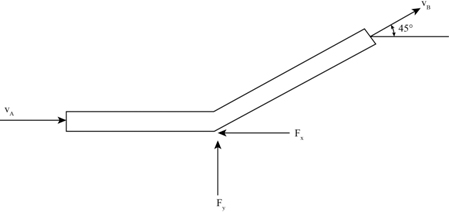
Here, ${F_x}$ is the reaction force along x-axis and ${F_y}$ is the reaction force along y-axis.
Step 3
To calculate the area of nozzle we use the formula:
\[A = \pi {\left( {\frac{d}{2}} \right)^2}\]Step 4
Substitute the known values in the formula:
\[\begin{array}{c} A = \left( {3.14} \right){\left( {\frac{{{\rm{50}}\;{\rm{mm}}}}{{\rm{2}}}} \right)^2}{\left( {\frac{{{{10}^{ - 3}}\;{\rm{m}}}}{{1\;{\rm{mm}}}}} \right)^2}\\ = 1.96 \times {10^{ - 3}}\;{{\rm{m}}^2} \end{array}\]Step 5
To calculate the rate of flow of water we use the formula:
\[Q = Av\]Step 6
Substitute the known values in the formula:
\[\begin{array}{c} Q = \left( {1.96 \times {{10}^{ - 3}}\;{{\rm{m}}^2}} \right)\left( {12\;{\rm{m/s}}} \right)\\ = 0.0235\;{{\rm{m}}^{\rm{3}}}{\rm{/s}} \end{array}\]Step 7
To calculate the mass flow rate of water we use the formula:
\[\frac{{dm}}{{dt}} = {\rho _w}Q\]Step 8
Substitute the known values in the formula:
\[\begin{array}{c} \frac{{dm}}{{dt}} = \left( {1000\;{\rm{kg/}}{{\rm{m}}^3}} \right)\left( {0.0235\;{{\rm{m}}^{\rm{3}}}{\rm{/s}}} \right)\\ = 23.5\;{\rm{kg/s}} \end{array}\]Step 9
To calculate the horizontal component of force acting on blade we use the equation:
\[{F_x} = \frac{{dm}}{{dt}}v\left( {1 - \cos \theta } \right)\]Step 10
Substitute the known values in the equation:
\[\begin{array}{c} {F_x} = \left( {{\rm{23}}{\rm{.5}}\;{\rm{kg/s}}} \right)\left( {{\rm{12}}\;{\rm{m/s}}} \right)\left( {\frac{{1\;{\rm{N}}}}{{1\;{\rm{kg}} \cdot {\rm{m/}}{{\rm{s}}^2}}}} \right)\left( {1 - \cos 45^\circ } \right)\\ = \left( {282\;{\rm{N}}} \right)\left( {1 - 0.707} \right)\\ = \left( {282\;{\rm{N}}} \right)\left( {0.293} \right)\\ = 82.6\;{\rm{N}} \end{array}\]Step 11
To calculate the vertical component of force acting on blade we use the equation:
\[{F_y} = \frac{{dm}}{{dt}}v\sin \theta \]Step 12
Substitute the known values in the equation:
\[\begin{array}{c} {F_y} = \left( {{\rm{23}}{\rm{.5}}\;{\rm{kg/s}}} \right)\left( {{\rm{12}}\;{\rm{m/s}}} \right)\left( {\frac{{1\;{\rm{N}}}}{{1\;{\rm{kg}} \cdot {\rm{m/}}{{\rm{s}}^2}}}} \right)\sin 45^\circ \\ = \left( {282\;{\rm{N}}} \right)\left( {0.707} \right)\\ = 199.4\;{\rm{N}} \end{array}\]Step 13
The free body diagram of the cart is shown as:
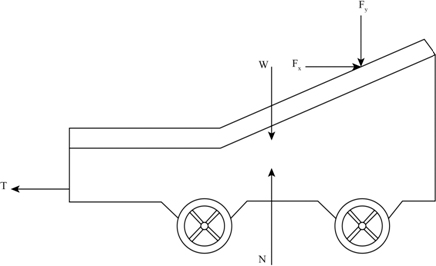
Here, T is the tension in the cord, N is the normal force and W is the weight of cart.
Step 14
Applying the equilibrium of force equation on the cart along x-axis:
\[\begin{array}{c} \sum {F_x} = 0\\ {F_x} - T = 0\\ T = {F_x} \end{array}\]Step 15
Substitute the known value in the equation:
\[T = 82.6\;{\rm{N}}\]Step 16
Applying the equilibrium of force equation on the cart along y-axis:
\[\begin{array}{c} \sum {F_y} = 0\\ N - W - {F_y} = 0\\ N = W + {F_y} \end{array}\]...... (1)Step 17
To calculate the weight of cart we use the formula:
\[W = mg\]Step 18
Substitute the known value in the equation (1):
\[N = mg + {F_y}\]Step 19
Substitute the known values in the equation:
\[\begin{array}{c} N = \left( {{\rm{20}}\;{\rm{kg}}} \right)\left( {{\rm{9}}{\rm{.81}}\,{\rm{m/}}{{\rm{s}}^{\rm{2}}}} \right)\left( {\frac{{{\rm{1}}\;{\rm{N}}}}{{{\rm{1}}\;{\rm{kg}} \cdot {\rm{m/}}{{\rm{s}}^{\rm{2}}}}}} \right) + 199.4\;{\rm{N}}\\ = 196.2\;{\rm{N}} + 199.4\;{\rm{N}}\\ = 395.6\;{\rm{N}} \end{array}\]