Engineering Mechanics: Statics and Dynamics, 14th Edition
Authors: Russell C. Hibbeler
ISBN-13: 978-0133915426
See our solution for Question 140P from Chapter 16 from Hibbeler's Engineering Mechanics.
Problem 140P
Step-by-Step Solution
We have given the following data:
The angular velocity of rod AB is ${\omega _{AB}} = 4\;{\rm{rad}}/{\rm{s}}$.
The angular acceleration of rod AB is ${\alpha _{AB}} = 2\;{\rm{rad}}/{{\rm{s}}^2}$.
We are asked to calculate the angular velocity and angular acceleration of rod CD.
Step 2
Draw a labeled diagram of the given system.
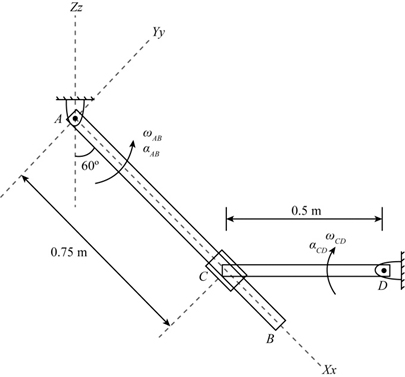
Here, ${\omega _{CD}}$ is the angular velocity of rod CD and ${\alpha _{CD}}$ is the angular acceleration of rod CD.
Consider that the origin of both fixed and moving frames of reference is located at point A. The x, y, z moving frame is attached to AB and rotates with rod AB since collar C slides along rod AB.
Step 3
The velocity of fixed point A in the vector form is given by:
\[{\overrightarrow v _A} = 0\;{\rm{m}}/{\rm{s}}\]The acceleration of fixed point A in the vector form is given by:
\[{\overrightarrow a _A} = 0\;{\rm{m}}/{{\rm{s}}^2}\]The angular velocity of rod AB in vector form is given by:
\[\Omega = 4{\bf{k}}\;{\rm{rad}}/{\rm{s}}\]The angular acceleration of rod AB in vector form is given by:
\[\dot \Omega = 2{\bf{k}}\;{\rm{rad}}/{{\rm{s}}^2}\]The distance of slider C relative to point A is given by:
\[{\overrightarrow r _{C/A}} = \left\{ {0.75{\bf{i}}} \right\}\;{\rm{m}}\]The velocity ${\left( {{v_{C/A}}} \right)_{xyz}}$ of slider C with respect to moving reference is given by:
\[{\left( {{{\overrightarrow v }_{C/A}}} \right)_{xyz}} = {\left( {{v_{C/A}}} \right)_{xyz}}{\bf{i}}\]The acceleration\[{\left( {{a_{C/A}}} \right)_{xyz}}\] of slider C with respect to moving reference is given by:
\[{\left( {{{\overrightarrow a }_{C/A}}} \right)_{xyz}} = {\left( {{a_{C/A}}} \right)_{xyz}}{\bf{i}}\]Step 4
The velocity of slider C is given by:
\[{\overrightarrow v _C} = {\overrightarrow v _A} + \Omega \times {\overrightarrow r _{C/A}} + {\left( {{{\overrightarrow v }_{C/A}}} \right)_{xyz}}\]......(1)Step 5
The acceleration of slider C is given by:
\[{\overrightarrow a _C} = {\overrightarrow a _A} + \dot \Omega \times {\overrightarrow r _{C/A}} + \Omega \times \left( {\Omega \times {{\overrightarrow r }_{C/A}}} \right) + 2\Omega \times {\left( {{{\overrightarrow v }_{C/A}}} \right)_{xyz}} + {\left( {{{\overrightarrow a }_{C/A}}} \right)_{xyz}}\]......(2)Step 6
The distance of point C from point D can be represented as:
\[\begin{array}{c} {\overrightarrow r _{C/D}} = \left\{ { - 0.5\cos 30^\circ {\bf{i}} - 0.5\sin 30^\circ {\bf{j}}} \right\}\;{\rm{m}}\\ = \left\{ { - 0.433{\bf{i}} - 0.25{\bf{j}}} \right\}\;{\rm{m}} \end{array}\]Step 7
Considering the figure, the velocity of the slider C can be expressed as:
\[{\overrightarrow v _C} = {\omega _{CD}} \times {\overrightarrow r _{C/D}}\]Substitute the value of ${\overrightarrow r _{C/D}}$ in the above equation:
\[\begin{array}{c} {\overrightarrow v _C} = - {\omega _{CD}}{\bf{k}} \times \left( { - 0.433{\bf{i}} - 0.25{\bf{j}}} \right)\\ = - 0.25{\omega _{CD}}{\bf{i}} + 0.433{\omega _{CD}}{\bf{j}} \end{array}\]Step 8
Considering the figure, the acceleration of the slider C can be expressed as:
\[{\overrightarrow a _C} = {\alpha _{CD}} \times {\overrightarrow r _{C/D}} - \omega _{CD}^2{\overrightarrow r _{C/D}}\]Substitute the value of ${\overrightarrow r _{C/D}}$ in the above equation:
\[\begin{array}{c} {\overrightarrow a _C} = - {\alpha _{CD}}{\bf{k}} \times \left( { - 0.433{\bf{i}} - 0.25{\bf{j}}} \right) - \omega _{CD}^2\left( { - 0.433{\bf{i}} - 0.25{\bf{j}}} \right)\\ = \left( {0.433\omega _{CD}^2 - 0.25{\alpha _{CD}}} \right){\bf{i}} + \left( {0.433{\alpha _{CD}} + 0.25\omega _{CD}^2} \right){\bf{j}} \end{array}\]Step 9
Substitute the values of parameters in equation (1):
\[\begin{array}{c} \left( { - 0.25{\omega _{CD}}{\bf{i}} + 0.433{\omega _{CD}}{\bf{j}}} \right) = \left( 0 \right) + \left( {4{\bf{k}}} \right) \times \left( {0.75{\bf{i}}} \right) + {\left( {{v_{C/A}}} \right)_{xyz}}{\bf{i}}\\ - 0.25{\omega _{CD}}{\bf{i}} + 0.433{\omega _{CD}}{\bf{j}} = {\left( {{v_{C/A}}} \right)_{xyz}}{\bf{i}} + 3{\bf{j}} \end{array}\]......(3)Step 10
On equating the ${\bf{j}}$ components of equation (3), we get:
\[\begin{array}{c} 0.433{\omega _{CD}} = 3\;{\rm{rad}}/{\rm{s}}\\ {\omega _{CD}} = 6.928\;{\rm{rad}}/{\rm{s}} \end{array}\]Step 11
On equating the ${\bf{i}}$ components of equation (3), we get:
\[{\left( {{v_{C/A}}} \right)_{xyz}} = - 0.25{\omega _{CD}}\]Substitute the value of ${\omega _{CD}}$in the above equation:
\[\begin{array}{c} {\left( {{v_{C/A}}} \right)_{xyz}} = - 0.25\left( {6.928} \right)\;{\rm{m}}/{\rm{s}}\\ {\left( {{v_{C/A}}} \right)_{xyz}} = - 1.732\;{\rm{m}}/{\rm{s}} \end{array}\]Step 12
Substitute the values of parameters in equation (2):
\[\begin{array}{c} \left\{ \begin{array}{l} \left( {0.433\omega _{CD}^2 - 0.25{\alpha _{CD}}} \right){\bf{i}}\\ + \left( {0.433{\alpha _{CD}} + 0.25\omega _{CD}^2} \right){\bf{j}} \end{array} \right\} = \left\{ \begin{array}{l} \left( 0 \right) + \left( {2{\bf{k}}} \right) \times \left( {0.75{\bf{i}}} \right) + \left( {4{\bf{k}}} \right) \times \left( {4{\bf{k}} \times 0.75{\bf{i}}} \right)\\ + 2\left( {4{\bf{k}}} \right) \times \left( { - 1.732{\bf{i}}} \right) + {\left( {{a_{C/A}}} \right)_{xyz}}{\bf{i}} \end{array} \right\}\\ \left\{ \begin{array}{l} \left( {0.433\omega _{CD}^2 - 0.25{\alpha _{CD}}} \right){\bf{i}}\\ + \left( {0.433{\alpha _{CD}} + 0.25\omega _{CD}^2} \right){\bf{j}} \end{array} \right\} = \left\{ {\left( {{{\left( {{a_{C/A}}} \right)}_{xyz}} - 12} \right){\bf{i}} - 12.36{\bf{j}}} \right\} \end{array}\]Substitute the value of ${\omega _{CD}}$ in the above equation:
\[\begin{array}{c} \left\{ \begin{array}{l} \left( {0.433{{\left( {6.928} \right)}^2} - 0.25{\alpha _{CD}}} \right){\bf{i}}\\ + \left( {0.433{\alpha _{CD}} + 0.25{{\left( {6.928} \right)}^2}} \right){\bf{j}} \end{array} \right\} = \left\{ {\left( {{{\left( {{a_{C/A}}} \right)}_{xyz}} - 12} \right){\bf{i}} - 12.36{\bf{j}}} \right\}\\ \left\{ {\left( {20.78 - 0.25{\alpha _{CD}}} \right){\bf{i}} + \left( {0.433{\alpha _{CD}} + 12} \right){\bf{j}}} \right\} = \left\{ {\left( {{{\left( {{a_{C/A}}} \right)}_{xyz}} - 12} \right){\bf{i}} - 12.36{\bf{j}}} \right\} \end{array}\]......(4)Step 13
On equating the ${\bf{j}}$ components of equation (4), we get:
\[\begin{array}{c} 0.433{\alpha _{CD}} + 12\;{\rm{rad}}/{{\rm{s}}^2} = - 12.36\;{\rm{rad}}/{{\rm{s}}^2}\\ 0.433{\alpha _{CD}} = - 24.36\;{\rm{rad}}/{{\rm{s}}^2}\\ {\alpha _{CD}} = - 56.2\;{\rm{rad}}/{{\rm{s}}^2} \end{array}\]Here, the negative sign indicates the anticlockwise direction.
Step 14
On equating the ${\bf{i}}$ components of equation (4), we get:
\[20.78 - 0.25{\alpha _{CD}} = {\left( {{a_{C/A}}} \right)_{xyz}} - 12\]Substitute the value of ${\alpha _{CD}}$ in the above equation:
\[\begin{array}{c} 20.78\;{\rm{m}}/{{\rm{s}}^2} - 0.25\left( { - 56.2} \right)\;{\rm{m}}/{{\rm{s}}^2} = {\left( {{a_{C/A}}} \right)_{xyz}} - 12\;{\rm{m}}/{{\rm{s}}^2}\\ {\left( {{a_{C/A}}} \right)_{xyz}} = 46.8\;{\rm{m}}/{{\rm{s}}^2} \end{array}\]