Step 1 We are given abar $AB$ rotating uniformly about the fixed pin $A$ with a constant angular velocity $\omega $.
We are asked to determine the velocity and acceleration of block $C$, at the instant $\theta = 60^\circ $.
Step 2 The kinematic diagram of the system is given below:
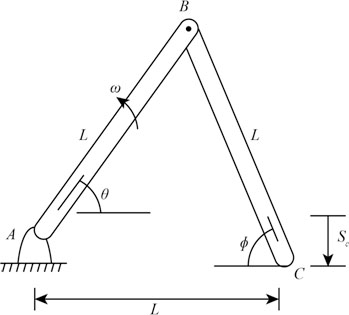
Here, $\omega $ represents the angular velocity of the link $AB$ and $L$ represents the length of both links $AB$ and $BC$.
Step 3 At the instant, the distance between the fixed pin $A$ and the slider $C$ using the right-angled triangle law is given by,
\[\begin{array}{c} AB\cos \theta + BC\cos \phi = L\\ L\cos \theta + L\cos \phi = L\\ \cos \theta + \cos \phi = 1 \end{array}\] … (1)
At the instant $\theta = 60^\circ $, the value of $\phi $ we get,
\[\begin{array}{c} \cos 60^\circ + \cos \phi = 1\\ \cos \phi = 1 - \cos 60^\circ \\ \phi = {\cos ^{ - 1}}\left( {\frac{1}{2}} \right)\\ \phi = 60^\circ \end{array}\]
Step 4 Differentiating the equation (1) with respect to time, we get,
\[\begin{array}{c} \frac{d}{{dt}}\left( {\cos \theta + \cos \phi } \right) = \frac{d}{{dt}}\left( 1 \right)\\ \sin \theta \cdot \dot \theta + \sin \phi \cdot \dot \phi = 0 \end{array}\] … (2)
At the instant $\theta = 60^\circ $, substituting the values in the above expression, we get,
\[\begin{array}{c} \sin 60^\circ \cdot \dot \theta + \sin 60^\circ \cdot \dot \phi = 0\\ \dot \theta = - \dot \phi \end{array}\]
Here, $\dot \theta = \omega $ represents the angular velocity of the link $AB$, and $ - \dot \phi = \omega $ is angular velocity of the link $BC$.
Differentiating the equation (2) with respect to time, we get,
\[\begin{array}{c} \frac{d}{{dt}}\left( {\sin \theta \cdot \dot \theta + \sin \phi \cdot \dot \phi } \right) = \frac{d}{{dt}}\left( 0 \right)\\ \cos \theta \cdot {{\dot \theta }^2} + \sin \theta \cdot \ddot \theta + \sin \phi \cdot \ddot \phi + \cos \phi \cdot {{\dot \phi }^2} = 0 \end{array}\]
At the instant $\theta = 60^\circ $ and $\ddot \theta = 0$ for constant angular velocity of link $AB$, substituting the values in the above expression, we get,
\[\begin{array}{c} \cos 60^\circ \cdot {\omega ^2} + \sin 60^\circ \cdot \left( 0 \right) + \sin 60^\circ \cdot \ddot \phi + \cos 60^\circ \cdot {\left( { - \omega } \right)^2} = 0\\ \sin 60^\circ \cdot \ddot \phi = - {\omega ^2}\\ \ddot \phi = - 1.155{\omega ^2} \end{array}\]
Step 5 The vertical displacement of the point $C$ of the slider using the right-angled triangle formula, can be given as,
\[\begin{array}{l} {S_c} = BC\sin \phi - AB\sin \theta \\ {S_c} = L\sin \phi - L\sin \theta \end{array}\]
Differentiating the above expression with respect to time, the velocity of block $C$ can be given as,
\[\begin{array}{c} \frac{d}{{dt}}\left( {{S_c}} \right) = \frac{d}{{dt}}\left( {L\sin \phi - L\sin \theta } \right)\\ {v_c} = L\cos \phi \cdot \dot \phi - L\cos \theta \cdot \dot \theta \end{array}\] … (3)
On substituting $\theta = 60^\circ $, $\phi = 60^\circ $, $\dot \theta = \omega $ and $\dot \phi = - \omega $ in the above expression, we get,
\[\begin{array}{c} {v_c} = L\cos 60^\circ \cdot \left( { - \omega } \right) - L\cos 60^\circ \cdot \omega \\ {v_c} = \frac{{ - \omega L}}{2} - \frac{{\omega L}}{2}\\ {v_c} = - \omega L \end{array}\]
The negative sign indicates that the block $C$ is moving upwards.
Step 6 Differentiating the equation (3) with respect to the time, the velocity of block $C$ can be given as,
\[\begin{array}{c} \frac{d}{{dt}}\left( {{v_c}} \right) = \frac{d}{{dt}}\left( {L\cos \phi \cdot \dot \phi - L\cos \theta \cdot \dot \theta } \right)\\ {a_c} = - L\sin \phi \cdot {\left( {\dot \phi } \right)^2} + L\cos \phi \cdot \ddot \phi - L\cos \theta \cdot \ddot \theta + L\sin \theta \cdot {\left( {\dot \theta } \right)^2} \end{array}\]
On substituting $\theta = 60^\circ $, $\phi = 60^\circ $, $\dot \theta = \omega $ and $\dot \phi = - \omega $, and $\ddot \phi = - 1.155{\omega ^2}$ in the above expression, we get,
\[\begin{array}{c} {a_c} = - L\sin 60^\circ \cdot {\left( { - \omega } \right)^2} + L\cos 60^\circ \cdot \left( { - 1.155{\omega ^2}} \right) - L\cos 60^\circ \cdot \left( 0 \right) + L\sin 60^\circ \cdot {\left( \omega \right)^2}\\ {a_c} = - 0.866L{\omega ^2} - 0.577L{\omega ^2} - 0 + 0.866L{\omega ^2}\\ {a_c} = - 0.577L{\omega ^2} \end{array}\]
The negative sign indicates that the block $C$ is moving upwards.