Engineering Mechanics: Statics and Dynamics, 14th Edition
Authors: Russell C. Hibbeler
ISBN-13: 978-0133915426
See our solution for Question 105P from Chapter 17 from Hibbeler's Engineering Mechanics.
Problem 105P
Step-by-Step Solution
We are given the weight of the roller as $W = 50\;{\rm{lb}}$, the radius of the roller as $r = 1.5\;{\rm{ft}}$, and the coefficient of static friction as ${\mu _s} = 0.25$.
We are asked to determine the maximum force $P$ and the angular acceleration of the roller.
Step 2
We will draw a free body diagram of the roller.
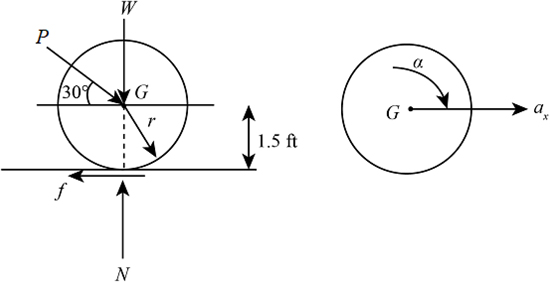
Here, $N$ is the normal force and $f = {\mu _s}N$ is the friction force.
Step 3
We will find the moment of inertia of the roller about the center.
\[\begin{array}{l} {I_G} = \frac{1}{2}m{r^2}\\ {I_G} = \frac{1}{2}\left( {\frac{W}{g}} \right){r^2} \end{array}\]Here, $g = 32.2\;{\rm{ft/}}{{\rm{s}}^{\rm{2}}}$ is the gravitational acceleration.
Substitute the given value in the above equation.
\[\begin{array}{c} {I_G} = \frac{1}{2}\left( {\frac{{50\;{\rm{lb}}}}{{32.2\;{\rm{ft/}}{{\rm{s}}^{\rm{2}}}}}} \right){\left( {1.5\;{\rm{ft}}} \right)^2}\\ \approx 1.75\;{\rm{lb}} \cdot {\rm{ft}} \cdot {{\rm{s}}^{\rm{2}}} \end{array}\]Step 4
We will resolve the force in vertical direction.
\[\begin{array}{c} \sum {{F_y}} = 0\\ N - W - P\sin 30^\circ = 0\\ N = W + P\sin 30^\circ \end{array}\]Substitute the given value in the above equation.
\[\begin{array}{c} N = \left( {50\;{\rm{lb}}} \right) + P\sin 30^\circ \\ N = \left( {50 + 0.5P} \right)\;{\rm{lb}} \end{array}\]Step 5
We will resolve the force in horizontal direction.
\[\begin{array}{c} \sum {{F_x}} = m{a_x}\\ P\cos 30^\circ - f = \left( {\frac{W}{g}} \right){a_x}\\ P\cos 30^\circ - {\mu _s}N = \left( {\frac{W}{g}} \right){a_x}\\ {a_x} = \frac{{g\left( {P\cos 30^\circ - {\mu _s}N} \right)}}{W}\;\;...\left( 1 \right) \end{array}\]Here, ${a_x}$ is the acceleration of the roller at the center in the horizontal direction.
Substitute the given value in the above equation.
\[\begin{array}{c} {a_x} = \left( {\frac{{32.2\left( {P\cos 30^\circ - 0.25\left( {50 + 0.5P} \right)} \right)}}{{50}}} \right){\rm{ft/}}{{\rm{s}}^{\rm{2}}}\\ {a_x} = \left( {\frac{{\left( {32.2P\cos 30^\circ - 402.5 - 4.025P} \right)}}{{50}}} \right){\rm{ft/}}{{\rm{s}}^{\rm{2}}}\\ {a_x} = \left( {\frac{{P\left( {32.2\cos 30^\circ - 4.025} \right) - 402.5}}{{50}}} \right){\rm{ft/}}{{\rm{s}}^{\rm{2}}}\;\;\;\;\;\;\;...\left( 2 \right) \end{array}\]Step 6
We will take the moment about point $G$.
\[\begin{array}{c} \sum {{M_G}} = {I_G}\alpha \\ fr = {I_G}\alpha \\ \left( {{\mu _s}N} \right)r = {I_G}\alpha \end{array}\]Substitute the given value in the above equation.
\[\begin{array}{c} \left( {0.25\left( {50 + 0.5P} \right){\rm{lb}}} \right)\left( {1.5\;{\rm{ft}}} \right) = \left( {1.75\;{\rm{lb}} \cdot {\rm{ft}} \cdot {{\rm{s}}^{\rm{2}}}} \right)\alpha \\ \left( {18.75 + 0.1875P} \right){\rm{lb}} \cdot {\rm{ft}} = \left( {1.75\;{\rm{lb}} \cdot {\rm{ft}} \cdot {{\rm{s}}^{\rm{2}}}} \right)\alpha \\ \alpha = \left( {\frac{{\left( {18.75 + 0.1875P} \right)}}{{1.75}}} \right)\;{\rm{rad/}}{{\rm{s}}^{\rm{2}}}\;\;\;\;...\left( 3 \right) \end{array}\]Step 7
We will find the angular acceleration of the roller to find the maximum force.
\[{a_x} = r\alpha \]Substitute the given value in the above equation.
\[\begin{array}{c} \left( {\frac{{P\left( {32.2\cos 30^\circ - 4.025} \right) - 402.5}}{{50}}} \right) = \left( {1.5} \right)\left( {\frac{{\left( {18.75 + 0.1875P} \right)}}{{1.75}}} \right)\\ 1.75P\left( {32.2\cos 30^\circ - 4.025} \right) - 704.375 = 1406.25 + 14.0625P\\ P\left( {1.75\left( {32.2\cos 30^\circ - 4.025} \right) - 14.0625} \right) = 1406.25 + 704.375\\ P = \frac{{1406.25 + 704.375}}{{\left( {1.75\left( {32.2\cos 30^\circ - 4.025} \right) - 14.0625} \right)}}\\ P \approx 76.21\;{\rm{lb}} \end{array}\]Step 8
Substitute the given value in equation (3) to find the angular acceleration of the roller.
\[\begin{array}{c} \alpha = \left( {\frac{{\left( {18.75 + 0.1875\left( {76.21} \right)} \right)}}{{1.75}}} \right)\;{\rm{rad/}}{{\rm{s}}^{\rm{2}}}\\ \approx 18.9\;{\rm{rad/}}{{\rm{s}}^{\rm{2}}} \end{array}\]