Engineering Mechanics: Statics and Dynamics, 14th Edition
Authors: Russell C. Hibbeler
ISBN-13: 978-0133915426
See our solution for Question 106P from Chapter 17 from Hibbeler's Engineering Mechanics.
Problem 106P
Step-by-Step Solution
We are given the mass of bar as $m$, the length of bar as $L$, and the horizontal force as ${\bf{P}}$.
We are asked to determine the initial angular acceleration of the bar and the acceleration of the bar at its top point $B$.
Step 2
We will draw a free body diagram of the bar.
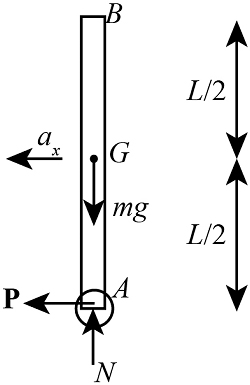
Here, $N$ is the normal force, ${a_x}$ is acceleration of the bar at the center $G$, and $g$ is the gravitational acceleration.
Step 3
We will find the moment of inertia of the bar.
\[{I_G} = \frac{{m{L^2}}}{{12}}\]Step 4
We will resolve the forces in the horizontal direction.
\[\begin{array}{c} \sum {{F_x}} = m{a_x}\\ {\bf{P}} = m{a_x}\\ {a_x} = \frac{{\bf{P}}}{m}\;\;\;\;\;\;\;...\left( 1 \right) \end{array}\]Step 5
We will take the moment about point $G$ to find the angular acceleration of the bar.
\[\begin{array}{c} \sum {{M_G}} = {I_G}\alpha \\ {\bf{P}} \times \frac{L}{2} = {I_G}\alpha \end{array}\]Here, $\alpha $ is the angular acceleration of the bar.
Substitute the given value in the above equation.
\[\begin{array}{c} {\bf{P}} \times \frac{L}{2} = \left( {\frac{{m{L^2}}}{{12}}} \right)\alpha \\ {\bf{P}}L = \left( {\frac{{m{L^2}}}{6}} \right)\alpha \\ \alpha = \frac{{6{\bf{P}}}}{{mL}} \end{array}\]Step 6
We will find the acceleration at point $B$.
\[\begin{array}{l} {a_B} = {a_x} - {a_{B/G}}\\ {a_B} = {a_x} - \left( {\frac{L}{2}} \right)\alpha \end{array}\]Substitute the given value in the above equation.
\[\begin{array}{l} {a_B} = \frac{{\bf{P}}}{m} - \left( {\frac{L}{2}} \right)\left( {\frac{{6{\bf{P}}}}{{mL}}} \right)\\ {a_B} = {\bf{P}}\left( {\frac{1}{m} - \frac{3}{m}} \right)\\ {a_B} = - \frac{{2{\bf{P}}}}{m} \end{array}\]So, the acceleration at point $B$ is $\frac{{2{\bf{P}}}}{m}$ towards right.