Engineering Mechanics: Statics and Dynamics, 14th Edition
Authors: Russell C. Hibbeler
ISBN-13: 978-0133915426
See our solution for Question 13FP from Chapter 17 from Hibbeler's Engineering Mechanics.
Problem 13FP
Step-by-Step Solution
We are given a uniform slender bar of mass $m = 60{\rm{ kg}}$ which is initially at rest on a smooth horizontal plane when the forces are applied on it.
We are asked to determine the acceleration of the bar’s mass center and the angular acceleration of the bar.
Step 2
The free-body diagram of the uniform rod is given below:
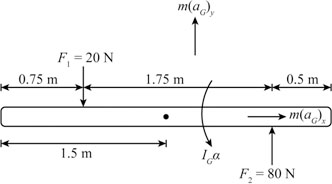
Here, $G$ represents the center of mass of the uniform rod.
Step 3
The moment of inertia of the slender uniform rod about its center of mass is given by,
\[{I_G} = \frac{{m{l^2}}}{{12}}\]Here, $m$ is the mass of the uniform rod and $l$ is the length of the uniform rod.
On substituting the values in the above expression, we get,
\[\begin{array}{c} {I_G} = \frac{{60{\rm{ kg}} \times {{\left( {3{\rm{ m}}} \right)}^2}}}{{12}}\\ {I_G} = 45{\rm{ kg}} \cdot {{\rm{m}}^2} \end{array}\]Step 4
At equilibrium condition, balancing all the forces acting on the rod about the vertical direction, we have,
\[\begin{array}{c} \sum {F_y} = 0\\ {F_2} - {F_1} = m{\left( {{a_G}} \right)_y} \end{array}\]Here, ${\left( {{a_G}} \right)_y}$ represents the vertical acceleration of the center of mass of the bar.
On substituting the values in the above expression, we have,
\[\begin{array}{c} \left( {80{\rm{ N}}} \right) - \left( {20{\rm{ N}}} \right) = \left( {60{\rm{ kg}}} \right) \times {\left( {{a_G}} \right)_y}\\ {\left( {{a_G}} \right)_y} = 1{\rm{ m/}}{{\rm{s}}^2} \end{array}\]At equilibrium condition, balancing all the forces acting on the rod about the horizontal direction, we have,
\[\begin{array}{c} \sum {F_x} = 0\\ 0 = m{\left( {{a_G}} \right)_x}\\ {\left( {{a_G}} \right)_x} = 0 \end{array}\]Here, ${\left( {{a_G}} \right)_x}$ represents the horizontal acceleration of the center of mass of the bar.
Step 5
At equilibrium condition, taking moments about the center of mass of the uniform rod, we have,
\[{F_2} \times \left( {1{\rm{ m}}} \right) + {F_1} \times \left( {0.75{\rm{ m}}} \right) = {I_G}\alpha \]On substituting the values in the above expression, we have,
\[\begin{array}{c} \left( {80{\rm{ N}}} \right) \times \left( {1{\rm{ m}}} \right) + \left( {20{\rm{ N}}} \right) \times \left( {0.75{\rm{ m}}} \right) = \left( {45{\rm{ kg}} \cdot {{\rm{m}}^2}} \right) \times \alpha \\ \left( {45{\rm{ kg}} \cdot {{\rm{m}}^2}} \right) \times \alpha = \left( {95{\rm{ N}} \cdot {\rm{m}}} \right)\\ \alpha = 2.11{\rm{ rad/}}{{\rm{s}}^2} \end{array}\]