Engineering Mechanics: Statics and Dynamics, 14th Edition
Authors: Russell C. Hibbeler
ISBN-13: 978-0133915426
See our solution for Question 15FP from Chapter 17 from Hibbeler's Engineering Mechanics.
Problem 15FP
Step-by-Step Solution
We are given a wheel that is subjected to the couple moment, and it slips as it rolls. The following data is given:
The mass of the wheel is, $m = 20{\rm{ kg}}$.
The radius of gyration of the wheel about its center $O$ is, ${k_O} = 300{\rm{ mm}}$
The coefficient of kinetic friction between the wheel and the plane is, ${\mu _k} = 0.5$.
We are asked to determine the angular acceleration of the wheel and the acceleration of the wheel’s center $O$.
Step 2
The free-body diagram of the wheel is given by,
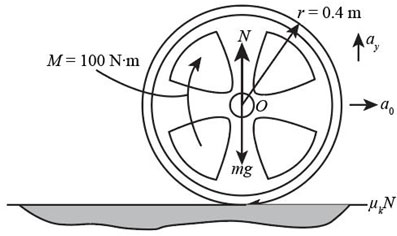
Here, $M$ is the moment applied on the wheel , $r$ is the radius of the wheel, $N$ is the normal reaction force of the wheel, and ${a_O}$ is the acceleration of the wheel’s center $O$.
Step 3
At equilibrium condition, balancing all the forces acting on the wheel in the vertical direction, we have,
\[\begin{array}{c} \sum {F_y} = 0\\ N - mg = m{a_y} \end{array}\]Since the wheel is moving in the horizontal direction, so the value of ${a_y}$ would be ${a_y} = 0$.
On substituting the values in the above expression, we get,
\[\begin{array}{c} N - 20 \times \left( {9.81{\rm{ m/}}{{\rm{s}}^2}} \right) = 20 \times 0\\ N = 196.2{\rm{ N}} \end{array}\]Step 4
Similarly, balancing all the forces acting on the wheel in the horizontal direction, we have,
\[\begin{array}{c} \sum {F_x} = 0\\ {\mu _k}N = m{a_O}\\ 0.5 \times \left( {196.2{\rm{ N}}} \right) = 20{\rm{ kg}} \times {a_O}\\ {a_O} = 4.905\;{\rm{m/}}{{\rm{s}}^2} \end{array}\]Step 5
Taking moments about the center of the wheel $O$, we have,
\[\begin{array}{c} \sum {M_O} = 0\\ {\mu _k}N \times r - M = \left( {m{k_o}^2} \right)\alpha \end{array}\]On substituting the values in the above expression, we get,
\[\begin{array}{c} 0.5 \times \left( {196.2{\rm{ N}}} \right) \times \left( {0.4{\rm{ m}}} \right) - \left( {100{\rm{ N}} \cdot {\rm{m}}} \right) = - \left( {20{\rm{ k}}} \right){\rm{g}} \times {\left( {300\;{\rm{mm}} \times \frac{{{{10}^{ - 3}}\;{\rm{m}}}}{{1\;{\rm{mm}}}}} \right)^2} \times \alpha \\ \left( {{\rm{39}}{\rm{.24 N}} \cdot {\rm{m}}} \right) - \left( {100{\rm{ N}} \cdot {\rm{m}}} \right) = - \left( {1.8{\rm{ kg}} \cdot {{\rm{m}}^2}} \right) \times \alpha \\ \left( { - 60.76\;{\rm{N}} \cdot {\rm{m}}} \right) = - \left( {1.8{\rm{ kg}} \cdot {{\rm{m}}^2}} \right) \times \alpha \\ \alpha = 33.8{\rm{ rad/}}{{\rm{s}}^2} \end{array}\]