Engineering Mechanics: Statics and Dynamics, 14th Edition
Authors: Russell C. Hibbeler
ISBN-13: 978-0133915426
See our solution for Question 1PP from Chapter 17 from Hibbeler's Engineering Mechanics.
Problem 1PP
Step-by-Step Solution
We are given the mass $m = 100\;{\rm{kg}}$ and force $F = 100\;{\rm{N}}$.
We are asked to draw the free body diagram and kinetic diagram of the object AB.
Step 2
(a)
To find the weight, we will use the relation,
\[\begin{array}{c} W = mg\\ W = \left( {100\;{\rm{kg}}} \right)\left( {9.81\;{\rm{m/}}{{\rm{s}}^2}} \right)\\ W = \left( {981\;{\rm{kg}} \cdot {\rm{m/}}{{\rm{s}}^2} \times \frac{{1\;{\rm{N}}}}{{1\;{\rm{kg}} \cdot {\rm{m/}}{{\rm{s}}^2}}}} \right)\\ W = 981\;{\rm{N}} \end{array}\]Here, $g$ is the gravitational acceleration.
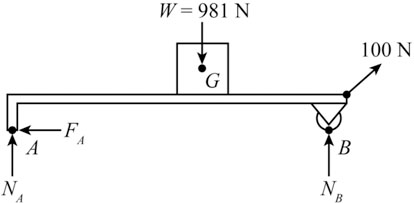
One of the essential thingis to know in order to draw the free body diagram is nature of the supports. External forces acting on object and weight of the object are considered in the free body diagram.
The free body diagram of object AB is as follows:
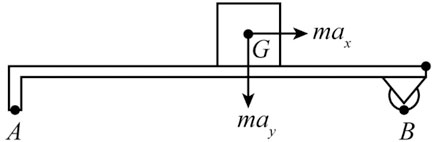
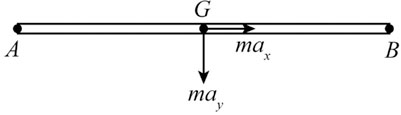
One of the essential part in kinetic diagram is to analyze the motion of element is restricted somehow. This diagram utilized the equation of motion, acceleration of center of mass and angular acceleration of the object.
In the given figure, the motion of the load is prevented in y-direction, so the vertical component will be equivalent to zero.
The kinetic diagram of object AB is as follows:
Step 3
(b)
To find the weight, we will use the relation,
\[\begin{array}{l} W = mg\\ W = \left( {100\;{\rm{kg}}} \right)\left( {9.81\;{\rm{m/}}{{\rm{s}}^2}} \right)\\ W = \left( {981\;{\rm{kg}} \cdot {\rm{m/}}{{\rm{s}}^2} \times \frac{{1\;{\rm{N}}}}{{1\;{\rm{kg}} \cdot {\rm{m/}}{{\rm{s}}^2}}}} \right)\\ W = 981\;{\rm{N}} \end{array}\]Here, $g$ is the gravitational acceleration.
The free body diagram of object AB is as follows:
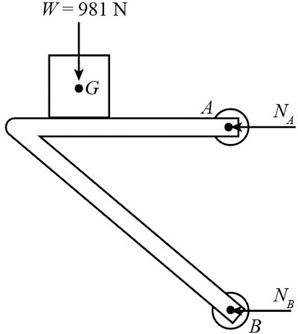
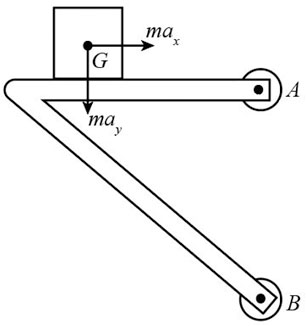
In the given figure, the motion of the load is prevented in x-direction, so the horizontal component will be equivalent to zero.
The kinetic diagram of object AB is as follows:
Step 4
(c)
To find the weight we will use the relation,
\[\begin{array}{l} W = mg\\ W = \left( {100\;{\rm{kg}}} \right)\left( {9.81\;{\rm{m/}}{{\rm{s}}^2}} \right)\\ W = \left( {981\;{\rm{kg}} \cdot {\rm{m/}}{{\rm{s}}^2} \times \frac{{1\;{\rm{N}}}}{{1\;{\rm{kg}} \cdot {\rm{m/}}{{\rm{s}}^2}}}} \right)\\ W = 981\;{\rm{N}} \end{array}\]Here, $g$ is the gravitational acceleration.
The free body diagram of object AB is as follows:
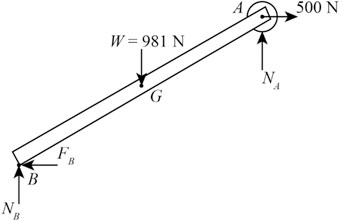
Here, ${F_B}$ is the force exerting on point B.
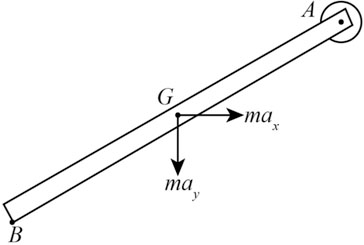
In the given figure, the motion of the load is prevented in y-direction, so the vertical component will be equivalent to zero.
The kinetic diagram of object AB is as follows:
Step 5
(d)
To find the weight we will use the relation,
\[\begin{array}{l} W = mg\\ W = \left( {100\;{\rm{kg}}} \right)\left( {9.81\;{\rm{m/}}{{\rm{s}}^2}} \right)\\ W = \left( {981\;{\rm{kg}} \cdot {\rm{m/}}{{\rm{s}}^2} \times \frac{{1\;{\rm{N}}}}{{1\;{\rm{kg}} \cdot {\rm{m/}}{{\rm{s}}^2}}}} \right)\\ W = 981\;{\rm{N}} \end{array}\]Here, $g$ is the gravitational acceleration.
The free body diagram of object AB is as follows:
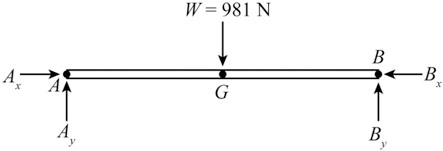
The motion of the member AB is translational, therefore the acceleration at point G is equivalent to acceleration at point A.
The kinetic diagram of object AB is as follows:
Step 6
(e)
To find the weight we will use the relation,
\[\begin{array}{l} W = mg\\ W = \left( {100\;{\rm{kg}}} \right)\left( {9.81\;{\rm{m/}}{{\rm{s}}^2}} \right)\\ W = \left( {981\;{\rm{kg}} \cdot {\rm{m/}}{{\rm{s}}^2} \times \frac{{1\;{\rm{N}}}}{{1\;{\rm{kg}} \cdot {\rm{m/}}{{\rm{s}}^2}}}} \right)\\ W = 981\;{\rm{N}} \end{array}\]Here, $g$ is the gravitational acceleration.
The free body diagram of object AB is as follows:
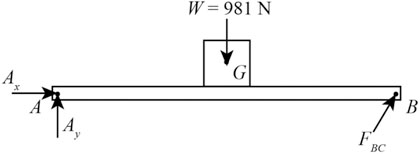
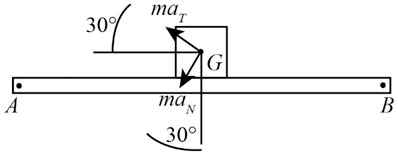
The normal acceleration is parallel to the member connected to A and it is directed towards the origin. The tangential component is perpendicular to the normal acceleration.
The kinetic diagram of object AB is as follows:
Step 7
(f)
To find the weight we will use the relation,
\[\begin{array}{l} W = mg\\ W = \left( {100\;{\rm{kg}}} \right)\left( {9.81\;{\rm{m/}}{{\rm{s}}^2}} \right)\\ W = \left( {981\;{\rm{kg}} \cdot {\rm{m/}}{{\rm{s}}^2} \times \frac{{1\;{\rm{N}}}}{{1\;{\rm{kg}} \cdot {\rm{m/}}{{\rm{s}}^2}}}} \right)\\ W = 981\;{\rm{N}} \end{array}\]Here, $g$ is the gravitational acceleration.
The free body diagram of object AB is as follows:
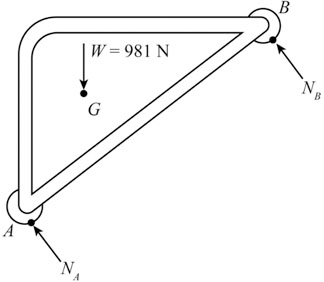
In the given figure, the motion of the load is prevented in y-direction, so the vertical component will be equivalent to zero.
The kinetic diagram of object AB is as follows: