Engineering Mechanics: Statics and Dynamics, 14th Edition
Authors: Russell C. Hibbeler
ISBN-13: 978-0133915426
See our solution for Question 62P from Chapter 17 from Hibbeler's Engineering Mechanics.
Problem 62P
Step-by-Step Solution
We are given the weight of the bar is $W = 10\;{\rm{lb}}$, the stiffness of the spring is $k = 5\;{\rm{lb}} \cdot {\rm{ft/rad}}$, and the magnitude of torque developed is $M = \left( {5\theta } \right)\;{\rm{lb}} \cdot {\rm{ft}}$.
We are asked to determine the angular velocity of the bar at the instant $\theta = 0^\circ $.
Step 2
The free body diagram of the system is shown as:
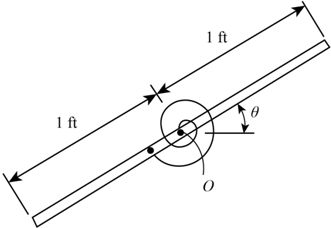
We have the length of the bar is $L = 1\;{\rm{ft}} + 1\;{\rm{ft}} = 2\;{\rm{ft}}$.
We have the initial angle of the bar is ${\theta _1} = 90^\circ \times \frac{{\pi \;{\rm{rad}}}}{{180^\circ }} = \frac{\pi }{2}\;{\rm{rad}}$.
We have the final angle of the bar is ${\theta _2} = 0^\circ \times \frac{{\pi \;{\rm{rad}}}}{{180^\circ }} = 0\;{\rm{rad}}$.
Step 3
The formula to calculate the moment of inertia about the point O is,
\[\begin{array}{l} {I_O} = \frac{{m{L^2}}}{{12}}\\ {I_O} = \frac{{W{L^2}}}{{12g}} \end{array}\]Here, g is the gravitational acceleration having a standard value of $32.2\;{\rm{ft/}}{{\rm{s}}^2}$.
Step 4
Substitute the values in the above expression.
\[\begin{array}{l} {I_O} = \frac{{\left( {10\;{\rm{lb}}} \right){{\left( {2\;{\rm{ft}}} \right)}^2}}}{{12\left( {32.2\;{\rm{ft/}}{{\rm{s}}^2}} \right)}}\\ {I_O} = 0.1035\;{\rm{lb}} \cdot {\rm{ft}} \cdot {{\rm{s}}^2} \end{array}\]Step 5
The formula to calculate the angular acceleration of the ball is,
\[ - M = {I_O}\alpha \]Step 6
Substitute the values in the above expression.
\[\begin{array}{c} - \left( {5\theta } \right)\;{\rm{lb}} \cdot {\rm{ft}} = \left( {0.1035\;{\rm{lb}} \cdot {\rm{ft}} \cdot {{\rm{s}}^2}} \right)\alpha \\ \alpha = - 48.3\theta \;{\rm{rad/}}{{\rm{s}}^2} \end{array}\]Step 7
The formula to calculate the angular velocity of the bar by kinematics is,
\[\alpha d\theta = \omega d\omega \]Step 8
On integrating the above expression, we get:
\[\int\limits_{{\theta _1}}^{{\theta _2}} \alpha d\theta = \int\limits_0^\omega \omega d\omega \]Step 9
Substitute the values in the above expression.
\[\begin{array}{c} \int\limits_{\frac{\pi }{2}}^0 {\left( { - 48.3\theta } \right)} d\theta = \int\limits_0^\omega \omega d\omega \\ \left[ { - 48.3\frac{{{\theta ^2}}}{2}} \right]_{\frac{\pi }{2}}^0 = \left[ {\frac{{{\omega ^2}}}{2}} \right]_0^\omega \\ \left[ {0 - \left( { - 48.3\frac{{{{\left( {\frac{\pi }{2}} \right)}^2}}}{2}} \right)} \right] = \left[ {\frac{{{\omega ^2}}}{2} - 0} \right]\\ \omega = 10.9\;{\rm{rad/s}} \end{array}\]