Engineering Mechanics: Statics and Dynamics, 14th Edition
Authors: Russell C. Hibbeler
ISBN-13: 978-0133915426
See our solution for Question 68P from Chapter 17 from Hibbeler's Engineering Mechanics.
Problem 68P
Step-by-Step Solution
We are given the mass of the steel plate is $m = 100\;{\rm{kg}}$ and the mass of concrete block is $M = 200\;{\rm{kg}}$.
We are asked to determine the moment of inertia of the plate and block about the hinged axis through A. Also, the initial angular acceleration of the assembly when it is released from rest at $\theta = 45^\circ $.
Step 2
The free body diagram of the system is shown as:
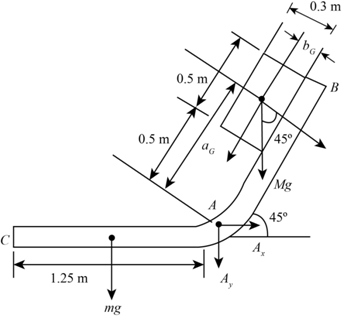
We have the width of the concrete block is $a = 0.5\;{\rm{m}}$.
We have the height of the concrete block is $b = 0.3\;{\rm{m}}$.
We have the distance between point A and center of gravity of concrete block is ${a_G} = 0.5\;{\rm{m}} + \frac{{0.5\;{\rm{m}}}}{2} = 0.75\;{\rm{m}}$.
We have the distance between point B and center of gravity of concrete block is ${b_G} = \frac{{0.3\;{\rm{m}}}}{2} = 0.15\;{\rm{m}}$.
We have the length of the plate is $L = 1.25\;{\rm{m}}$.
We have the angle of inclination is $\theta = 45^\circ $.
Step 3
The formula to calculate the mass moment of inertia of the block about the point A is,
\[\begin{array}{l} {I_b} = {I_G} + M{\left( {\sqrt {{{\left( {{a_G}} \right)}^2} + {{\left( {{b_G}} \right)}^2}} } \right)^2}\\ {I_b} = \frac{{M\left( {{a^2} + {b^2}} \right)}}{{12}} + M{\left( {\sqrt {{{\left( {{a_G}} \right)}^2} + {{\left( {{b_G}} \right)}^2}} } \right)^2} \end{array}\]Step 4
Substitute the values in the above expression.
\[\begin{array}{l} {I_b} = \frac{{\left( {200\;{\rm{kg}}} \right)\left[ {{{\left( {0.5\;{\rm{m}}} \right)}^2} + {{\left( {0.3\;{\rm{m}}} \right)}^2}} \right]}}{{12}} + \left( {200\;{\rm{kg}}} \right){\left( {\sqrt {{{\left( {0.75\;{\rm{m}}} \right)}^2} + {{\left( {0.15\;{\rm{m}}} \right)}^2}} } \right)^2}\\ {I_b} = 122.66\;{\rm{kg}} \cdot {{\rm{m}}^2} \end{array}\]Step 5
The formula to calculate the moment of inertia of the plate about the point A is,
\[{I_P} = \frac{1}{2}m{L^2} + m{\left( {\frac{L}{2}} \right)^2}\]Step 6
Substitute the values in the above expression.
\[\begin{array}{l} {I_P} = \frac{1}{2}\left( {100\;{\rm{kg}}} \right){\left( {1.25\;{\rm{m}}} \right)^2} + \left( {100\;{\rm{kg}}} \right){\left( {\frac{{1.25\;{\rm{m}}}}{2}} \right)^2}\\ {I_P} = 52.10\;{\rm{kg}} \cdot {{\rm{m}}^2} \end{array}\]Step 7
The formula to calculate the moment of inertia of the system about the point A is,
\[{I_A} = {I_b} + {I_P}\]Step 8
Substitute the values in the above expression.
\[\begin{array}{l} {I_A} = 122.66\;{\rm{kg}} \cdot {{\rm{m}}^2} + 52.10\;{\rm{kg}} \cdot {{\rm{m}}^2}\\ {I_A} = 174.76\;{\rm{kg}} \cdot {{\rm{m}}^2} \end{array}\]Step 9
The formula to calculate the angular acceleration of the plate is,
\[mg\left( {\frac{L}{2}} \right) + Mg\sin \theta \left( {{b_G}} \right) - Mg\cos \theta \left( {{a_G}} \right) = - {I_A}\alpha \]Here, g is the gravitational acceleration, having a standard value of $9.81\;{\rm{m/}}{{\rm{s}}^2}$.
Step 10
Substitute the values in the above expression.
\[\begin{array}{c} \left[ \begin{array}{c} \left( {100\;{\rm{kg}}} \right)\left( {9.81\;{\rm{m/}}{{\rm{s}}^2}} \right)\left( {\frac{{1.25\;{\rm{m}}}}{2}} \right)\\ + \left( {200\;{\rm{kg}}} \right)\left( {9.81\;{\rm{m/}}{{\rm{s}}^2}} \right)\left( {\sin 45^\circ } \right)\left( {0.15\;{\rm{m}}} \right)\\ - \left( {200\;{\rm{kg}}} \right)\left( {9.81\;{\rm{m/}}{{\rm{s}}^2}} \right)\left( {\cos 45^\circ } \right)\left( {0.75\;{\rm{m}}} \right) \end{array} \right] = - \left( {174.76\;{\rm{kg}} \cdot {{\rm{m}}^2}} \right)\alpha \\ - 219.30\;{\rm{kg}} \cdot {{\rm{m}}^{\rm{2}}}{\rm{/}}{{\rm{s}}^{\rm{2}}} = - \left( {174.76\;{\rm{kg}} \cdot {{\rm{m}}^2}} \right)\alpha \\ \alpha = 1.25\;{\rm{rad/}}{{\rm{s}}^2} \end{array}\]