Engineering Mechanics: Statics and Dynamics, 14th Edition
Authors: Russell C. Hibbeler
ISBN-13: 978-0133915426
See our solution for Question 93P from Chapter 17 from Hibbeler's Engineering Mechanics.
Problem 93P
Step-by-Step Solution
We are given the mass as $m = 12\;{\rm{kg}}$, angular velocity $\omega = 2\;{\rm{rad/s}}$, length of the beam as $L = 3\,{\rm{m}}$.
We are asked to determine theangular acceleration and the normal reactions of the smooth surface A and B.
Step 2
The free body diagram of the slender bar is as follows:
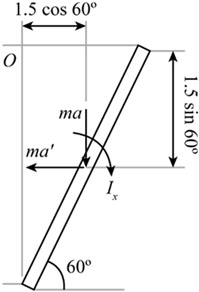
To find the mass moment of inertia, we will use the relation,
\[\begin{array}{c} I = \frac{1}{{12}}m{L^2}\\ I = \frac{1}{{12}}\left( {12\;{\rm{kg}}} \right){\left( {3\;{\rm{m}}} \right)^2}\\ I = 9\;{\rm{kg}} \cdot {{\rm{m}}^2} \end{array}\]Step 3
Now, we can consider the normal reactions at point A and B, the free-body diagram of the slender bar is as follows:
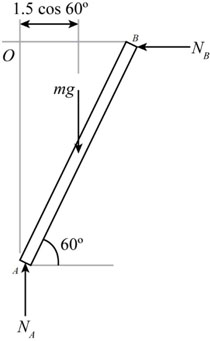
To find the force in x-direction, we will use the relation,
\[\begin{array}{c} \Sigma {F_x} = ma'\\ {N_B} = ma'\\ {N_B} = \left( {12\;{\rm{kg}}} \right)a' \end{array}\] … (1)To find the force in y-direction, we will use the relation,
\[\begin{array}{c} \Sigma {F_y} = ma\\ {N_A} - W = ma\\ {N_A} - mg = \left( {12\,{\rm{kg}}} \right)a\\ {N_A} - \left( {12\,{\rm{kg}}} \right)\left( {9.81\,{\rm{m/}}{{\rm{s}}^2}} \right) = \left( {12\,{\rm{kg}}} \right)a\\ {N_A} - \left( {117.72\,{\rm{kg}} \cdot {\rm{m/}}{{\rm{s}}^2}} \right) = \left( {12\,{\rm{kg}}} \right)a \end{array}\] …. (2)Step 4
To find the moment, we will use the relation,
\[\begin{array}{c} \Sigma {M_0} = \Sigma {M_G}\\ W\left( {{d_1}\cos 60^\circ } \right) = - ma'\left( {{d_1}\sin 60^\circ } \right) - ma\left( {{d_1}\cos 60^\circ } \right) - I\alpha \end{array}\]Here, ${d_1}$ is the distance from point A to centre of mass G.
On plugging the values in the above relation, we get,
\[\begin{array}{c} \left( {12\;{\rm{kg}} \times 9.81\;{\rm{m/}}{{\rm{s}}^2}} \right)\left( {1.5\cos 60^\circ } \right) = \left[ \begin{array}{l} - \left( {12\;{\rm{kg}}} \right)a'\left( {1.5\sin 60^\circ } \right)\\ - \left( {12\;{\rm{kg}}} \right)a\left( {1.5\cos 60^\circ } \right) - \left( {12\;{\rm{kg}} \cdot {\rm{m/s}}} \right)\alpha \end{array} \right]\\ \sqrt 3 a' + 3a + \alpha = 9.81 \end{array}\] …. (3)Step 5
To find the acceleration, we will use the relation,
\[\begin{array}{c} {{\vec a}_G} = {{\vec a}_B} + \vec \alpha {{\vec r}_{GB}} - {{\vec \omega }^2}{{\vec r}_{GB}}\\ - a'\hat i - a\hat j = - {a_B}\hat j - \left( {\alpha \hat k} \right)\left( { - {d_1}\cos 60^\circ \hat i - {d_1}\sin 60^\circ \hat j} \right) - {\left( 2 \right)^2}\left( { - {d_1}\cos 60^\circ \hat i - {d_1}\sin 60^\circ \hat j} \right)\\ - a'\hat i - a\hat j = \left( {3 - 0.75\sqrt 3 \alpha } \right)\hat i + \left( {0.75\alpha - {a_B} + 3\sqrt 3 } \right)\hat j \end{array}\]On equating the components of $\hat i$, we get,
\[ - a' = \left( {3 - 0.75\sqrt 3 \alpha } \right)\] … (4)On equating the components of $\hat j$, we get,
\[ - a = \left( {0.75\alpha - {a_B} + 3\sqrt 3 } \right)\] … (5)Step 6
On applying the relative acceleration equation, we get,
\[\begin{array}{c} {{\vec a}_A} = {{\vec a}_B} + \vec \alpha {{\vec r}_{AB}} - {{\vec \omega }^2}{{\vec r}_{AB}}\\ - {a_A}\hat i = \left[ \begin{array}{l} - {a_B}\hat j - \left( {\alpha \hat k} \right)\left( { - L\cos 60^\circ \hat i - L\sin 60^\circ \hat j} \right) - \\ {\left( 2 \right)^2}\left( { - L\cos 60^\circ \hat i - L\sin 60^\circ \hat j} \right) \end{array} \right]\\ - {a_A}\hat i = \left[ \begin{array}{l} - {a_B}\hat j - \left( {\alpha \hat k} \right)\left( { - \left( {3\,{\rm{m}}} \right)\cos 60^\circ \hat i - \left( {3\,{\rm{m}}} \right)\sin 60^\circ \hat j} \right) - \\ {\left( 2 \right)^2}\left( { - \left( {3\,{\rm{m}}} \right)\cos 60^\circ \hat i - \left( {3\,{\rm{m}}} \right)\sin 60^\circ \hat j} \right) \end{array} \right]\\ - {a_A}\hat i = \left( {6 - 1.5\sqrt 3 \alpha } \right)\hat i + \left( {1.5\alpha - {a_B} + 6\sqrt 3 } \right)\hat j \end{array}\]On equating the components of $\hat j$, we get,
\[\begin{array}{c} 0 = \left( {1.5\alpha - {a_B} + 6\sqrt 3 } \right)\\ {a_B} = 1.5\alpha + 6\sqrt 3 \end{array}\]On plugging the values in the equation (5), we get,
\[\begin{array}{c} - a = \left( {0.75\alpha - \left( {1.5\alpha + 6\sqrt 3 } \right) + 3\sqrt 3 } \right)\\ a = \left( {0.75\alpha + 3\sqrt 3 } \right) \end{array}\]…... (6)Step 7
On plugging the values in the equation (3), we get,
\[\begin{array}{c} \sqrt 3 \left( { - \left( {3 - 0.75\sqrt 3 \alpha } \right)} \right) + 3\left( {0.75\alpha + 3\sqrt 3 } \right) + \alpha = 9.81\\ \sqrt 3 \left( {0.75\sqrt 3 \alpha - 3} \right) + 3\left( {0.75\alpha + 3\sqrt 3 } \right) + \alpha = 9.81\\ \alpha = 2.45\,{\rm{rad/}}{{\rm{s}}^2} \end{array}\]On plugging the values in the equation (6), we get,
\[\begin{array}{l} a = \left( {0.75\left( {2.45\,{\rm{rad/}}{{\rm{s}}^2}} \right) + 3\sqrt 3 } \right)\\ a = 7.03\,{\rm{m/}}{{\rm{s}}^2} \end{array}\]On plugging the values in the equation (4), we get,
\[\begin{array}{c} - a' = \left( {3 - 0.75\sqrt 3 \left( {2.45\,{\rm{rad/}}{{\rm{s}}^2}} \right)} \right)\\ a' = 0.18\;{\rm{m/}}{{\rm{s}}^2} \end{array}\]Step 8
On plugging the values in the equation (1), we get,
\[\begin{array}{c} {N_B} = \left( {12\;{\rm{kg}}} \right)\left( {0.18\;{\rm{m/}}{{\rm{s}}^2}} \right)\\ {N_B} = 2.16\;{\rm{N}} \end{array}\]On plugging the values in the equation (2), we get,
\[\begin{array}{c} {N_A} - \left( {117.72\,{\rm{kg}} \cdot {\rm{m/}}{{\rm{s}}^2}} \right) = - \left( {12\,{\rm{kg}}} \right)\left( {7.03\;{\rm{m/}}{{\rm{s}}^2}} \right)\\ {N_A} = 33.36\;{\rm{N}} \end{array}\]