Engineering Mechanics: Statics and Dynamics, 14th Edition
Authors: Russell C. Hibbeler
ISBN-13: 978-0133915426
See our solution for Question 14P from Chapter 18 from Hibbeler's Engineering Mechanics.
Problem 14P
Step-by-Step Solution
We are given the following data:
The mass of the slender rod is $m = 10\;{\rm{kg}}$.
The value of force is $F = 150\;{\rm{N}}$.
The value of $\theta $ is $\theta = 180^\circ $.
The length of the rod is $l = 3\;{\rm{m}}$.
We are asked to determine the angular velocity of the rod when it has rotates $180^\circ $ clockwise from the position shown.
Step 2
We will draw the free-body diagram of the rod.
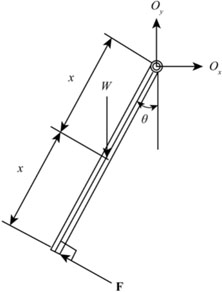
Here, $W$ represent the weight of the rod and ${O_x}$ and ${O_y}$ are the horizontal and vertical reaction force at point $O$.
Step 3
The formula to calculate the distance $x$is given by,
\[x = \frac{l}{2}\]Substitute all the known values in the above formula.
\[\begin{array}{c} x = \left( {\frac{{3\;{\rm{m}}}}{2}} \right)\\ = 1.5\;{\rm{m}} \end{array}\]Step 4
Since the rod starts from rest then, ${T_1} = 0$.
The formula to calculate the mass moment of inertia of the rod about $O$ is given by,
\[{I_O} = \left[ {\frac{1}{{12}}m{l^2} + m{x^2}} \right]\]Substitute all the known values in the above formula.
\[\begin{array}{c} {I_O} = \left[ {\frac{1}{{12}}\left( {10\;{\rm{kg}}} \right){{\left( {3\;{\rm{m}}} \right)}^2} + \left( {10\;{\rm{kg}}} \right){{\left( {1.5\;{\rm{m}}} \right)}^2}} \right]\\ = 30.0\;{\rm{kg}} \cdot {{\rm{m}}^{\rm{2}}} \end{array}\]Step 5
The formula to calculate the value of ${T_2}$ is given by,
\[{T_2} = \frac{1}{2}{I_O}{\omega ^2}\]Here, $\omega $ represent the angular velocity of the rod.
Substitute all the known values in the above formula.
\[\begin{array}{c} {T_2} = \frac{1}{2}\left( {30\;{\rm{kg}} \cdot {{\rm{m}}^{\rm{2}}}} \right){\omega ^2}\\ = \left( {15\;{\rm{kg}} \cdot {{\rm{m}}^{\rm{2}}}} \right){\omega ^2} \end{array}\]Step 6
The force ${\bf{F}}$ work positive when the rod undergoes an angular displacement $\theta $ whereas $W$ does negative work. When $\theta = 180^\circ $, the displacement due to the weight of the rod is,
\[{S_W} = l\]Substitute all the known values in the above formula.
\[{S_W} = 3\;{\rm{m}}\]Step 7
The formula to calculate the displacement due to force $F$ is given by,
\[{S_F} = \left( \theta \right)\left( l \right)\]Substitute all the known values in the above formula.
\[\begin{array}{c} {S_F} = \left( {\pi \;{\rm{rad}}} \right)\left( {3\,{\rm{m}}} \right)\\ = \left( {3\pi } \right)\;{\rm{m}} \end{array}\]Step 8
The formula to calculate the work done by the force is given by,
\[{U_F} = \left( {{S_F}} \right)\left( F \right)\]Substitute all the known values in the above formula.
\[\begin{array}{c} {U_F} = \left( {3\pi \;{\rm{m}}} \right)\left( {150\;{\rm{N}}} \right)\\ = \left( {450\pi } \right)\;{\rm{J}} \end{array}\]Step 9
The formula to calculate the work done by the weight force is given by,
\[{U_W} = - \left( {mg{S_W}} \right)\]Here, $g$ represent the gravitational acceleration $\left( {g = 9.81\;{\rm{m/}}{{\rm{s}}^{\rm{2}}}} \right)$.
Substitute all the known values in the above formula.
\[\begin{array}{c} {U_W} = - \left( {10\;{\rm{kg}}} \right)\left( {9.81\;{\rm{m/}}{{\rm{s}}^{\rm{2}}}} \right)\left( {3\;{\rm{m}}} \right)\\ = - 294.3\;{\rm{J}} \end{array}\]Step 10
We will apply the principle of work and energy on the rod system.
\[\begin{array}{c} {T_1} + \sum {{U_{1 - 2}}} = {T_2}\\ \left[ {{T_1} + {U_F} + {U_W}} \right] = {T_2} \end{array}\]Substitute all the known values in the above formula.
\[\begin{array}{c} \left[ {0 + \left( {450\pi \;{\rm{J}}} \right) + \left( { - 294.3\;{\rm{J}}} \right)} \right] = \left( {15\;{\rm{kg}} \cdot {{\rm{m}}^{\rm{2}}}} \right){\omega ^2}\\ {\omega ^2} = \frac{{\left( {1119.4167\;{\rm{J}}} \right)}}{{\left( {15\;{\rm{kg}} \cdot {{\rm{m}}^{\rm{2}}}} \right)}}\\ \omega \approx 8.64\;{\rm{rad/s}} \end{array}\]