Engineering Mechanics: Statics and Dynamics, 14th Edition
Authors: Russell C. Hibbeler
ISBN-13: 978-0133915426
See our solution for Question 3FP from Chapter 18 from Hibbeler's Engineering Mechanics.
Problem 3FP
Step-by-Step Solution
We are given a uniform slender rod at rest in the position shown in the diagram.
The mass of the rod is $m = 50{\rm{ kg}}$.
Force applied to the rod is $P = 600{\rm{ N}}$.
We are asked to determine the angular velocity of the rod when the rod reaches the vertical position.
Step 2
The free-body diagram of the rod at the instant is given below:
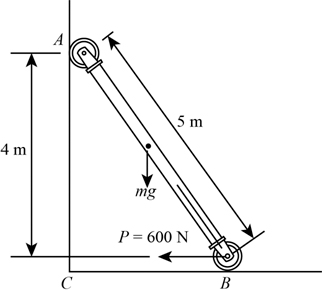
Using the Pythagoras theorem, the distance $BC$ is given by,
\[\begin{array}{l} BC = \sqrt {A{B^2} - A{C^2}} \\ BC = \sqrt {{{\left( {5{\rm{ m}}} \right)}^2} - {{\left( {4{\rm{ m}}} \right)}^2}} \\ BC = 3{\rm{ m}} \end{array}\]Step 3
Using the relation between the linear velocity and the angular velocity, the expression for the linear velocity of the center of mass of the rod $AB$ with respect to the end $B$ is given by,
\[\begin{array}{c} {\left( {{v_G}} \right)_2} = {\omega _2}\left( {\frac{{AB}}{2}} \right)\\ {\left( {{v_G}} \right)_2} = {\omega _2}\left( {\frac{5}{2}} \right)\\ {\left( {{v_G}} \right)_2} = \left( {2.5{\omega _2}} \right){\rm{ m/s}} \end{array}\]Here, ${\omega _2}$ is the final angular velocity of the rod.
Step 4
The moment of inertia of the slender rod about its center of gravity is given by,
\[\begin{array}{c} {I_G} = \frac{1 }{{12}}m{\left( {AB} \right)^2}\\ {I_G} = \frac{1}{{12}}\left( {50{\rm{ kg}}} \right){\left( {5{\rm{ m}}} \right)^2}\\ {I_G} = 104.17{\rm{ kg}} \cdot {{\rm{m}}^2} \end{array}\]Step 5
The expression for the initial kinetic energy of the rod is given by,
\[{T_1} = \frac{1}{2}m{\left( {{v_G}} \right)_1}^2\]At initial condition, there is no movement of the rod, so the initial velocity of the rod will be zero ${\left( {{v_G}} \right)_1} = 0$.
\[\begin{array}{l} {T_1} = \frac{1}{2}m{\left( 0 \right)^2}\\ {T_1} = 0 \end{array}\]Step 6
The expression for the final kinetic energy of the rod is given by,
\[{T_2} = \frac{1}{2}m{\left( {{v_G}} \right)_2}^2 + \frac{1}{2}{I_G}{\omega _2}^2\]Substituting the values in the above expression, we get,
\[\begin{array}{c} {T_2} = \frac{1}{2}\left( {50} \right){\left( {2.5{\omega _2}} \right)^2} + \frac{1}{2}\left( {104.17} \right){\omega _2}^2\\ {T_2} = 208.33{\omega _2}^2 \end{array}\]Step 7
The energy required to move the point $B$ to the final position $C$ by the force $P$ is given by,
\[\begin{array}{c} {U_P} = P \times BC\\ {U_P} = 600 \times \left( 3 \right)\\ {U_P} = 1800{\rm{ J}} \end{array}\]The gravitational potential energy required to move the center of gravity of the rod in the vertical position is given by,
\[\begin{array}{c} {U_W} = - mg\left( {\frac{{AB}}{2} - \frac{{AC}}{2}} \right)\\ {U_W} = - \left( {50} \right)\left( {9.81} \right)\left( {\frac{5}{2} - \frac{4}{2}} \right)\\ {U_W} = - \left( {50} \right)\left( {9.81} \right)\left( {2.5 - 2} \right)\\ {U_W} = - 245.25{\rm{ J}} \end{array}\]Step 8
Now applying the conservation of energy principle, we get,
\[\begin{array}{c} {T_1} + \left( {{U_P} + {U_W}} \right) = {T_2}\\ 0 + 1800 + \left( { - 245.25} \right) = 208.33{\omega _2}^2\\ {\omega _2}^2 = \left( {\frac{{1554.75}}{{208.33}}} \right)\\ {\omega _2} = 2.732{\rm{ rad/s}} \end{array}\]