Engineering Mechanics: Statics and Dynamics, 14th Edition
Authors: Russell C. Hibbeler
ISBN-13: 978-0133915426
See our solution for Question 19P from Chapter 19 from Hibbeler's Engineering Mechanics.
Problem 19P
Step-by-Step Solution
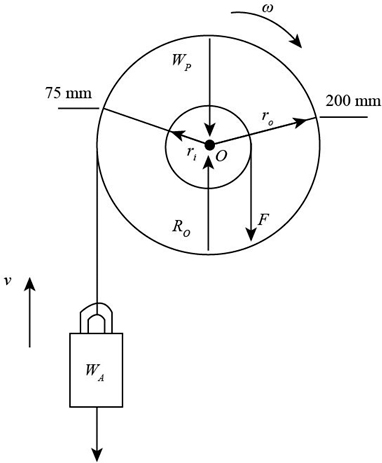
We are given the mass of the pulley as $m = 15\,{\rm{kg}}$, the radius of the gyration as ${k_O} = 110\,{\rm{mm}}$, the mass of block $A$ as ${m_A} = 40\,{\rm{kg}}$, the time of observation as $t = 3\,{\rm{s}}$, the force applied to the rope as $F = 2\,{\rm{kN}}$, the smaller radius of inner hub as ${r_i} = 75\,{\rm{mm}}$, and the larger radius of the outer hub of the pulley as ${r_o} = 200\,{\rm{mm}}$.
We are asked to determine the speed of the block in $3\,{\rm{s}}$.
Step 2
The free body diagram of the system can be drawn as shown below.
Step 3
Find the moment of the given system about $O$ using the following relation.
\[{M_O} = \left( {F \times {r_i}} \right) - \left( {{W_A} \times {r_o}} \right)\]On substituting the known values in the above equation we get,
\[\begin{array}{c} {M_O} = \left( {\left( {2\,{\rm{kN}}} \right) \times \left( {75\,{\rm{mm}}} \right)} \right) - \left( {\left( {40\,{\rm{kg}}} \right)\left( {9.81\,{\rm{m/}}{{\rm{s}}^{\rm{2}}}} \right) \times \left( {200\,{\rm{mm}} \times \left( {\frac{{{{10}^{ - 3}}\,{\rm{m}}}}{{1\,{\rm{mm}}}}} \right)} \right)} \right)\\ = \left( {150\,{\rm{kN}} \cdot {\rm{mm}}} \right) \times \left( {\frac{{1{\rm{N}} \cdot {\rm{m}}}}{{1\,{\rm{kN}} \cdot {\rm{mm}}}}} \right) - \left( {78.48\,{\rm{kg}} \cdot {{\rm{m}}^2}{\rm{/}}{{\rm{s}}^2}} \right) \times \left( {\frac{{1\,{\rm{N}} \cdot {\rm{m}}}}{{1\,{\rm{kg}} \cdot {{\rm{m}}^2}{\rm{/}}{{\rm{s}}^2}}}} \right)\\ = 71.52\,{\rm{N}} \cdot {\rm{m}} \end{array}\]Step 4
Find the moment of inertia of the pulley using the following relation.
\[I = mk_O^2\]On substituting the known values in the above equation we get,
\[\begin{array}{c} I = \left( {15\,{\rm{kg}}} \right){\left( {110\,{\rm{mm}}} \right)^2}\\ = \left( {181500\,{\rm{kg}} \cdot {\rm{m}}{{\rm{m}}^2}} \right) \times \left( {\frac{{{{10}^{ - 6}}\,{\rm{kg}} \cdot {{\rm{m}}^2}}}{{1\,{\rm{kg}} \cdot {\rm{m}}{{\rm{m}}^2}}}} \right)\\ = 0.182\,{\rm{kg}} \cdot {{\rm{m}}^2} \end{array}\]Step 5
Find the final angular momentum using the following relation.
\[{\left( {{H_O}} \right)_2} = I{\omega _2} + {m_A}{\omega _2}r_o^2\]On substituting the known values in the above equation we get,
\[\begin{array}{c} {\left( {{H_O}} \right)_2} = \left( {0.182\,{\rm{kg}} \cdot {{\rm{m}}^2}} \right){\omega _2} + \left( {40\,{\rm{kg}}} \right){\omega _2}{\left( {200\,{\rm{mm}} \times \left( {\frac{{{{10}^{ - 3}}\,{\rm{m}}}}{{1\,{\rm{mm}}}}} \right)} \right)^2}\\ = \left[ {\left( {0.182\,{\rm{kg}} \cdot {{\rm{m}}^2}} \right) + \left( {1.6\,{\rm{kg}} \cdot {{\rm{m}}^{\rm{2}}}} \right)} \right]{\omega _2}\\ = \left( {1.782\,{\rm{kg}} \cdot {{\rm{m}}^2}} \right){\omega _2}\,......\left( 1 \right) \end{array}\]Step 6
As pulley is initially at rest, the angular moment at initial stage is zero $\left( {{{\left( {{H_O}} \right)}_1} = 0} \right)$.
Find the final angular velocity of the pulley using the following relation.
\[{\left( {{H_O}} \right)_1} + \int\limits_0^t {{M_O}dt} = {\left( {{H_O}} \right)_2}\]On integrating the above equation we get,
\[\begin{array}{c} {\left( {{H_O}} \right)_1} + {M_O}\left[ t \right]_0^t = {\left( {{H_O}} \right)_2}\\ {\left( {{H_O}} \right)_1} + {M_O}\left( t \right) = {\left( {{H_O}} \right)_2} \end{array}\]On substituting the known values in the above equation we get,
\[\begin{array}{c} 0 + \left( {71.52\,{\rm{N}} \cdot {\rm{m}} \times \left( {\frac{{1\,{\rm{kg}} \cdot {{\rm{m}}^{\rm{2}}}{\rm{/}}{{\rm{s}}^{\rm{2}}}}}{{1\,{\rm{N}} \cdot {\rm{s}}}}} \right)} \right)\left( {3\,{\rm{s}}} \right) = \left( {1.782{\rm{kg}} \cdot {{\rm{m}}^2}} \right){\omega _2}\\ {\omega _2} = 120.4\,{\rm{rad/s}} \end{array}\]Step 7
Find the velocity of the block using the following relation.
\[{v_A} = {\omega _2}{r_O}\]On substituting the known values in the above equation we get,
\[\begin{array}{c} {v_A} = \left( {120.4\,{\rm{rad/s}}} \right)\left( {200\,{\rm{mm}}} \right)\\ = \left( {24080\,{\rm{mm/s}}} \right) \times \left( {\frac{{{{10}^{ - 3}}\,{\rm{m}}}}{{1\,{\rm{mm}}}}} \right)\\ = 24.08\,{\rm{m/s}} \end{array}\]