Engineering Mechanics: Statics and Dynamics, 14th Edition
Authors: Russell C. Hibbeler
ISBN-13: 978-0133915426
See our solution for Question 46P from Chapter 19 from Hibbeler's Engineering Mechanics.
Problem 46P
Step-by-Step Solution
We are given the following data:
The value of height is $h$.
The mass of the billiard ball is $m$.
The radius of the ball is $r$.
The initial velocity of the ball is ${v_1} = 0$. (Since start from rest)
We are asked to determine the height $h$ at which a billiard ball of mass $m$ must be struck so that no frictional force develops between it and the table at $A$.
Step 2
We will draw the free-body diagram of the ball.
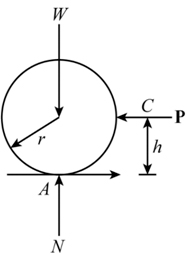
Here, $W$ represent the weight of the ball and $N$ represent the normal reaction force.
Step 3
We will apply the principle of linear impulse and momentum on the billiard ball.
\[\begin{array}{c} m{v_1} + \sum {\int {Fdt} } = m{v_2}\\ m{v_1} + {\bf{P}}\Delta t = m{v_2} \end{array}\]Here, ${v_2}$ represent the final velocity of the ball.
Substitute all the known values in the above equation.
\[\begin{array}{c} m\left( 0 \right) + {\bf{P}}\Delta t = m{v_2}\\ {\bf{P}}\Delta t = m{v_2}\\ {\bf{P}} = \frac{{m{v_2}}}{{\Delta t}} \end{array}\]Step 4
We will apply the principle of angular impulse and momentum on the billiard ball.
\[\begin{array}{c} {\left( {{H_A}} \right)_1} + \sum {\int {{M_A}dt} } = {\left( {{H_A}} \right)_2}\\ \left( {{I_1}{\omega _1}} \right) + \sum {\int {{M_A}dt} } = \left( {{I_2}{\omega _2}} \right)\\ \left( {{I_1}{\omega _1}} \right) + \left[ {{\bf{P}}\Delta t\left( h \right)} \right] = \left[ {\frac{2}{5}m{r^2} + m{r^2}} \right]{\omega _2} \end{array}\]Here, ${\omega _1}$ represent the initial angular velocity that can be considered as zero ${\omega _1} = 0$ because it starts from rest and ${\omega _2}$ is the final angular velocity.
Substitute all the known values in the above equation.
\[\begin{array}{c} \left( 0 \right) + \left[ {\left( {\frac{{m{v_2}}}{{\Delta t}}} \right)\Delta t\left( h \right)} \right] = \left[ {\frac{2}{5}m{r^2} + m{r^2}} \right]{\omega _2}\\ {v_2}h = \left[ {\frac{2}{5}{r^2} + {r^2}} \right]{\omega _2}\\ {v_2}h = \left[ {\frac{7}{5}{r^2}} \right]{\omega _2} \end{array}\] … (1)Step 5
The equation of the final velocity ${v_2}$ can be written as,
\[{v_2} = r{\omega _2}\]Step 6
Substitute all the known values in the equation (1) to obtain the height $h$.
\[\begin{array}{c} \left( {r{\omega _2}} \right)h = \left[ {\frac{7}{5}{r^2}} \right]{\omega _2}\\ h = \frac{7}{5}r \end{array}\]