Engineering Mechanics: Statics and Dynamics, 14th Edition
Authors: Russell C. Hibbeler
ISBN-13: 978-0133915426
See our solution for Question 4P from Chapter 19 from Hibbeler's Engineering Mechanics.
Problem 4P
Step-by-Step Solution
We are given the mass of disk as $m = 4{\rm{0}}\;{\rm{kg}}$, the angular velocity of the disk as $\omega = 100\;{\rm{rad/s}}$, the coefficient of kinetic friction as ${\mu _k} = 0.3$, and the radius of the disk as $r = 150\,{\rm{mm}}$.
We are asked to determine the time required to stay the disk from rotating.
Step 2
We will draw a free body diagram of the brake and the disk.
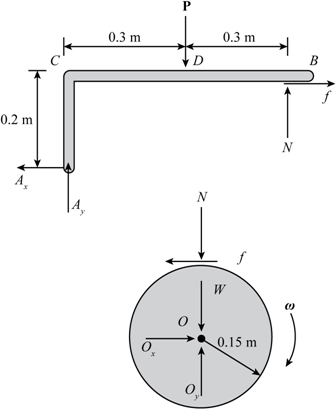
Here, $N$ is the normal force, $f = {\mu _k}N$ is the friction force, ${A_x}$ and ${A_y}$ are the reaction force at point $A$, and ${O_x}$ and${O_y}$ are the reaction force at point $O$.
The length $AC$ is $AC = 0.2\;{\rm{m}}$.
The length $CD$ is $CD = 0.3\;{\rm{m}}$.
The length $DB$ is $DB = 0.3\;{\rm{m}}$.
Step 3
We will take the moment about point $A$.
\[\begin{array}{c} \sum {{M_A}} = 0\\ N \times \left( {CD + DB} \right) - {\bf{P}} \times CD - f \times AC = 0\\ N \times \left( {CD + DB} \right) - {\bf{P}} \times CD - {\mu _k}N \times AC = 0 \end{array}\] … (1)Substitute the given value in the above equation.
\[\begin{array}{c} N \times \left( {0.3\;{\rm{m}} + 0.3\;{\rm{m}}} \right) - {\bf{P}} \times \left( {0.3\;{\rm{m}}} \right) - \left( {0.3} \right)N \times \left( {0.2\;{\rm{m}}} \right) = 0\\ N\left( {0.6 - 0.06} \right) = 0.3{\bf{P}}\\ N = 0.555{\bf{P}} \end{array}\] … (2)Step 4
We will find the moment of inertia of the disk about point $O$.
\[{I_o} = \frac{1}{2}m{r^2}\]Substitute the given value in the above equation.
\[\begin{array}{c} {I_o} = \frac{1}{2}\left( {4{\rm{0}}\;{\rm{kg}}} \right){\left( {150\,{\rm{mm}}} \right)^2}\\ {I_o} = \frac{1}{2}\left( {4{\rm{0}}\;{\rm{kg}}} \right){\left( {150\,{\rm{mm}} \times \frac{{{\rm{1}}\;{\rm{m}}}}{{{\rm{1000}}\;{\rm{mm}}}}} \right)^2}\\ {I_o} = 0.45\;{\rm{kg}} \cdot {{\rm{m}}^{\rm{2}}} \end{array}\]Step 5
We will apply the principle of impulse and momentum equation on the disk.
\[\begin{array}{c} {I_o}\omega + \int\limits_0^t {\left( { - f \times r} \right)dt} = {I_o}{\omega _f}\\ {I_o}\omega + \int\limits_0^t {\left( { - {\mu _k}N \times r} \right)dt} = {I_o}{\omega _f} \end{array}\]Here, ${\omega _f} = 0\;{\rm{rad/s}}$ is the final angular velocity of the disk.
Substitute the given value in the above equation.
\[\begin{array}{c} \left[ \begin{array}{l} \left( {0.45\;{\rm{kg}} \cdot {{\rm{m}}^{\rm{2}}}} \right)\left( {100\;{\rm{rad/s}}} \right) + \\ \int\limits_0^t {\left( { - 0.3\left( {0.555{\bf{P}}} \right) \times \left( {{\rm{150}}\;{\rm{mm}}} \right)} \right)dt} \end{array} \right] = \left( {0.45\;{\rm{kg}} \cdot {{\rm{m}}^{\rm{2}}}} \right)\left( {0\;{\rm{rad/s}}} \right)\\ \left[ \begin{array}{l} \left( {0.45\;{\rm{kg}} \cdot {{\rm{m}}^{\rm{2}}}} \right)\left( {100\;{\rm{rad/s}}} \right) + \\ \int\limits_0^t {\left( { - 0.3\left( {0.555{\bf{P}}} \right) \times \left( {{\rm{150}}\;{\rm{mm}} \times \frac{{{\rm{1}}\;{\rm{m}}}}{{{\rm{1000}}\;{\rm{mm}}}}} \right)} \right)dt} \end{array} \right] = 0\\ \left[ \begin{array}{l} \left( {0.45\;{\rm{kg}} \cdot {{\rm{m}}^{\rm{2}}}} \right)\left( {100\;{\rm{rad/s}}} \right) - \\ \left( {0.3\left( {0.555} \right)0.15\;{\rm{m}}} \right)\int\limits_0^t {{\bf{P}}tdt} \end{array} \right] = 0 \end{array}\]Solve the above equation.
\[\begin{array}{c} \left( {0.45} \right)\left( {100} \right) - \left( {0.3\left( {0.555} \right)0.15} \right)\int\limits_0^t {{\bf{P}}tdt} = 0\\ \left( {0.3\left( {0.555} \right)0.15} \right)\int\limits_0^t {{\bf{P}}tdt} = 45\\ \int\limits_0^t {{\bf{P}}tdt} = 1801.8 \end{array}\] … (3)Step 6
We will find the area under the curve of $P - t$ graph.
\[\begin{array}{c} \int\limits_0^t {{\bf{P}}tdt} = \frac{1}{2} \times \left( 2 \right) \times \left( {{\rm{500}}\;{\rm{N}}} \right) + \left( {{\rm{500}}\;{\rm{N}}} \right)\left( {t - 2} \right)\\ \int\limits_0^t {{\bf{P}}tdt} = \left[ {500 + {\rm{500}}\left( {t - 2} \right)} \right]\;{\rm{N}} \end{array}\]Substitute the given value in equation (3).
\[\begin{array}{c} 500 + {\rm{500}}\left( {t - 2} \right) = 1801.8\\ \left( {t - 2} \right) = \left( {\frac{{1801.8 - 500}}{{500}}} \right)\\ t = \left( {\frac{{1801.8 - 500}}{{500}} + 2} \right)\;{\rm{s}}\\ t = 4.6\;{\rm{s}} \end{array}\]