Engineering Mechanics: Statics and Dynamics, 14th Edition
Authors: Russell C. Hibbeler
ISBN-13: 978-0133915426
See our solution for Question 1PP from Chapter 2 from Hibbeler's Engineering Mechanics.
Problem 1PP
Step-by-Step Solution
(a)
We are given the value of force in figure (a) ${F_1} = 200\;{\rm{N}}$ and ${F_2} = 100\;{\rm{N}}$, in figure (b) ${F_1} = 400\;{\rm{N}}$ and ${F_2} = 500\;{\rm{N}}$ and in figure (c) ${F_1} = 450\;{\rm{N}}$ and ${F_2} = 300\;{\rm{N}}$.
We are asked to construct the parallelogram law to show and establish the triangle rule.
Step 2
In order to construct the parallelogram law, we will use the following assumptions.
(1) The both vectors should be start at the same point.
(2) To construct a parallelogram we will first draw a parallel line to the vector ${\vec F_2}$ from the end of vector ${\vec F_1}$ and similarly created a parallelogram and the resultant vector is presented by its diagonal that starts at the origin $O$.
(3) As the vector ${\vec F_1}$ makes angle of $45^\circ $ with the $y$-axis and the vector ${\vec F_2}$ makes angle of $15^\circ $.
To find the angle between the two vectors we will use the following relation.
\[\begin{array}{c} \alpha = 45^\circ + 15^\circ \\ = 60^\circ \end{array}\]As the sum of all angles in a parallelogram is equal to $360^\circ $ so the angle $\beta $will be determined by using the relation.
\[\begin{array}{c} 2\alpha + 2\beta = 360^\circ \\ 2\beta = 360^\circ - 2\alpha \\ \beta = 180^\circ - \alpha \end{array}\]On plugging the values in the above relation we get,
\[\begin{array}{c} \beta = 180^\circ - 60^\circ \\ \beta = 120^\circ \end{array}\]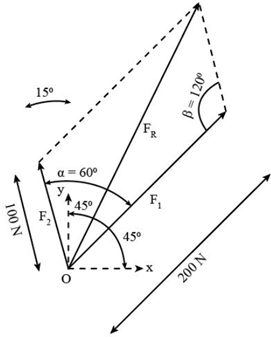
Step 3
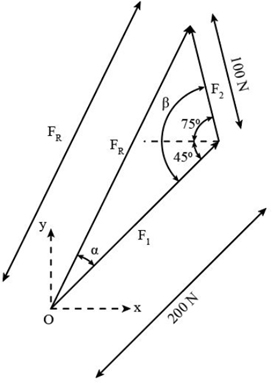
In order to construct the triangle we simply draw the vector ${\vec F_1}$ and connect the end of the vector ${\vec F_2}$ with the one end of the vector ${\vec F_1}$. The third side of the triangle represents the vector ${\vec F_{\rm{R}}}$.
Now, the vector ${\vec F_1}$makes an angle $45^\circ $ with the $x$-axis and the vector ${\vec F_2}$ makes the angle $75^\circ $.
To find the angle between the two vectors we will use,
\[\begin{array}{c} \beta = 45^\circ + 75^\circ \\ = 120^\circ \end{array}\]By using the sine and cosine rule we can draw the triangle and calculate the angle $\alpha $ and $\gamma $ as well as the value of the resultant ${\vec F_{\rm{R}}}$.
The following is the diagram to establish the triangle rule.
Step 4
(b)
In order to construct the parallelogram law, we will use the following assumptions.
(1) The both vectors should be start at the same point.
(2) To construct a parallelogram we will first draw a parallel line to the vector ${\vec F_2}$ from the end of vector ${\vec F_1}$ and similarly created a parallelogram and the resultant vector is presented by its diagonal that starts at the origin $O$.
(3) As the vector ${\vec F_1}$ makes angle of $130^\circ $ with the $x$-axis and the vector ${\vec F_2}$is parallel to the $x$-axis then the angle between the two vectors is,
\[\beta = 130^\circ \]We know that the sum of all angles in a parallelogram is equal to$360^\circ $ so the angle $\alpha $can be calculated as,
\[\begin{array}{c} 2\alpha + 2\beta = 360^\circ \\ 2\alpha = 360^\circ - 2\beta \\ \alpha = 180^\circ - \beta \end{array}\]On plugging the values in the above relation we get,
\[\begin{array}{c} \alpha = 180^\circ - 130^\circ \\ \alpha = 50^\circ \end{array}\]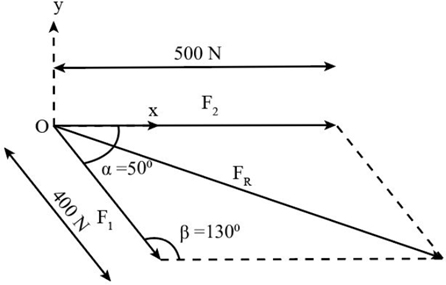
Step 5
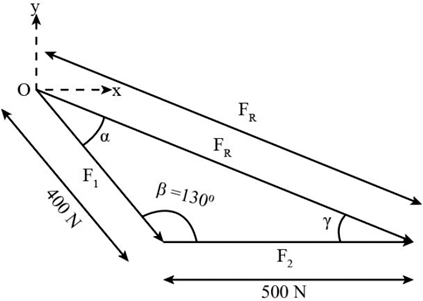
To construct the triangle we simply draw the vector ${\vec F_1}$ and connect the end of the vector ${\vec F_2}$ with the one end of the vector ${\vec F_1}$. The third side of the triangle represents the vector ${\vec F_{\rm{R}}}$.
Now, the vector ${\vec F_1}$makes an angle $130^\circ $ with the $x$-axis and the vector ${\vec F_2}$is parallel to the $x$-axis. So, the angle between the two vectors can be calculated as,
\[\beta = 130^\circ \]By using the sine and cosine rule we can draw the triangle and calculate the angle $\alpha $ and $\gamma $ as well as the value of the resultant ${\vec F_{\rm{R}}}$.
The following is the diagram to establish the triangle rule.
Step 6
(c)
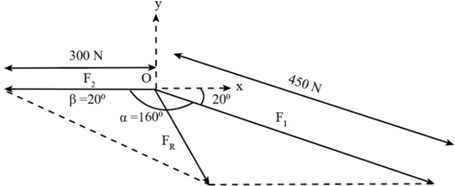
In order to construct the parallelogram law, we will use the following assumptions.
(1) The both vectors should be start at the same point.
(2) To construct a parallelogram we will first draw a parallel line to the vector ${\vec F_2}$ from the end of vector ${\vec F_1}$ and similarly created a parallelogram and the resultant vector is presented by its diagonal that starts at the origin $O$.
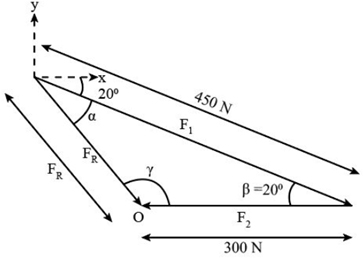
(3) As the vector ${\vec F_1}$ makes angle of $20^\circ $ with the $x$-axis and the vector ${\vec F_2}$ is parallel to the $x$-axis and directed towards its negative side then the angle between the two vectors is,
\[\begin{array}{c} \alpha = 180^\circ - 20^\circ \\ = 160^\circ \end{array}\]We know that the sum of all angles in a parallelogram is equal to$360^\circ $ so the angle $\beta $can be calculated as,
\[\begin{array}{c} 2\alpha + 2\beta = 360^\circ \\ 2\beta = 360^\circ - 2\alpha \\ \beta = 180^\circ - \alpha \end{array}\]On plugging the values in the above relation we get,
\[\begin{array}{c} \beta = 180^\circ - 160^\circ \\ \beta = 20^\circ \end{array}\]The following is the diagram to establish the triangle rule.
Step 7
To construct the triangle we simply draw the vector ${\vec F_1}$ and connect the end of the vector ${\vec F_2}$ with the one end of the vector ${\vec F_1}$. The third side of the triangle represents the vector ${\vec F_{\rm{R}}}$.
Now, the vector ${\vec F_1}$makes an angle $20^\circ $ with the $x$-axis and the vector ${\vec F_2}$ is parallel to the $x$-axis. So, the angle between the two vectors can be calculated as,
\[\beta = 20^\circ \]On using the sine and cosine rule we can draw the triangle and determine the angle $\alpha $ and $\gamma $ as well as the value of the resultant.