Engineering Mechanics: Statics and Dynamics, 14th Edition
Authors: Russell C. Hibbeler
ISBN-13: 978-0133915426
See our solution for Question 32P from Chapter 2 from Hibbeler's Engineering Mechanics.
Problem 32P
Step-by-Step Solution
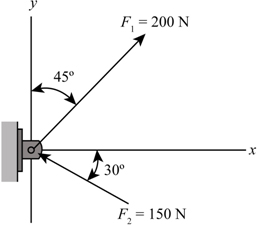
We are given the force ${F_1} = 200\;{\rm{N}}$ and ${F_2} = 150\;{\rm{N}}$ as shown in the figure.
We are asked to determine the magnitude of the resultant force and its direction measured counterclockwise from the positive x-axis.
Step 2
Resolve the forces ${F_1}$ and ${F_2}$ into two components as shown in the figure below,
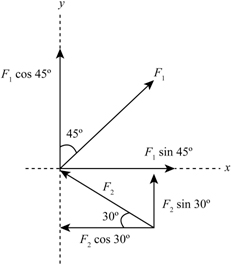
Consider the force equilibrium equation in the x direction as follows:
\[\begin{array}{c} \sum {F_x} = {R_x}\\ {F_1}\sin \left( {45^\circ } \right) - {F_2}\cos \left( {30^\circ } \right) = {R_x}\\ {R_x} = \frac{1}{{\sqrt 2 }}{F_1} - \frac{{\sqrt 3 }}{2}{F_2} \end{array}\]Substitute the values in the above expression, we get:
\[\begin{array}{c} {R_x} = \frac{{200\;{\rm{N}}}}{{\sqrt 2 }} - \frac{{\left( {150\;{\rm{N}}} \right) \times \sqrt 3 }}{2}\\ {R_x} = \left( {141.42\;{\rm{N}}} \right) - \left( {129.90\;{\rm{N}}} \right)\\ {R_x} = 11.52\;{\rm{N}} \end{array}\]Step 3
Consider the force equilibrium equation in the y direction as follows:
\[\begin{array}{c} \sum {F_y} = {R_y}\\ {F_1}\cos \left( {45^\circ } \right) + {F_2}\sin \left( {30^\circ } \right) = {R_y}\\ {R_y} = \frac{1}{{\sqrt 2 }}{F_1} + \frac{1}{2}{F_2} \end{array}\]Substitute the values in the above expression, we get:
\[\begin{array}{c} {R_y} = \frac{{200\;{\rm{N}}}}{{\sqrt 2 }} + \frac{{\left( {150\;{\rm{N}}} \right)}}{2}\\ {R_y} = \left( {141.42\;{\rm{N}}} \right) + \left( {75\;{\rm{N}}} \right)\\ {R_y} = 216.42\;{\rm{N}} \end{array}\]To find the magnitude of the resultant force, we have:
\[R = \sqrt {{{\left( {{R_x}} \right)}^2} + {{\left( {{R_y}} \right)}^2}} \]Substitute the values in the above expression, we get:
\[\begin{array}{c} R = \sqrt {{{\left( {11.52\;{\rm{N}}} \right)}^2} + {{\left( {216.42\;{\rm{N}}} \right)}^2}} \\ R = \sqrt {46.97 \times {{10}^3}} \;{\rm{N}}\\ R = 216.73\;{\rm{N}} \end{array}\]Now, to find the angle made by the resultant force with the positive x axis in the counterclockwise direction, we have:
\[\begin{array}{c} \tan \phi = \frac{{{R_y}}}{{{R_x}}}\\ \tan \phi = \frac{{216.42\;{\rm{N}}}}{{11.52\;{\rm{N}}}}\\ \tan \phi = 18.79\\ \phi = 86.95^\circ \end{array}\]