Engineering Mechanics: Statics and Dynamics, 14th Edition
Authors: Russell C. Hibbeler
ISBN-13: 978-0133915426
See our solution for Question 3PP from Chapter 2 from Hibbeler's Engineering Mechanics.
Problem 3PP
Step-by-Step Solution
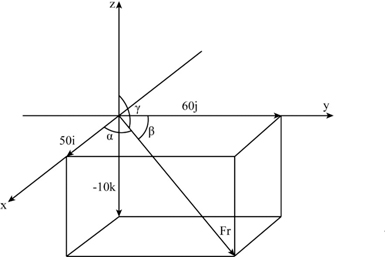
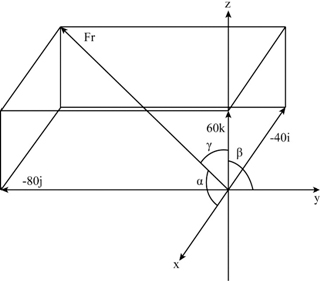
We are given the force $F = \left( {50i + 60j - 10k} \right)\;{\rm{kN}}$ and $F = \left( { - 40i - 80j + 60k} \right)\;{\rm{kN}}$.
We are asked to sketch the given forces and show $\alpha $, $\beta $ and $\gamma $.
Step 2
(a)
In the co-ordinate system, we will add all the vector components x, y and z direction. The angles $\alpha $, $\beta $ and $\gamma $ are the angles among the co-ordinates x, y and z.
The following is the diagram of the forces on the x, y and z co-ordinates.
To find the Cartesian vector form we will use the relation.
\[\begin{array}{l} F = {F_x}\hat i + {F_y}\hat j + {F_z}\hat k\\ F = \left( {50\hat i + 60\hat j - 10\hat k} \right)\;{\rm{kN}} \end{array}\]The magnitude of the resultant force is,
\[\begin{array}{l} \left| F \right| = \sqrt {{F_x}^2 + {F_y}^2 + {F_y}^2} \\ \left| F \right| = \sqrt {{{\left( {50\;{\rm{kN}}} \right)}^2} + {{\left( {60\;{\rm{kN}}} \right)}^2} + {{\left( { - 10\;{\rm{kN}}} \right)}^2}} \\ \left| F \right| = 78.74\;{\rm{kN}} \end{array}\]Step 3
To find the direction cosines of the component we will use,
\[\begin{array}{l} \alpha = {\cos ^{ - 1}}\left( {\frac{{{F_x}}}{{\left| F \right|}}} \right)\\ \alpha = {\cos ^{ - 1}}\left( {\frac{{50\;{\rm{kN}}}}{{78.74\;{\rm{kN}}}}} \right)\\ \alpha = 50.58^\circ \end{array}\]To find the direction cosines of the component we will use,
\[\begin{array}{l} \beta = {\cos ^{ - 1}}\left( {\frac{{{F_y}}}{{\left| F \right|}}} \right)\\ \beta = {\cos ^{ - 1}}\left( {\frac{{60\;{\rm{kN}}}}{{78.74\;{\rm{kN}}}}} \right)\\ \beta = 40.36^\circ \end{array}\]To find the direction cosines of the component we will use,
\[\begin{array}{l} \gamma = {\cos ^{ - 1}}\left( {\frac{{{F_z}}}{{\left| F \right|}}} \right)\\ \gamma = {\cos ^{ - 1}}\left( {\frac{{ - 10\;{\rm{kN}}}}{{78.74\;{\rm{kN}}}}} \right)\\ \gamma = 97.29^\circ \end{array}\]Step 4
(b)
The following is the diagram of the forces on the x, y and z co-ordinates.
To find the Cartesian vector form we will use the relation.
\[\begin{array}{l} F = {F_x}\hat i + {F_y}\hat j + {F_z}\hat k\\ F = \left( { - 40\hat i - 80\hat j + 60\hat k} \right)\;{\rm{kN}} \end{array}\]The magnitude of the resultant force is,
\[\begin{array}{l} \left| F \right| = \sqrt {{F_x}^2 + {F_y}^2 + {F_y}^2} \\ \left| F \right| = \sqrt {{{\left( { - 40\;{\rm{kN}}} \right)}^2} + {{\left( { - 80\;{\rm{kN}}} \right)}^2} + {{\left( {60\;{\rm{kN}}} \right)}^2}} \\ \left| F \right| = 107.7\;{\rm{kN}} \end{array}\]Step 3
To find the direction cosines of the component we will use,
\[\begin{array}{l} \alpha = {\cos ^{ - 1}}\left( {\frac{{{F_x}}}{{\left| F \right|}}} \right)\\ \alpha = {\cos ^{ - 1}}\left( {\frac{{ - 40\;{\rm{kN}}}}{{107.7\;{\rm{kN}}}}} \right)\\ \alpha = 111.802^\circ \end{array}\]To find the direction cosines of the component we will use,
\[\begin{array}{l} \beta = {\cos ^{ - 1}}\left( {\frac{{{F_y}}}{{\left| F \right|}}} \right)\\ \beta = {\cos ^{ - 1}}\left( {\frac{{ - 80\;{\rm{kN}}}}{{107.7\;{\rm{kN}}}}} \right)\\ \beta = 137.97^\circ \end{array}\]To find the direction cosines of the component we will use,
\[\begin{array}{l} \gamma = {\cos ^{ - 1}}\left( {\frac{{{F_z}}}{{\left| F \right|}}} \right)\\ \gamma = {\cos ^{ - 1}}\left( {\frac{{60\;{\rm{kN}}}}{{107.7\;{\rm{kN}}}}} \right)\\ \gamma = 56.14^\circ \end{array}\]