Engineering Mechanics: Statics and Dynamics, 14th Edition
Authors: Russell C. Hibbeler
ISBN-13: 978-0133915426
See our solution for Question 70P from Chapter 2 from Hibbeler's Engineering Mechanics.
Problem 70P
Step-by-Step Solution
We are given the force ${F_1} = 450\;{\rm{N}}$ and ${F_2} = 525\;{\rm{N}}$.
We are asked to determine the magnitude and coordinate direction angles of the resultant force and also to sketch the vector on the coordinate system.

Step 2
On analyzing the above figure, the x and y component of force ${F_1}$ can be written as:
\[\begin{array}{c} {F_{1x}} = 0\;{\rm{N}}\\ {F_{1y}} = \left( {\frac{3}{5}} \right){F_1}\\ {F_{1z}} = \left( {\frac{4}{5}} \right){F_1} \end{array}\]Similarly, for the force ${F_2}$, its x and y components can be written as:
\[\begin{array}{c} {F_{2x}} = {F_2}\cos 45^\circ \\ {F_{2y}} = {F_2}\cos 120^\circ \\ {F_{2z}} = {F_2}\cos 60^\circ \end{array}\]Step 3
From the above figure, we can write the force ${F_1}$ in the Cartesian vector form as follows:
\[\begin{array}{c} {{\vec F}_1} = {F_1}\left( {0\hat i + \frac{3}{5}\hat j - \frac{4}{5}\hat k} \right)\\ {{\vec F}_1} = \left( {450\;{\rm{N}}} \right) \times \left( {0\hat i + 0.6\hat j - 0.8\hat k} \right)\\ {{\vec F}_1} = \left( {0\hat i + 270\hat j - 360\hat k} \right)\;{\rm{N}} \end{array}\]Similarly, we can consider the force ${F_2}$ in the Cartesian vector form as follows:
\[\begin{array}{c} {{\vec F}_2} = {F_2}\left( {\cos 45^\circ \hat i + \cos 120^\circ \hat j + \cos 60^\circ \hat k} \right)\\ {{\vec F}_2} = \left( {525\;{\rm{N}}} \right) \times \left( {\frac{1}{{\sqrt 2 }}\hat i - \frac{1}{2}\hat j + \frac{1}{2}\hat k} \right)\\ {{\vec F}_2} = \left( {371.23\hat i - 262.5\hat j + 262.5\hat k} \right)\;{\rm{N}} \end{array}\]Step 4
The resultant force in the Cartesian vector form can be calculated as follows:
\[\begin{array}{c} {{\vec F}_R} = {{\vec F}_1} + {{\vec F}_2}\\ {{\vec F}_R} = \left( {0\hat i + 270\hat j - 360\hat k} \right)\;{\rm{N}} + \left( {371.23\hat i - 262.5\hat j + 262.5\hat k} \right)\;{\rm{N}}\\ {{\vec F}_R} = \left( {0\hat i + 371.23\hat i} \right)\;{\rm{N}} + \left( {270\hat j - 262.5\hat j} \right)\;{\rm{N}} + \left( { - 360\hat k + 262.5\hat k} \right)\;{\rm{N}}\\ {{\vec F}_R} = \left( {371.23\hat i + 7.5\hat j - 97.5\hat k} \right)\;{\rm{N}} \end{array}\]Now, to find the magnitude of the resultant force, we have:
\[\begin{array}{c} \left| {{{\vec F}_R}} \right| = \sqrt {\left( {{{\vec F}_R}} \right)_x^2 + \left( {{{\vec F}_R}} \right)_y^2 + \left( {{{\vec F}_R}} \right)_z^2} \\ \left| {{{\vec F}_R}} \right| = \sqrt {{{\left( {371.23\;{\rm{N}}} \right)}^2} + {{\left( {7.5\;{\rm{N}}} \right)}^2} + {{\left( { - 97.5\;{\rm{N}}} \right)}^2}} \\ \left| {{{\vec F}_R}} \right| = \sqrt {147.37 \times {{10}^3}} \;{\rm{N}}\\ \left| {{{\vec F}_R}} \right| = 383.88\;{\rm{N}} \end{array}\]Now, to show the coordinate system acting on the resultant force, the free-body diagram can be drawn as:
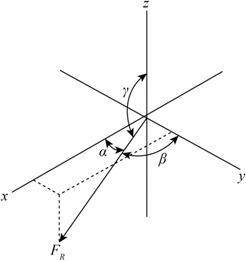
From the above figure, the coordinate direction angle of the resultant force along the x-axis can be calculated as follows:
\[\begin{array}{c} \cos \alpha = \frac{{{{\left( {{F_R}} \right)}_x}}}{{{F_R}}}\\ \alpha = {\cos ^{ - 1}}\left( {\frac{{371.23\;{\rm{N}}}}{{383.88\;{\rm{N}}}}} \right)\\ \alpha = {\cos ^{ - 1}}\left( {0.967} \right)\\ \alpha = 14.76^\circ \end{array}\]Step 5
The coordinate direction angle of the resultant force along the y-axis can be calculated as follows:
\[\begin{array}{c} \cos \beta = \frac{{{{\left( {{F_R}} \right)}_y}}}{{{F_R}}}\\ \beta = {\cos ^{ - 1}}\left( {\frac{{7.5\;{\rm{N}}}}{{383.88\;{\rm{N}}}}} \right)\\ \beta = {\cos ^{ - 1}}\left( {0.0195} \right)\\ \beta = 88.88^\circ \end{array}\]Similarly, the coordinate direction angle of the resultant force along the z-axis can be calculated as follows:
\[\begin{array}{c} \cos \gamma = \frac{{{{\left( {{F_R}} \right)}_z}}}{{{F_R}}}\\ \gamma = {\cos ^{ - 1}}\left( {\frac{{ - 97.5\;{\rm{N}}}}{{383.88\;{\rm{N}}}}} \right)\\ \gamma = {\cos ^{ - 1}}\left( { - 0.253} \right)\\ \gamma = 104.65^\circ \end{array}\]