Engineering Mechanics: Statics and Dynamics, 14th Edition
Authors: Russell C. Hibbeler
ISBN-13: 978-0133915426
See our solution for Question 15P from Chapter 20 from Hibbeler's Engineering Mechanics.
Problem 15P
Step-by-Step Solution
We are given a tower crane rotating about the $z$ axis. The following data is given:
The angular velocity of the crane is ${\omega _1} = 0.25{\rm{ rad/s}}$.
The increasing rate of the angular velocity of the crane is ${\dot \omega _1} = 0.6\;{\rm{rad/}}{{\rm{s}}^{\rm{2}}}$.
The angular velocity of the boom is ${\omega _2} = 0.4\;{\rm{rad/s}}$.
The increasing rate of the angular velocity of the boom is ${\dot \omega _2} = 0.8\;{\rm{rad/}}{{\rm{s}}^{\rm{2}}}$.
We are asked to determine the velocity and acceleration of point $A$ located at the end of the boom at this instant.
Step 2
The kinematic diagram of the crane is given below:
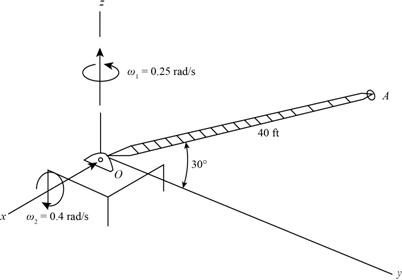
The vector representation of the expression for the angular velocity of the crane is given by,
\[\begin{array}{c} \omega = {\omega _1}{\bf{k}} - {\omega _2}{\bf{i}}\\ \omega = \left( {0.25{\bf{k}} - 0.4{\bf{i}}} \right)\;{\rm{rad/s}} \end{array}\]The negative sign of ${\omega _2}$ indicates that the boom is moving downwards.
Step 3
The increasing rate of the angular velocity of the crane with respect to $xyz$ is given by,
\[{\left( {{{\dot \omega }_1}} \right)_{xyz}} = \left( {0.6{\bf{k}}} \right)\;{\rm{rad/}}{{\rm{s}}^{\rm{2}}}\]The increasing rate of the angular velocity of the boom with respect to $xyz$ is given by,
\[{\left( {{{\dot \omega }_2}} \right)_{xyz}} = - 0.8{\bf{i}}\;{\rm{rad/}}{{\rm{s}}^{\rm{2}}}\]The negative sign indicates that the boom is moving downwards.
Step 4
The expression for the increasing rate of angular acceleration of the crane is given by,
\[\begin{array}{c} {{\dot \omega }_1} = \left[ {{{\left( {{{\dot \omega }_1}} \right)}_{xyz}} + {\omega _1} \times {\omega _1}} \right]\\ {{\dot \omega }_1} = \left[ {\left( {0.6{\bf{k}}} \right) + \left( {0.25{\bf{k}}} \right) \times \left( {0.25{\bf{k}}} \right)} \right]\;{\rm{rad/}}{{\rm{s}}^2}\\ {{\dot \omega }_1} = \left( {0.6{\bf{k}}} \right)\;{\rm{rad/}}{{\rm{s}}^2} \end{array}\]The expression for the increasing rate of angular acceleration of the boom is given by,
\[\begin{array}{c} {{\dot \omega }_2} = \left[ {{{\left( {{{\dot \omega }_2}} \right)}_{xyz}} + {\omega _1} \times {\omega _2}} \right]\\ {{\dot \omega }_2} = \left[ {{{\left( {{{\dot \omega }_2}} \right)}_{xyz}} + \left( {0.25k} \right) \times \left( { - 0.4{\bf{i}}} \right)} \right]\\ {{\dot \omega }_2} = \left[ {\left( { - 0.8{\bf{i}}} \right) - \left( {0.1j} \right)} \right]\;{\rm{rad/}}{{\rm{s}}^2} \end{array}\]Step 5
The vector representation of the expression for the angular acceleration of the crane is given by,
\[\begin{array}{c} \alpha = \dot \omega \\ \alpha = {{\dot \omega }_1} + {{\dot \omega }_2}\\ \alpha = \left[ {\left( {0.6{\bf{k}}} \right)} \right]\;{\rm{rad/}}{{\rm{s}}^2} + \left[ {\left( { - 0.8{\bf{i}}} \right) - \left( {0.1j} \right)} \right]\;{\rm{rad/}}{{\rm{s}}^2}\\ \alpha = \left( { - 0.8{\bf{i}} - 0.1{\bf{j}} + 0.6{\bf{k}}} \right)\;{\rm{rad/}}{{\rm{s}}^{\rm{2}}} \end{array}\]The expression for the position vector of point $A$ is given by,
\[\begin{array}{c} {{\bf{r}}_A} = \left( {OA\cos \theta {\bf{j}} + OA\sin \theta {\bf{k}}} \right)\\ {{\bf{r}}_A} = \left( {40\cos 30^\circ {\bf{j}} + 40\sin 30^\circ {\bf{k}}} \right)\;{\rm{ft}}\\ {{\bf{r}}_A} = \left( {34.64{\bf{j}} + 20{\bf{k}}} \right)\;{\rm{ft}} \end{array}\]Step 6
Using the relation between the linear velocity and the angular velocity, the linear velocity of the point $A$ is given by,
\[\begin{array}{c} {v_A} = \omega \times {{\bf{r}}_A}\\ {v_A} = \left( {0.25{\bf{k}} - 0.4{\bf{i}}} \right)\;{\rm{rad/s}} \times \left( {34.64{\bf{j}} + 20{\bf{k}}} \right)\;{\rm{ft}}\\ {v_A} = \left( { - 8.66{\bf{i}} + 0 - 13.9{\bf{k}} + 8{\bf{j}}} \right)\;{\rm{ft/s}}\\ {v_A} = \left( { - 8.66{\bf{i}} + 8{\bf{j}} - 13.9{\bf{k}}} \right)\;{\rm{ft/s}} \end{array}\]The expression for the linear acceleration of point $A$ is given by,
\[{a_A} = \alpha \times {{\bf{r}}_A} + \omega \times {v_A}\]Substituting the values in the above expression and solving we get,
\[\begin{array}{c} {a_A} = \left( { - 0.8{\bf{i}} - 0.1{\bf{j}} + 0.6{\bf{k}}} \right) \times \left( {34.64{\bf{j}} + 20{\bf{k}}} \right) + \left( {0.25{\bf{k}} - 0.4{\bf{i}}} \right) \times \left( { - 8.66{\bf{i}} + 8{\bf{j}} - 13.9{\bf{k}}} \right)\\ {a_A} = \left| {\begin{array}{*{20}{c}} {\bf{i}}&{\bf{j}}&{\bf{k}}\\ { - 0.8}&{ - 0.1}&{0.6}\\ 0&{34.64}&{20} \end{array}} \right| + \left| {\begin{array}{*{20}{c}} {\bf{i}}&{\bf{j}}&{\bf{k}}\\ { - 0.4}&0&{0.25}\\ { - 8.66}&8&{ - 13.9} \end{array}} \right|\\ {a_A} = \left[ {{\bf{i}}\left( { - 2 - 20.784} \right) - {\bf{j}}\left( { - 16 - 0} \right) + {\bf{k}}\left( {27.712 - 0} \right) + {\bf{i}}\left( {0 - 2} \right) - {\bf{j}}\left( {5.56 + 2.165} \right) + {\bf{k}}\left( { - 3.2 - 0} \right)} \right]\\ {a_A} = \left[ { - 24.8{\bf{i}} + 8.29{\bf{j}} - 30.9{\bf{k}}} \right]\;{\rm{ft/}}{{\rm{s}}^2} \end{array}\]