Engineering Mechanics: Statics and Dynamics, 14th Edition
Authors: Russell C. Hibbeler
ISBN-13: 978-0133915426
See our solution for Question 33P from Chapter 21 from Hibbeler's Engineering Mechanics.
Problem 33P
Step-by-Step Solution
We are given the mass of a sphere as $m = 20\;{\rm{kg}}$, the angular velocity of a sphere as ${\omega _s} = 60\;{\rm{rad/s}}$, the torque on shaft AB as $M = 50\;{\rm{N}} \cdot {\rm{m}}$, the radius of the sphere as $r = 0.1\;{\rm{m}}$ and initially the value of ${\omega _p}$ is zero.
We are asked to determine the value of ${\omega _p}$ after the shaft has turned $90^\circ $ from the position shown.
Step 2
The initial and final positions of the balloon can be shown as:
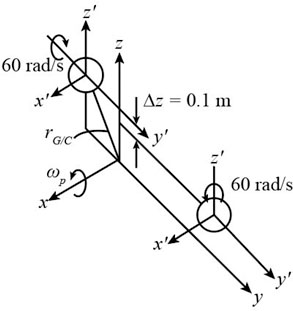
Here, ${r_{G/C}}$ is the position vector of point G with respect to point C and $\Delta z$ is the vertical distance between the mass center in position 1 and mass center in position 2 whose value is 0.1.
Step 3
The mass moment of inertia of the sphere about its center can be given as:
\[I = \frac{2}{5}m{r^2}\]The mass moment of inertia of the sphere about $x'$, $y'$ and $z'$ axis can be calculated as:
\[\begin{array}{c} {I_{x'}} = {I_{y'}} = {I_{z'}} = I\\ {I_{x'}} = {I_{y'}} = {I_{z'}} = \frac{2}{5}m{r^2}\\ {I_{x'}} = {I_{y'}} = {I_{z'}} = \frac{2}{5} \times \left( {20\;{\rm{kg}}} \right) \times {\left( {0.1\;{\rm{m}}} \right)^2}\\ {I_{x'}} = {I_{y'}} = {I_{z'}} = 0.08\;{\rm{kg}} \cdot {{\rm{m}}^2} \end{array}\]Step 4
To calculate the kinetic energy of the system at position 1, we have:
\[{K_1} = \frac{1}{2}m\left( {{v_G}} \right)_1^2 + \frac{1}{2}{I_{x'}}\left( {{\omega _1}} \right)_{x'}^2 + \frac{1}{2}{I_{y'}}\left( {{\omega _1}} \right)_{y'}^2 + \frac{1}{2}{I_{z'}}\left( {{\omega _1}} \right)_{z'}^2\]Here, ${\left( {{v_G}} \right)_1}$ is the velocity of center of the balloon at position 1 whose value is zero, ${\left( {{\omega _1}} \right)_{x'}}$ is the x-component of the angular velocity of the balloon whose value is zero, ${\left( {{\omega _1}} \right)_{y'}}$ is the y-component of the angular velocity of the balloon whose value is zero and ${\left( {{\omega _1}} \right)_{z'}}$ is the z-component of the angular velocity of the balloon$\left( {{{\left( {{\omega _1}} \right)}_{z'}} = {\omega _s}} \right)$.
On substituting the values in the above expression, we get:
\[\begin{array}{c} {K_1} = \left[ \begin{array}{l} \frac{1}{2} \times \left( {20\;{\rm{kg}}} \right) \times {\left( 0 \right)^2} + \frac{1}{2} \times \left( {0.08\;{\rm{kg}} \cdot {{\rm{m}}^2}} \right) \times {\left( 0 \right)^2} + \\ \frac{1}{2} \times \left( {0.08\;{\rm{kg}} \cdot {{\rm{m}}^2}} \right) \times {\left( 0 \right)^2} + \frac{1}{2}\left( {0.08\;{\rm{kg}} \cdot {{\rm{m}}^2}} \right) \times {\left( {60\;{\rm{rad/s}}} \right)^2} \end{array} \right]\\ {K_1} = 144\;{\rm{J}} \end{array}\]Step 5
The position vector of point G with respect to point C can be given as:
\[{r_{G/C}} = \left( { - 0.3j + 0.4k} \right)\;{\rm{m}}\]The velocity vector of mass center at position 2 can be calculated as:
\[\begin{array}{c} {\left( {{v_G}} \right)_2} = {\omega _p}{r_{G/C}}\\ {\left( {{v_G}} \right)_2} = \left( {{\omega _p}i} \right)\left( { - 0.3j + 0.4k} \right)\\ {\left( {{v_G}} \right)_2} = - 0.4{\omega _p}j - 0.3{\omega _p}k \end{array}\]Step 6
The magnitude of the velocity vector of mass center at position 2 can be calculated as:
\[\begin{array}{c} {\left( {{v_G}} \right)_2} = \sqrt {{{\left( { - 0.4{\omega _p}} \right)}^2} + {{\left( { - 0.3{\omega _p}} \right)}^2}} \\ {\left( {{v_G}} \right)_2} = \sqrt {0.25\omega _p^2} \\ {\left( {{v_G}} \right)_2} = 0.5{\omega _p} \end{array}\]To calculate the angular velocity vector of the balloon at position 2, we have:
\[{\omega _2} = {\left( {{\omega _2}} \right)_{x'}}i + {\left( {{\omega _2}} \right)_{y'}}j + {\left( {{\omega _2}} \right)_{z'}}k\]Here, ${\left( {{\omega _2}} \right)_{x'}} = {\omega _p}$ is the x-component of the angular velocity of the balloon, ${\left( {{\omega _2}} \right)_{y'}} = - 60{\rm{ rad/s}}$ is the y-component of the angular velocity of the balloon and ${\left( {{\omega _2}} \right)_{z'}} = 0$ is the z-component of the angular velocity of the balloon.
On substituting the values in the above expression, we get:
\[\begin{array}{c} {\omega _2} = {\omega _p}i + 0k + \left( { - 60} \right)j\\ {\omega _2} = {\omega _p}i - 60j \end{array}\]Step 7
To calculate the kinetic energy of the system at position 2, we have:
\[{K_2} = \frac{1}{2}m\left( {{v_G}} \right)_2^2 + \frac{1}{2}{I_{x'}}\left( {{\omega _2}} \right)_{x'}^2 + \frac{1}{2}{I_{y'}}\left( {{\omega _2}} \right)_{y'}^2 + \frac{1}{2}{I_{z'}}\left( {{\omega _2}} \right)_{z'}^2\]On substituting the values in the above expression, we get:
\[\begin{array}{c} {K_2} = \left[ \begin{array}{l} \frac{1}{2} \times \left( {20\;{\rm{kg}}} \right) \times {\left( {0.5{\omega _p}} \right)^2} + \frac{1}{2} \times \left( {0.08\;{\rm{kg}} \cdot {{\rm{m}}^2}} \right) \times {\left( {{\omega _p}} \right)^2} + \\ \frac{1}{2} \times \left( {0.08\;{\rm{kg}} \cdot {{\rm{m}}^2}} \right) \times {\left( { - 60} \right)^2} + \frac{1}{2}\left( {0.08\;{\rm{kg}} \cdot {{\rm{m}}^2}} \right) \times {\left( 0 \right)^2} \end{array} \right]\\ {K_2} = 10\left( {0.25\omega _p^2} \right) + 0.04\omega _p^2 + 0.04\left( {3600} \right)\\ {K_2} = \left\{ {2.54\omega _p^2 + 144} \right\}\left( {{\rm{kg}} \cdot {{\rm{m}}^2}{\rm{/}}{{\rm{s}}^2}} \right)\left( {\frac{{1\;{\rm{J}}}}{{1{\rm{ kg}} \cdot {{\rm{m}}^2}{\rm{/}}{{\rm{s}}^2}}}} \right)\\ {K_2} = \left\{ {2.54\omega _p^2 + 144} \right\}{\rm{ J}} \end{array}\]Step 8
The work done by the weight of the sphere can be calculated as:
\[\begin{array}{c} {U_W} = - mg\left( {\Delta z} \right)\\ {U_W} = - \left( {20\;{\rm{kg}}} \right) \times \left( {9.81\;{\rm{m/}}{{\rm{s}}^2}} \right) \times \left( {0.1\;{\rm{m}}} \right)\left( {\frac{{1\;{\rm{J}}}}{{1{\rm{ kg}} \cdot {{\rm{m}}^2}{\rm{/}}{{\rm{s}}^2}}}} \right)\\ {U_W} = - 19.62\;{\rm{J}} \end{array}\]The work done by the couple moment can be calculated as:
\[\begin{array}{c} {U_M} = M\theta \\ {U_M} = \left( {50\;{\rm{N}} \cdot {\rm{m}}} \right) \times \left( {\frac{\pi }{2}} \right)\left( {\frac{{1{\rm{ J}}}}{{1{\rm{ N}} \cdot {\rm{m}}}}} \right)\\ {U_M} = 25\pi \;{\rm{J}} \end{array}\]Step 9
On applying the energy balance equation to the system, we get:
\[\begin{array}{c} {K_1} + {U_W} + {U_M} = {K_2}\\ \left( {144\;{\rm{J}}} \right) + \left( { - 19.62\;{\rm{J}}} \right) + \left( {25\pi \;{\rm{J}}} \right) = \left( {2.54\omega _p^2 + 144} \right){\rm{ J}}\\ \left( {58.919} \right) = 2.54\omega _p^2\\ {\omega _p} = 4.82\;{\rm{rad/s}} \end{array}\]