Step 1 We are given the tension in wire $AB$ as $T = 20\,{\rm{lb}}$, the magnitude of weight as $W = 5\,{\rm{lb}}$, the displacement given to the weight as $x = 2\,{\rm{in}}{\rm{.}}$, and the distance of weight from $A$ and $B$ as $l = 6\,{\rm{ft}}$.
We are asked to determine the equation which describes the motion when the weight is displaced $2\,{\rm{in}}{\rm{.}}$ horizontally and released from rest.
Step 2 The free body diagram of the given system after displacement can be drawn as shown below.
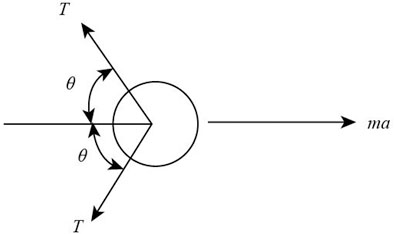
Step 3 Find the mass of the weight using the following relation.
\[m = \frac{W}{g}\]
On substituting the known values in the above equation we get,
\[\begin{array}{c} m = \frac{{5\,{\rm{lb}}}}{{32.2\,{\rm{ft/}}{{\rm{s}}^{\rm{2}}}}}\\ = 0.155\,\frac{{{\rm{lb}} \cdot {{\rm{s}}^2}}}{{{\rm{ft}}}} \end{array}\]
Step 4 Find the sine of angle $\left( \theta \right)$ made by wire with horizontal using the following relation.
\[\sin \theta = \frac{{{\rm{base}}}}{{{\rm{hypotenuse}}}}\]
Here, ${\rm{base}}$ is the horizontal displacement of weight which is $x$ and ${\rm{hypotenuse}}$ is the length of wire which is $l$.
On substituting the known values in the above equation we get,
\[\sin \theta = \frac{x}{l}\,......\left( 1 \right)\]
Step 5 Find the acceleration of the weight by balancing force along $x$-axis using the following relation.
\[ - 2T\sin \theta = ma\]
On rearranging the above equation we get,
\[\begin{array}{c} - 2T\sin \theta = ma\\ a = - \frac{{2T}}{m}\sin \theta \end{array}\]
On substituting the known value of equation (1) in the above equation we get,
\[a = - \frac{{2T}}{m}\left( {\frac{x}{l}} \right)\]
The acceleration of the weight can also written as $\ddot x$.
On substituting $\ddot x$ for $a$ in the above equation we get,
\[\ddot x = - \frac{{2T}}{m}\left( {\frac{x}{l}} \right)\,......\left( 2 \right)\]
Step 6 Find the angular frequency of the system using the following relation.
\[\ddot x + \omega _n^2x = 0\]
On substituting the known value of equation (2) in the above equation we get,
\[\begin{array}{c} \left( { - \frac{{2T}}{m}\left( {\frac{x}{l}} \right)} \right) + \omega _n^2x = 0\\ {\omega _n} = \sqrt {\frac{{2T}}{{ml}}} \end{array}\]
On substituting the known values in the above equation we get,
\[\begin{array}{c} {\omega _n} = \sqrt {\frac{{2\left( {20\,{\rm{lb}}} \right)}}{{\left( {0.155\,\frac{{{\rm{lb}} \cdot {{\rm{s}}^{\rm{2}}}}}{{{\rm{ft}}}}} \right)\left( {6\,{\rm{ft}}} \right)}}} \\ = 6.55\,{\rm{rad/s}} \end{array}\]
Step 7 Find the velocity by using the following relation.
\[v = \frac{d}{{dt}}\left( {A\sin \left( {{\omega _n}t} \right) + B\cos \left( {{\omega _n}t} \right)} \right)\]
On differentiating the above equation we get,
\[v = A{\omega _n}\cos \left( {{\omega _n}t} \right) - B{\omega _n}\sin \left( {{\omega _n}t} \right)\,......\left( 3 \right)\]
Step 8 The initial conditions are at $t = 0$, the displacement is $x = 2\,{\rm{in}}{\rm{.}}$, and the velocity is zero$\left( {v = 0} \right)$.
Find the constant $A$ by initial conditions using the following relation.
\[v = A{\omega _n}\cos \left( {{\omega _n}t} \right) - B{\omega _n}\sin \left( {{\omega _n}t} \right)\,\]
On substituting the known values in the above equation we get,
\[\begin{array}{c} 0 = A{\omega _n}\cos \left( {{\omega _n}\left( 0 \right)} \right) - B{\omega _n}\sin \left( {{\omega _n}\left( 0 \right)} \right)\\ 0 = A{\omega _n}\left( 1 \right) - 0\\ A = 0 \end{array}\]
Step 9 Find the constant $B$ by initial condition using the following relation.
\[x = A\sin \left( {{\omega _n}t} \right) - B\cos \left( {{\omega _n}t} \right)\]
On substituting the known values in the above equation we get,
\[\begin{array}{c} \left( {2\,{\rm{in}}{\rm{.}}} \right) \times \left( {\frac{{\left( {1/12} \right)\,{\rm{ft}}}}{{1\,{\rm{in}}{\rm{.}}}}} \right) = A\sin \left( {{\omega _n}\left( 0 \right)} \right) + B\cos \left( {{\omega _n}\left( 0 \right)} \right)\\ B = \frac{1}{6}\,{\rm{ft}} \end{array}\]
Step 10 Find the equation of motion using the following relation.
\[x = A\sin \left( {{\omega _n}t} \right) - B\cos \left( {{\omega _n}t} \right)\]
On substituting the obtained values in the above equation we get,
\[\begin{array}{c} x = \left( 0 \right)\sin \left( {\left( {6.55\,{\rm{rad/s}}} \right)t} \right) - \left( {\frac{1}{6}\,{\rm{ft}}} \right)\cos \left( {\left( {6.55\,{\rm{rad/s}}} \right)t} \right)\\ = \left( {0.167\,{\rm{ft}}} \right)\cos \left( {\left( {6.55\,{\rm{rad/s}}} \right)t} \right) \end{array}\]