Step 1 We are given the weight of the semicircular disk as $w = 10\,{\rm{lb}}$ and the radius of the disk as $r = 0.5\,{\rm{ft}}$.
We are asked to determine the natural period of vibration of the semicircular disk.
Step 2 The diagram of the system having angular displacement $\theta $ can be drawn as shown below.
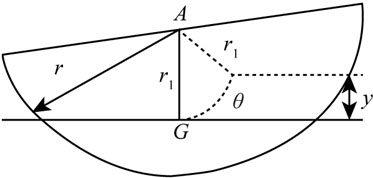
Step 3 Find the mass of the semicircular disk using the following relation.
\[m = \frac{w}{g}\]
On substituting the known values in the above equation we get,
\[\begin{array}{c} m = \frac{{10\,{\rm{lb}}}}{{32.2\,{\rm{ft/}}{{\rm{s}}^{\rm{2}}}}}\\ = \,0.311\,\frac{{{\rm{lb}} \cdot {{\rm{s}}^{\rm{2}}}}}{{{\rm{ft}}}} \end{array}\]
Step 4 Find the moment of inertia of the semicircular disc at centre $A$ using the following relation.
\[{I_A} = \frac{{m{r^2}}}{2}\]
On substituting the known values in the above equation we get,
\[\begin{array}{c} {I_A} = \frac{{\left( {0.311\,\frac{{{\rm{lb}} \cdot {{\rm{s}}^{\rm{2}}}}}{{{\rm{ft}}}}} \right){{\left( {0.5\,{\rm{ft}}} \right)}^2}}}{2}\\ = 0.0389\,{\rm{lb}} \cdot {\rm{ft}} \cdot {{\rm{s}}^{\rm{2}}} \end{array}\]
Step 5 Find the distance between $A$ and $G$ using the following relation.
\[{r_1} = \frac{{4\left( r \right)}}{{3\pi }}\]
On substituting the known values in the above equation we get,
\[\begin{array}{c} {r_1} = \frac{{4\left( {0.5\,{\rm{ft}}} \right)}}{{3\pi }}\\ = 0.2122\,{\rm{ft}} \end{array}\]
Step 6 Find the moment of inertia of the semicircular disk at the centre of gravity using the following relation.
\[{I_A} = {I_G} + mr_1^2\]
On substituting the known values in the above equation we get,
\[\begin{array}{c} 0.0389\,lb \cdot ft \cdot {s^2} = {I_G} + \left( {0.311\,\frac{{{\rm{lb}} \cdot {{\rm{s}}^{\rm{2}}}}}{{{\rm{ft}}}}} \right){\left( {0.2122\,{\rm{ft}}} \right)^2}\\ {I_G} = 0.0249\,lb \cdot ft \cdot {s^2} \end{array}\]
Step 7 Find the moment of inertia of disk at instantaneous centre using the following relation.
\[{I_C} = {I_G} + m\left( {r - {r_1}} \right)\]
On substituting the known values in the above equation we get,
\[\begin{array}{c} {I_C} = 0.0249\,{\rm{lb}} \cdot {\rm{ft}} \cdot {{\rm{s}}^{\rm{2}}} + \left( {0.311\,\frac{{{\rm{lb}} \cdot {{\rm{s}}^{\rm{2}}}}}{{{\rm{ft}}}}} \right){\left( {0.5\,{\rm{ft}} - 0.2122\,{\rm{ft}}} \right)^2}\\ {I_C} = 0.0507\,{\rm{lb}} \cdot {\rm{ft}} \cdot {{\rm{s}}^{\rm{2}}} \end{array}\]
Step 8 Find the kinetic energy of the disk using the following relation.
\[T = \frac{1}{2}{I_C}{\dot \theta ^2}\]
On substituting the known values in the above equation we get,
\[\begin{array}{c} T = \frac{1}{2}\left( {0.0507\,{\rm{lb}} \cdot {\rm{ft}} \cdot {{\rm{s}}^{\rm{2}}}} \right){{\dot \theta }^2}\\ = \left( {0.0254\,{\rm{lb}} \cdot {\rm{ft}} \cdot {{\rm{s}}^{\rm{2}}}} \right){{\dot \theta }^2}\,......\left( 1 \right) \end{array}\]
Step 9 Find the potential energy of the disk using the following relation.
\[V = w{r_1}\left( {1 - \cos \theta } \right)\]
On substituting the known values in the above equation we get,
\[\begin{array}{c} V = \left( {10\,{\rm{lb}}} \right)\left( {0.2122\,{\rm{ft}}} \right)\left( {1 - \cos \theta } \right)\\ = \left( {2.122\,{\rm{lb}} \cdot {\rm{ft}}} \right)\left( {1 - \cos \theta } \right)\,......\left( 2 \right) \end{array}\]
Step 10 Find the angular acceleration of the disk by the conservation of energy using the following relation.
\[T + V = C\]
Here, $C$ is the constant.
On substituting the known values of equation (1) and equation (2) in the above equation we get,
\[\left( {0.0254\,{\rm{lb}} \cdot {\rm{ft}} \cdot {{\rm{s}}^{\rm{2}}}} \right){\dot \theta ^2} + \left( {2.122\,{\rm{lb}} \cdot {\rm{ft}}} \right)\left( {1 - \cos \theta } \right) = C\]
On differentiating the above equation on both sides with respect to time $t$ we get,
\[\begin{array}{c} \frac{d}{{dt}}\left[ {\left( {0.0254\,{\rm{lb}} \cdot {\rm{ft}} \cdot {{\rm{s}}^{\rm{2}}}} \right){{\dot \theta }^2} + \left( {2.122\,{\rm{lb}} \cdot {\rm{ft}}} \right)\left( {1 - \cos \theta } \right)} \right] = \frac{d}{{dt}}C\\ \left( {0.0254\,{\rm{lb}} \cdot {\rm{ft}} \cdot {{\rm{s}}^{\rm{2}}}} \right)\left( {2\dot \theta } \right)\ddot \theta + \left( {2.122\,{\rm{lb}} \cdot {\rm{ft}}} \right)\left( {\sin \theta } \right)\dot \theta = 0\\ \left[ {\left( {0.0508\,{\rm{lb}} \cdot {\rm{ft}} \cdot {{\rm{s}}^{\rm{2}}}} \right)\ddot \theta + \left( {2.122\,{\rm{lb}} \cdot {\rm{ft}}} \right)\left( {\sin \theta } \right)} \right]\dot \theta = 0 \end{array}\]
As $\theta $ is a smaller angle, the sine of angle $\theta $ is $\sin \theta = \theta $.
On substituting $\theta $ for $\sin \theta $ in the above equation we get,
\[\begin{array}{c} \left[ {\left( {0.0508\,{\rm{lb}} \cdot {\rm{ft}} \cdot {{\rm{s}}^{\rm{2}}}} \right)\ddot \theta + \left( {2.122\,{\rm{lb}} \cdot {\rm{ft}}} \right)\left( \theta \right)} \right]\dot \theta = 0\\ \left( {0.0508\,{\rm{lb}} \cdot {\rm{ft}} \cdot {{\rm{s}}^{\rm{2}}}} \right)\ddot \theta + \left( {2.122\,{\rm{lb}} \cdot {\rm{ft}}} \right)\theta = 0\\ \ddot \theta = - \left( {41.77\,{\rm{rad/}}{{\rm{s}}^{\rm{2}}}} \right)\theta \,......\left( 3 \right) \end{array}\]
Step 11 Find the natural angular frequency of the disk using the following relation.
\[\ddot \theta + \omega _n^2\theta = 0\]
On substituting the known values of equation (3) in the above equation we get,
\[\begin{array}{c} - \left( {41.77\,{\rm{rad/}}{{\rm{s}}^{\rm{2}}}} \right)\theta + \omega _n^2\theta = 0\\ {\omega _n} = 6.46\,{\rm{rad/s}} \end{array}\]
Step 12 Find the natural period of vibration using the following relation.
\[\tau = \frac{{2\pi }}{{{\omega _{n\,}}}}\]
On substituting the known values in the above equation we get,
\[\begin{array}{c} \tau = \frac{{2\pi }}{{6.46\,{\rm{rad/s}}}}\\ = 0.973\,{\rm{s}} \end{array}\]