Engineering Mechanics: Statics and Dynamics, 14th Edition
Authors: Russell C. Hibbeler
ISBN-13: 978-0133915426
See our solution for Question 35P from Chapter 22 from Hibbeler's Engineering Mechanics.
Problem 35P
Step-by-Step Solution
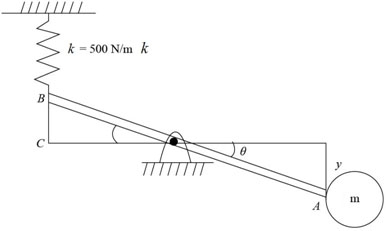
We are given the mass of the sphere as $m = 3\,{\rm{kg}}$, the distance between the centre & spring and the centre & sphere as $b = 300\,{\rm{mm}}$, and the stiffness of spring as $k = 500\,{\rm{N/m}}$.
We are asked to determine the natural period of vibration of the sphere.
Step 2
The diagram of the system having angular displacement of $\theta $ can be drawn as shown below.
Step 3
Find the displacement $BC$ using the following relation.
\[\frac{{BC}}{b} = \frac{{DA}}{b}\]On substituting $y$ for $DA$ in the above equation we get,
\[\frac{{BC}}{b} = \frac{{DA}}{b}\]On substituting the known values in the above equation we get,
\[\begin{array}{c} \frac{{BC}}{{300\,{\rm{mm}}}} = \frac{y}{{300\,{\rm{mm}}}}\\ BC = y\,......\left( 1 \right) \end{array}\]Step 4
Find the kinetic energy of the ball using the following relation.
\[T = \frac{1}{2}m{\dot y^2}\]On substituting the known values in the above equation we get,
\[\begin{array}{c} T = \frac{1}{2}\left( {3\,{\rm{kg}}} \right){{\dot y}^2}\\ = \left( {1.5\,{\rm{kg}}} \right){{\dot y}^2}\,......\left( 2 \right) \end{array}\]Step 5
Find the potential energy of the spring using the following relation.
\[V = \frac{1}{2}k{\left( {BC} \right)^2}\]On substituting the known value of equation (2) in the above equation we get,
\[\begin{array}{c} V = \frac{1}{2}\left[ {\left( {500\,{\rm{N/m}}} \right) \times \left( {\frac{{1\,{\rm{kg/}}{{\rm{s}}^{\rm{2}}}}}{{1\,{\rm{N/m}}}}} \right)} \right]{y^2}\\ = \left( {250\,{\rm{kg/}}{{\rm{s}}^{\rm{2}}}} \right){y^2}\,......\left( 3 \right) \end{array}\]Step 6
Find the angular acceleration of the wheel by the conservation of energy using the following relation.
\[T + V = C\]Here, $C$ is the constant.
On substituting the known values of equation (1) and equation (3) in the above equation we get,
\[\left( {1.5\,{\rm{kg}}} \right){\dot y^2} + \left( {250\,{\rm{kg/}}{{\rm{s}}^{\rm{2}}}} \right){y^2} = C\]On differentiating the above equation on both sides with respect to time $t$ we get,
\[\begin{array}{c} \frac{d}{{dt}}\left[ {\left( {1.5\,{\rm{kg}}} \right){{\dot y}^2} + \left( {250\,{\rm{kg/}}{{\rm{s}}^{\rm{2}}}} \right){y^2}} \right] = \frac{d}{{dt}}C\\ \left( {1.5\,{\rm{kg}}} \right)\dot y\ddot y + \left( {250\,{\rm{kg/}}{{\rm{s}}^{\rm{2}}}} \right)y\dot y = 0\\ \left( {1.5\,{\rm{kg}}} \right)\ddot y + \left( {250\,{\rm{kg/}}{{\rm{s}}^{\rm{2}}}} \right)y = 0\\ \ddot y = - \left( {166.67\,{\rm{rad/}}{{\rm{s}}^{\rm{2}}}} \right)y\,......\left( 3 \right) \end{array}\]Step 7
Find the natural angular frequency using the following relation.
\[\ddot y + \omega _n^2y = 0\]On substituting the know value of equation (3) in the above equation we get,
\[\begin{array}{c} - \left( {166.67\,{\rm{rad/}}{{\rm{s}}^{\rm{2}}}} \right)y + \omega _n^2y = 0\\ {\omega _n} = 12.91\,{\rm{rad/s}} \end{array}\]Step 8
Find the natural period of vibration using the following relation we get,
\[\tau = \frac{{2\pi }}{{{\omega _n}}}\]On substituting the know value in the above equation we get,
\[\begin{array}{c} \tau = \frac{{2\pi }}{{12.91\,{\rm{rad/s}}}}\\ = 0.487\,{\rm{s}} \end{array}\]