Engineering Mechanics: Statics and Dynamics, 14th Edition
Authors: Russell C. Hibbeler
ISBN-13: 978-0133915426
See our solution for Question 11FP from Chapter 3 from Hibbeler's Engineering Mechanics.
Problem 11FP
Step-by-Step Solution
We have given that the weight of the crate is $150\;{\rm{lb}}$.
We are asked to find the tension in the cables AB, BC, and AD.
Step 2
Let ${T_{AB}}$ is the tension in cable AB, ${T_{BC}}$ is the tension in cable BE, ${T_{AD}}$ is the tension in cable AD, and ${T_{AE}}$ is the tension in cable AE.
Draw a labeled diagram of the given force system.
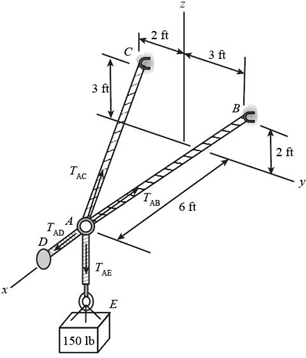
The tension in cable AB is equal to the weight of the crate because the cable AE is directly connected with the crate. Then:
\[{T_{AE}} = 150\;{\rm{lb}}\]The coordinates of points A, B, and C are:
\[\begin{array}{c} A = \left( {6,\;0,\;0} \right)\\ B = \left( {0,\;3,\;2} \right)\\ C = \left( {0,\; - 2,\;3} \right) \end{array}\]Calculate the vector of line AB:
\[\begin{array}{c} \overrightarrow {AB} = \left( {0 - 6} \right)\;\widehat i + \left( {3 - 0} \right)\;\widehat j + \left( {2 - 0} \right)\;\widehat k\\ = - 6\;\widehat i + 3\;\widehat j + 2\;\widehat k \end{array}\]Calculate the magnitude of cable AB:
\[\begin{array}{c} \left| {\overrightarrow {AB} } \right| = \sqrt {{{\left( { - 6} \right)}^2} + {{\left( 3 \right)}^2} + {{\left( 2 \right)}^2}} \\ = 7\; \end{array}\]Calculate the unit vector of line AB:
\[\begin{array}{c} {\overrightarrow U _{AB}} = \frac{{\overrightarrow {AB} }}{{\left| {\overrightarrow {AB} } \right|}}\\ = \frac{{ - 6\;\widehat i + 3\;\widehat j + 2\;\widehat k}}{7}\\ = - 0.857\;\widehat i + 0.429\;\widehat j + 0.286\;\widehat k \end{array}\]Calculate the tension vector in cable AB:
\[\begin{array}{c} {\overrightarrow T _{AB}} = {T_{AB}} \cdot {\overrightarrow U _{AB}}\\ {\overrightarrow T _{AB}} = {T_{AB}}\left( { - 0.857\;\widehat i + 0.429\;\widehat j + 0.286\;\widehat k} \right)\\ {\overrightarrow T _{AB}} = - 0.857{T_{AB}}\;\widehat i + 0.429{T_{AB}}\;\widehat j + 0.286{T_{AB}}\;\widehat k \end{array}\] ……………(1)Calculate the vector of line AC:
\[\begin{array}{c} \overrightarrow {AC} = \left( {0 - 6} \right)\;\widehat i + \left( { - 2 - 0} \right)\;\widehat j + \left( {3 - 0} \right)\;\widehat k\\ = - 6\;\widehat i - 2\;\widehat j + 3\;\widehat k \end{array}\]Calculate the magnitude of cable AC:
\[\begin{array}{c} \left| {\overrightarrow {AC} } \right| = \sqrt {{{\left( { - 6} \right)}^2} + {{\left( { - 2} \right)}^2} + {{\left( 3 \right)}^2}} \\ = 7\; \end{array}\]Calculate the unit vector of line AC:
\[\begin{array}{c} {\overrightarrow U _{AC}} = \frac{{\overrightarrow {AC} }}{{\left| {\overrightarrow {AC} } \right|}}\\ = \frac{{ - 6\;\widehat i - 2\;\widehat j + 3\;\widehat k}}{7}\\ = - 0.857\;\widehat i - 0.286\;\widehat j + 0.429\;\widehat k \end{array}\]Calculate the tension vector in cable AC:
\[\begin{array}{c} {\overrightarrow T _{AC}} = {T_{AC}} \cdot {\overrightarrow U _{AC}}\\ {\overrightarrow T _{AC}} = {T_{AC}}\left( { - 0.857\;\widehat i - 0.286\;\widehat j + 0.429\;\widehat k} \right)\\ {\overrightarrow T _{AC}} = - 0.857{T_{AC}}\;\widehat i - 0.286{T_{AC}}\;\widehat j + 0.429{T_{AC}}\;\widehat k \end{array}\] ……………(2)The vector of line AD is acting straight along the x-axis. Thus, the unit vector of line AD is:
\[{\overrightarrow U _{AD}} = 1\;\widehat i + 0\;\widehat j + 0\;\widehat k\]Calculate the tension vector in cable AD:
\[\begin{array}{c} {\overrightarrow T _{AD}} = {T_{AD}} \cdot {\overrightarrow U _{AD}}\\ {\overrightarrow T _{AD}} = {T_{AD}}\left( {1\;\widehat i + 0\;\widehat j + 0\;\widehat k} \right)\\ {\overrightarrow T _{AD}} = {T_{AD}}\;\widehat i + 0\;\widehat j + 0\;\widehat k \end{array}\] ……………(3)The vector of line AE is acting straight down along the negative z-axis. Thus, the unit vector of line AE is:
\[{\overrightarrow U _{AE}} = 0\;\widehat i + 0\;\widehat j - 1\;\widehat k\]Calculate the tension vector in cable AE:
\[\begin{array}{c} {\overrightarrow T _{AE}} = {T_{AE}} \cdot {\overrightarrow U _{AE}}\\ {\overrightarrow T _{AE}} = 150\;{\rm{lb}}\left( {0\;\widehat i + 0\;\widehat j - 1\;\widehat k} \right)\\ {\overrightarrow T _{AE}} = 0\;\widehat i + 0\;\widehat j - \left( {150\;{\rm{lb}}} \right)\;\widehat k \end{array}\] ……………(4)From equations (1), (2), (3),and (4), substitute the coefficients of $\widehat i$ equals to zero for the equilibrium of forces in the x-direction. Then,
\[ - 0.857{T_{AB}} - 0.875{T_{AC}} + {T_{AD}} = 0\] ……………(5)From equations (1), (2), (3), and (4), substitute the coefficients of $\widehat j$ equals to zero for the equilibrium of forces in the y-direction. Then,
\[\begin{array}{c} 0.429{T_{AB}} - 0.286{T_{AC}} = 0\\ 0.429{T_{AB}} = 0.286{T_{AC}}\\ {T_{AC}} = \frac{{0.429{T_{AB}}}}{{0.286}}\\ {T_{AC}} = 1.5{T_{AB}} \end{array}\] ……………(6)From equations (1), (2), (3), and (4), substitute the coefficients of $\widehat k$ equals to zero for the equilibrium of forces in the z-direction. Then,
\[\begin{array}{c} 0.286{T_{AB}} + 0.429{T_{AC}} - 150\;{\rm{lb}} = 0\\ 0.286{T_{AB}} + 0.429{T_{AC}} = 150\;{\rm{lb}} \end{array}\] …………...(7)Step 3
Substitute the value of equation (6) in equation (7):
\[\begin{array}{c} 0.286{T_{AB}} + 0.429\left( {1.5{T_{AB}}} \right) = 150\;{\rm{lb}}\\ 0.9295{T_{AB}} = 150\;{\rm{lb}}\\ {T_{AB}} = \frac{{150\;{\rm{lb}}}}{{0.9295}}\\ {T_{AB}} \approx 161.4\;{\rm{lb}} \end{array}\]Substitute the above value in equation (6):
\[\begin{array}{c} {T_{AC}} = 1.5\left( {161.4\;{\rm{lb}}} \right)\\ = 242.1\;{\rm{lb}} \end{array}\]Substitute the value of ${T_{AB}}$ and ${T_{AC}}$ in equation (5):
\[\begin{array}{c} - 0.857\left( {161.4\;{\rm{lb}}} \right) - 0.857\left( {242.1\,{\rm{lb}}} \right) + {T_{AD}} = 0\\ - 345.8\;{\rm{lb}} + {T_{AD}} = 0\\ {T_{AD}} = 345.8\;{\rm{lb}} \end{array}\]