Engineering Mechanics: Statics and Dynamics, 14th Edition
Authors: Russell C. Hibbeler
ISBN-13: 978-0133915426
See our solution for Question 12P from Chapter 4 from Hibbeler's Engineering Mechanics.
Problem 12P
Step-by-Step Solution
We have given that the magnitude of the force acting at the end of the boom is $P = 6\;{\rm{kN}}$ and the horizontal distance of point B from a for the maximum moment is $x = 10\;{\rm{m}}$.
We are asked to calculate the angle $\theta$ and the moment about point O for the maximum moment condition.
Step 2
For the maximum moment, the cable AB must be perpendicular to the boom AO.
A labeled diagram for the maximum moment condition is shown below.
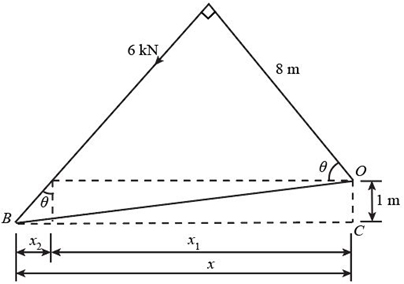
From the geometry of the diagram, the distance $x$ can be written as:
\[\begin{array}{c} x = {x_1} + {x_2}\\ x = \frac{{8\;{\rm{m}}}}{{\cos \theta }} + 1\;{\rm{m}} \times \tan \theta \\ x = \frac{{8\;{\rm{m}}}}{{\cos \theta }} + 1\;{\rm{m}} \times \frac{{\sin \theta }}{{\cos \theta }} \end{array}\]Substitute the value of $x$ in the above equation and multiply $\cos \theta $ on both side:
\[\begin{array}{c} \left( {10\;{\rm{m}}} \right) \times \cos \theta = \left( {\frac{{8\;{\rm{m}}}}{{\cos \theta }} + 1\;{\rm{m}} \times \frac{{\sin \theta }}{{\cos \theta }}} \right) \times \cos \theta \\ \left( {10\;{\rm{m}}} \right) \times \cos \theta = 8\;{\rm{m}} + 1\;{\rm{m}} \times \sin \theta \end{array}\]Divide the above equation by $\sqrt {101} \;{\rm{m}}$ on both sides:
\[\left( {\frac{{10\;{\rm{m}}}}{{\sqrt {101} \;{\rm{m}}}}} \right) \times \cos \theta = \frac{{8\;{\rm{m}}}}{{\sqrt {101} \;{\rm{m}}}} + \frac{{1\;{\rm{m}}}}{{\sqrt {101} \;{\rm{m}}}} \times \sin \theta \] ……(1)Calculate the length OB by applying Pythagoras theorem in triangle OBC:
\[\begin{array}{c} {\left( {OB} \right)^2} = {\left( {OC} \right)^2} + {\left( {BC} \right)^2}\\ {\left( {OB} \right)^2} = {\left( {1\;{\rm{m}}} \right)^2} + {\left( {10\;{\rm{m}}} \right)^2}\\ {\left( {OB} \right)^2} = 101\;{{\rm{m}}^2}\\ OB = \sqrt {101} \;{\rm{m}} \end{array}\]From triangle OBC, calculate the angle $\alpha$:
\[\begin{array}{l} \alpha = {\tan ^{ - 1}}\left( {\frac{{1\;{\rm{m}}}}{{10\;{\rm{m}}}}} \right)\\ \alpha = 5.71^\circ \end{array}\]From the geometry of triangle OBC, we get:
\[\begin{array}{c} \sin \alpha = \frac{{OC}}{{OB}}\\ \sin 5.71^\circ = \frac{{1\;{\rm{m}}}}{{\sqrt {101} \;{\rm{m}}}} \end{array}\]Again from the geometry of triangle OBC, we get:
\[\begin{array}{c} \cos \alpha = \frac{{BC}}{{OC}}\\ \cos 5.71^\circ = \frac{{10\;{\rm{m}}}}{{\sqrt {101} \;{\rm{m}}}} \end{array}\]Substitute $\sin 5.71^\circ $ for $\frac{{1\;{\rm{m}}}}{{\sqrt {101} \;{\rm{m}}}}$ and $\cos 5.71^\circ $ for $\frac{{10\;{\rm{m}}}}{{\sqrt {101} \;{\rm{m}}}}$ in equation (1):
\[\begin{array}{c} \left( {\cos 5.71^\circ } \right) \times \cos \theta = \frac{{8\;{\rm{m}}}}{{\sqrt {101} \;{\rm{m}}}} + \sin 5.71^\circ \times \sin \theta \\ \cos \theta \times \cos 5.71^\circ - \sin \theta \times \sin 5.71^\circ = \frac{{8\;{\rm{m}}}}{{\sqrt {101} \;{\rm{m}}}}\\ \cos \theta \times \cos 5.71^\circ - \sin \theta \times \sin 5.71^\circ = 0.796 \end{array}\]Apply the formula $\cos \left( {a + b} \right) = \cos a \times \cos b - \sin a \times \sin b$ in the above equation, we get:
\[\begin{array}{c} \cos \left( {\theta + 5.71^\circ } \right) = 0.796\\ \theta + 5.71^\circ = {\cos ^{ - 1}}\left( {0.796} \right)\\ \theta + 5.71^\circ = 37.25^\circ \\ \theta = 31.54^\circ \end{array}\]Step 3
Consider the moment in the counter-clockwise direction as positive.
The equation of moment about point O can be given as:
\[{M_O} = P \times 8\;{\rm{m}}\]Substitute the value of $P$ in the above equation:
\[\begin{array}{c} {M_O} = 6\;{\rm{kN}} \times 8\;{\rm{m}}\\ = 48.0\;{\rm{kN}} \cdot {\rm{m}} \end{array}\]