Engineering Mechanics: Statics and Dynamics, 14th Edition
Authors: Russell C. Hibbeler
ISBN-13: 978-0133915426
See our solution for Question 137P from Chapter 4 from Hibbeler's Engineering Mechanics.
Problem 137P
Step-by-Step Solution
We are given the following data:
The force at the point $A$ is ${{\bf{F}}_{\rm{A}}} = \left\{ {400{\bf{i}}} \right\}\;{\rm{N}}$.
The force at the point $B$ is ${{\bf{F}}_{\rm{B}}} = \left\{ { - 300{\bf{k}}} \right\}\;{\rm{N}}$.
The force at the point $C$ is ${{\bf{F}}_{\rm{C}}} = \left\{ {200{\bf{j}}} \right\}\;{\rm{N}}$.
We are asked to estimate the magnitude of the force and couple moment for the wrench and the point $P\left( {x,z} \right)$.
Step 2
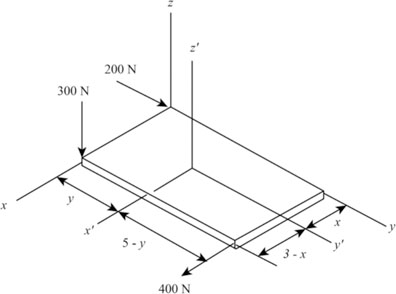
The free-body diagram of the plate is given below.
The formula to calculate the resultant force vector is given by,
\[{{\bf{F}}_{\rm{R}}} = \left\{ {{{\bf{F}}_A} + {{\bf{F}}_{\rm{B}}} + {{\bf{F}}_{\rm{C}}}} \right\}\]Substitute all the known values in the above formula.
\[{{\bf{F}}_{\rm{R}}}{\rm{ = }}\left\{ {400{\bf{i}} + 200{\bf{j}} - 300{\bf{k}}} \right\}\;{\rm{N}}\]Step 3
The formula to calculate the magnitude of the resultant force is given by,
\[{F_{\rm{R}}} = \sqrt {{{\left( {{F_{\rm{A}}}} \right)}^2} + {{\left( {{F_{\rm{B}}}} \right)}^2} + {{\left( {{F_{\rm{C}}}} \right)}^2}} \]Substitute all the known values in the above formula.
\[\begin{array}{c} {F_{\rm{R}}} = \sqrt {{{\left( {400\;{\rm{N}}} \right)}^2} + {{\left( {200\;{\rm{N}}} \right)}^2} + {{\left( { - 300\;{\rm{N}}} \right)}^2}} \\ = \sqrt {\left( {29 \times {{10}^4}} \right){{\rm{N}}^{\rm{2}}}} \\ \approx 538.52\;{\rm{N}} \end{array}\]Step 4
The formula to calculate the direction of resultant force is given by,
\[{{\bf{u}}_{{F_{\rm{R}}}}} = \frac{{{{\bf{F}}_{\rm{R}}}}}{{{F_{\rm{R}}}}}\]Substitute all the known values in the above formula.
\[\begin{array}{c} {{\bf{u}}_{{F_{\rm{R}}}}} = \frac{{\left\{ {400{\bf{i}} + 200{\bf{j}} - 300{\bf{k}}} \right\}\;{\rm{N}}}}{{\left( {538.52\;{\rm{N}}} \right)}}\\ = \left( {0.7428{\bf{i}} + 0.3714{\bf{j}} - 0.5571{\bf{k}}} \right) \end{array}\]As the line of action of ${{\bf{M}}_{\rm{R}}}$ of the wrench is parallel to ${{\bf{F}}_{\rm{R}}}$ So, both ${{\bf{M}}_{\rm{R}}}$ and ${{\bf{F}}_{\rm{R}}}$ have the same sense. So,
\[\begin{array}{c} {{\bf{u}}_{{M_{\rm{R}}}}} = {{\bf{u}}_{{F_{\rm{R}}}}}\\ = \left( {0.7428{\bf{i}} + 0.3714{\bf{j}} - 0.5571{\bf{k}}} \right) \end{array}\]Step 5
The axes $x'$, $y'$ and $z'$ are parallel to the axes $x$,$y$ and $z$ respectively and are located at a distance $\left( {3 - x} \right)$ to the left of the center of the plate and $\left( {5 - y} \right)$ to the right. . Consider that the wrench acts in the $\left( {x - z} \right)$ plane.
The formula to calculate the moment about the $x'$ axis is given by,
\[{\left( {{M_{\rm{R}}}} \right)_{{\rm{x'}}}} = \sum {{M_{{\rm{x'}}}}} \]Here, ${\left( {{M_{\rm{R}}}} \right)_{{\rm{x'}}}}$ represent the resultant moment about the $x'$ and $\sum {{M_{{\rm{x'}}}}} $ is the summation of the moment about the $x'$ axis.
Substitute all the known values in the above formula.
\[\begin{array}{c} 0.7428{M_{\rm{R}}} = 300y\\ {M_{\rm{R}}} = \frac{{300y}}{{0.7428}}\\ {M_{\rm{R}}} = 403.877y\;...............\;\left( 1 \right) \end{array}\]Step 6
The formula to calculate the moment about the $y'$ axis is given by,
\[{\left( {{M_{\rm{R}}}} \right)_{{\rm{y'}}}} = \sum {{M_{{\rm{y'}}}}} \]Here, ${\left( {{M_{\rm{R}}}} \right)_{{\rm{y'}}}}$ represent the resultant moment about the $y'$ and $\sum {{M_{{\rm{x'}}}}} $ is the summation of the moment about the $y'$ axis.
Substitute all the known values in the above formula.
\[\begin{array}{c} 0.374{M_{\rm{R}}} = 300\left( {3 - x} \right)\\ 0.374\left( {403.877y} \right) = 900 - 300x\\ 151.05y = 900 - 300x\\ 300x + 151.05y = 900 \end{array}\]On further solving the above equation,
\[\begin{array}{c} 300x + 151.05y = 900\\ 300x = 900 - 151.05y\\ x = \frac{{\left( {900 - 151.05y} \right)}}{{300}}\\ x = \left( {3 - 0.504y} \right)\;..............\left( 2 \right) \end{array}\]Step 7
The formula to calculate the moment about the $z'$ axis is given by,
\[{\left( {{M_{\rm{R}}}} \right)_{{\rm{z'}}}} = \sum {{M_{{\rm{z'}}}}} \]Here, ${\left( {{M_{\rm{R}}}} \right)_{{\rm{z'}}}}$ represent the resultant moment about the $z'$ and $\sum {{M_{{\rm{z'}}}}} $ is the summation of the moment about the $z'$ axis.
Substitute all the known values in the above formula.
\[\begin{array}{c} - 0.5571{M_{\rm{R}}} = \left( { - 200x} \right) - \left( {400} \right)\left( {5 - y} \right)\\ \left( { - 0.5571} \right)\left( {403.877y} \right) = - 200x - 2000 + 400y\\ - 225y = - 200x - 2000 + 400y\\ 200x - 625y = - 2000 \end{array}\]On further solving the above equation,
\[\begin{array}{c} 200x - 625y = - 2000\\ 200\left( {3 - 0.504y} \right) - 625y = - 2000\\ 600 - 100.8y - 625y = - 2000\\ y \approx 3.59\;{\rm{m}} \end{array}\]Step 8
Substitute the value of $y$ in the equation (2) to find the value of $x$ coordinate.
\[\begin{array}{c} x = \left( {3 - 0.504y} \right)\\ = \left( {3 - 0.504\left( {3.58} \right)} \right)\\ = 1.21\;{\rm{m}} \end{array}\]Step 9
Substitute the value of $x$ and $y$ in the equation (1) to find the value of ${M_R}$.
\[\begin{array}{c} {M_{\rm{R}}} = \left( {403.877} \right)y\\ = \left( {403.877} \right)\left( {3.59} \right)\\ = 1448.42\;{\rm{N}} \cdot {\rm{m}} \end{array}\]