Engineering Mechanics: Statics and Dynamics, 14th Edition
Authors: Russell C. Hibbeler
ISBN-13: 978-0133915426
See our solution for Question 159P from Chapter 4 from Hibbeler's Engineering Mechanics.
Problem 159P
Step-by-Step Solution
We are given the distributed load $w = \left( {2{x^2} - 8x + 18} \right)\;{{{\rm{lb}}} \mathord{\left/ {\vphantom {{{\rm{lb}}} {{\rm{ft}}}}} \right. } {{\rm{ft}}}}$ as shown in the figure.
We are asked to determine the magnitude of the equivalent resistance force and its location measured from the support A.

Step 2
To represent the elemental area of the loading on the beam, we need to draw the diagram of the beam as:
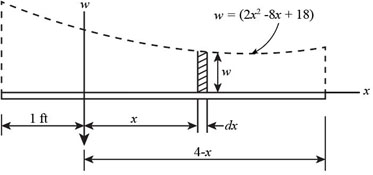
To calculate the equivalent resultant force exerting on the beam, we need to integrate the elemental area $\left( {dA} \right)$ from the limit $ - 1$ to $4$ as:
\[\begin{array}{c} {F_R} = \int\limits_{ - 1}^4 {dA} \\ {F_R} = \int\limits_{ - 1}^4 {wdx} \\ {F_R} = \int\limits_{ - 1}^4 {\left[ {\left( {2{x^2} - 8x + 18} \right)} \right] \cdot dx} \\ {F_R} = \left[ {\frac{{2{x^3}}}{3} - 4{x^2} + 18x} \right]_{ - 1}^4 \end{array}\]Substitute the limits in x, we get:
\[\begin{array}{c} {F_R} = \left[ {\left\{ {\left( {\frac{{2 \times {{\left( 4 \right)}^3}}}{3}} \right) - \left( {4 \times {{\left( 4 \right)}^2}} \right) + \left( {18 \times \left( 4 \right)} \right)} \right\} - \left\{ {\left( {\frac{{2 \times {{\left( { - 1} \right)}^3}}}{3}} \right) - \left( {4 \times {{\left( { - 1} \right)}^2}} \right) + \left( {18 \times \left( { - 1} \right)} \right)} \right\}} \right]\;{\rm{lb}}\\ {F_R} = \left( {50.66 + 20.66} \right)\;{\rm{lb}}\\ {F_R} = 73.3\;{\rm{lb}} \end{array}\]Step 3
To calculate the location $x$ of the resultant force $\left( {{F_R}} \right)$ measured from point O, we have:
\[x = \frac{{\int {xdA} }}{{\int\limits_A {dA} }}\]Substitute the values in the above expression, we get:
\[\begin{array}{l} x = \frac{{\int\limits_{ - 1}^4 {x\left( {2{x^2} - 8x + 18} \right) \cdot dx} }}{{\int\limits_A {dA} }}\\ x = \frac{{\int\limits_{ - 1}^4 {\left( {2{x^3} - 8{x^2} + 18x} \right) \cdot dx} }}{{\int\limits_A {dA} }}\\ x = \frac{{\left[ {\frac{{{x^4}}}{2} - \frac{{8{x^3}}}{3} + 9{x^2}} \right]_{ - 1}^4}}{{\left( {73.3\;{\rm{lb}}} \right)}} \end{array}\]Substitute the limit in x, we get:
\[\begin{array}{c} x = \frac{{\left\{ {\left( {\frac{{{{\left( 4 \right)}^4}}}{2}} \right) - \left( {\frac{{8 \times {{\left( 4 \right)}^3}}}{3}} \right) + \left( {9 \times {{\left( 4 \right)}^2}} \right)} \right\} - \left\{ {\left( {\frac{{{{\left( { - 1} \right)}^4}}}{2}} \right) - \left( {\frac{{8 \times {{\left( { - 1} \right)}^3}}}{3}} \right) + \left( {9 \times {{\left( { - 1} \right)}^2}} \right)} \right\}}}{{\left( {73.3\;{\rm{lb}}} \right)}}\\ x = \frac{{\left( {101.33 - 12.16} \right)\;{\rm{lb}} \cdot {\rm{ft}}}}{{\left( {73.3\;{\rm{lb}}} \right)}}\\ x = \frac{{\left( {89.17\;{\rm{lb}} \cdot {\rm{ft}}} \right)}}{{\left( {73.3\;{\rm{lb}}} \right)}}\\ x = 1.22\;{\rm{ft}} \end{array}\]Now, to calculate the location $\bar x$ of the resultant force $\left( {{F_R}} \right)$ measured from the support A, we have:
\[d = \left( {1\;{\rm{ft}}} \right) + x\]Substitute the values in the above expression, we get:
\[\begin{array}{c} d = \left( {1\;{\rm{ft}}} \right) + \left( {1.22\;{\rm{ft}}} \right)\\ d = 2.22\;{\rm{ft}} \end{array}\]