Engineering Mechanics: Statics and Dynamics, 14th Edition
Authors: Russell C. Hibbeler
ISBN-13: 978-0133915426
See our solution for Question 20FP from Chapter 4 from Hibbeler's Engineering Mechanics.
Problem 20FP
Chapter:
Problem:
Determine the resultant couple moment acting on the triangular plate.
Step-by-Step Solution
Step 1
Step 2
Step 3
We are given the forces ${F_1} = 150\;{\rm{lb}}$, ${F_1}' = 150\;{\rm{lb}}$, ${F_2} = 300\;{\rm{lb}}$, ${F_2}' = 300\;{\rm{lb}}$, ${F_3} = 200\;{\rm{lb}}$, and ${F_3}' = 200\;{\rm{lb}}$, the perpendicular distance as $d = 4\;{\rm{ft}}$.
We are asked to determine the resultant couple moment.
Step 2
We first draw a free body diagram of the given system.
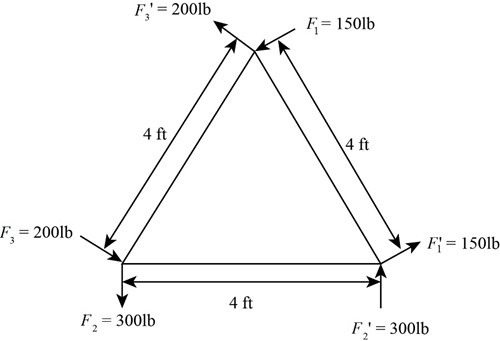
Figure-(1)
Step 3
Consider the counterclockwise couple is positive and clockwise is negative.
To find the resultant moment use the following relation.
\[{M_R} = {F_1} \times d + {F_2} \times d + {F_3} \times d\]Substitute the known values in the above expression.
\begin{array}{c} {M_R} = \left( {150\;{\rm{lb}}} \right) \times \left( {4\;{\rm{ft}}} \right) + \left( {300\;{\rm{N}}} \right) \times \left( {4\;{\rm{ft}}} \right) + \left( {200\;{\rm{lb}}} \right) \times \left( {4\;{\rm{ft}}} \right)\\ = 600\;{\rm{lb}} \cdot {\rm{ft}} + 1200\;{\rm{lb}} \cdot {\rm{ft}} + 800\;{\rm{lb}} \cdot {\rm{ft}}\\ = 2600\;{\rm{lb}} \cdot {\rm{ft}}\\ = 2{\rm{600}}\;{\rm{lb}} \cdot {\rm{ft }}\left( {{\rm{CCW}}} \right) \end{array}