Engineering Mechanics: Statics and Dynamics, 14th Edition
Authors: Russell C. Hibbeler
ISBN-13: 978-0133915426
See our solution for Question 10FP from Chapter 5 from Hibbeler's Engineering Mechanics.
Problem 10FP
Step-by-Step Solution
We are given a force $F = 450\;{\rm{N}}$ at point $D$, the position of point $A$ is $\left( {0,\,0,\,0} \right)\;{\rm{m}}$, the position of point $B$ is $\left( {0.6,\;0.6,\,0} \right)\;{\rm{m}}$, the position of point $C$ is $\left( {1,\,1.2,\,0} \right)\;{\rm{m}}$, and the position of point $D$ is $\left( {0.6,\,1.2,\,0} \right)\;{\rm{m}}$.
We are asked to determine the support reactions at the smooth journal bearings $A$, $B$, and $C$.
Step 2
First draw the free body diagram for the given pipe assembly.
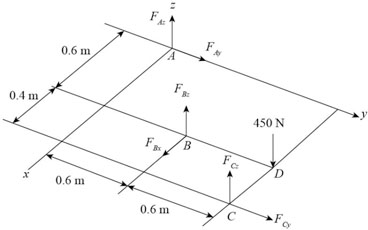
Figure-(1)
Step 3
Find the vector position of $AB$ using the following relation.
\[{{\bf{r}}_{AB}} = \left( {{x_b} - {x_a}} \right){\bf{i}} + \left( {{y_b} - {y_a}} \right){\bf{j}} + \left( {{z_b} - {z_a}} \right){\bf{k}}\]Substitute the known values in the above expression.
\[\begin{array}{c} {{\bf{r}}_{AB}} = \left( {0.6 - 0} \right){\bf{i}} + \left( {0.6 - 0} \right){\bf{j}} + \left( {0 - 0} \right){\bf{k}}\\ = \left[ {0.6{\bf{i}} + 0.6{\bf{j}}} \right]\;{\rm{m}} \end{array}\]Step 4
Find the vector position of $AC$ using the following relation.
\[{{\bf{r}}_{AC}} = \left( {{x_c} - {x_a}} \right){\bf{i}} + \left( {{y_c} - {y_a}} \right){\bf{j}} + \left( {{z_c} - {z_a}} \right){\bf{k}}\]Substitute the known values in the above expression.
\[\begin{array}{c} {{\bf{r}}_{AC}} = \left( {1 - 0} \right){\bf{i}} + \left( {1.2 - 0} \right){\bf{j}} + \left( {0 - 0} \right){\bf{k}}\\ = \left[ {1{\bf{i}} + 1.2{\bf{j}}\,} \right]\,{\rm{m}} \end{array}\]Step 5
Find the vector position of $AD$ using the following relation.
\[{{\bf{r}}_{AD}} = \left( {{x_d} - {x_a}} \right){\bf{i}} + \left( {{y_d} - {y_a}} \right){\bf{j}} + \left( {{z_d} - {z_a}} \right){\bf{k}}\]Substitute the known values in the above expression.
\[\begin{array}{c} {{\bf{r}}_{AD}} = \left( {0.6 - 0} \right){\bf{i}} + \left( {1.2 - 0} \right){\bf{j}} + \left( {0 - 0} \right){\bf{k}}\\ = \left[ {0.6{\bf{i}} + 1.2{\bf{j}}} \right]\,{\rm{m}} \end{array}\]Step 6
The reaction at bearing $A$ is along $y$ and $z$ axes, the reaction at bearing $B$ is along $x$ and $z$ axes, and the reaction at bearing $C$ is along $y$ and $z$ axis.
Find the moment at point $A$ in equilibrium condition using the following relation.
\[{\bf{M}} = {{\bf{r}}_{AB}} \times {{\bf{F}}_B} + {{\bf{r}}_{AC}} \times {{\bf{F}}_C} + {{\bf{r}}_{AD}} \times {{\bf{F}}_D}\]Substitute the known values in the above expression.
\[\begin{array}{l} \left( {0{\bf{i}} + 0{\bf{j}} + 0{\bf{k}}} \right) = \left| {\begin{array}{*{20}{c}} {\bf{i}}&{\bf{j}}&{\bf{k}}\\ {0.6}&{0.6}&0\\ {{F_{Bx}}}&0&{{F_{Bz}}} \end{array}} \right| + \left| {\begin{array}{*{20}{c}} {\bf{i}}&{\bf{j}}&{\bf{k}}\\ 1&{1.2}&0\\ 0&{{F_{Cy}}}&{{F_{Cz}}} \end{array}} \right| + \left| {\begin{array}{*{20}{c}} {\bf{i}}&{\bf{j}}&{\bf{k}}\\ {0.6}&{1.2}&0\\ 0&0&{ - 450} \end{array}} \right|\\ \left( {0{\bf{i}} + 0{\bf{j}} + 0{\bf{k}}} \right) = \left[ \begin{array}{l} \left( {0.6{F_{Bz}} - 0} \right){\bf{i}} - \left( {0.6{F_{Bz}} - 0} \right){\bf{j}} + \left( {0 - 0.6{F_{Bx}}} \right){\bf{k}} + \\ \left( {1.2{F_{Cz}} - 0} \right){\bf{i}} - \left( {{F_{Cz}} - 0} \right){\bf{j}} + \left( {{F_{Cy}} - 0} \right){\bf{k}} + \\ \left( { - 540 - 0} \right){\bf{i}} - \left( { - 270 - 0} \right){\bf{j}} + \left( {0 - 0} \right){\bf{k}} \end{array} \right]\\ \left( {0{\bf{i}} + 0{\bf{j}} + 0{\bf{k}}} \right) = \left[ \begin{array}{c} \left( {0.6{F_{Bz}} + 1.2{F_{Cz}} - 540} \right){\bf{i}} + \left( { - 0.6{F_{Bz}} - {F_{Cz}} + 270} \right){\bf{j}}\\ + \left( { - 0.6{F_{Bx}} + {F_{Cy}}} \right){\bf{k}} \end{array} \right] \end{array}\]Step 7
To find the force ${F_{Bz}}$ by equating along $x$-axis use the following relation.
\[\left( {0{\bf{i}} + 0{\bf{j}} + 0{\bf{k}}} \right) = \left[ \begin{array}{l} \left( {0.6{F_{Bz}} + 1.2{F_{Cz}} - 540} \right){\bf{i}} + \left( { - 0.6{F_{Bz}} - {F_{Cz}} + 270} \right){\bf{j}}\\ + \left( { - 0.6{F_{Bx}} + {F_{Cy}}} \right){\bf{k}} \end{array} \right]\]Substitute the known values in the above expression.
\[\begin{array}{c} 0 = \left( {0.6{F_{Bz}} + 1.2{F_{Cz}} - 540} \right)\\ {F_{Bz}} = \frac{{540 - 1.2{F_{Cz}}}}{{0.6}} \end{array}\]Step 8
To find the force ${F_{Cz}}$ by equating along $y$-axis use the following relation.
\[\left( {0{\bf{i}} + 0{\bf{j}} + 0{\bf{k}}} \right) = \left[ \begin{array}{l} \left( {0.6{F_{Bz}} + 1.2{F_{Cz}} - 540} \right){\bf{i}} + \left( { - 0.6{F_{Bz}} - {F_{Cz}} + 270} \right){\bf{j}}\\ + \left( { - 0.6{F_{Bx}} + {F_{Cy}}} \right){\bf{k}} \end{array} \right]\]Substitute the known values in the above expression.
\[\begin{array}{c} 0 = \left( { - 0.6\left( {\frac{{540 - 1.2{F_{Cz}}}}{{0.6}}} \right) - {F_{Cz}} + 270} \right)\\ - 540 + 1.2{F_{Cz}} - {F_{Cz}} + 270 = 0\\ 0.2{F_{Cz}} = 270\\ {F_{Cz}} = 1350\,{\rm{N}} \end{array}\]Step 9
To find the force ${F_{Bz}}$ use the following relation.
\[{F_{Bz}} = \frac{{540 - 1.2{F_{Cz}}}}{{0.6}}\]Substitute the known values in the above expression.
\[\begin{array}{c} {F_{Bz}} = \frac{{540 - 1.2\left( {1350} \right)}}{{0.6}}\\ = - 1800\;{\rm{N}} \end{array}\]Step 10
To find the force ${F_{Bz}}$ by equating along $z$-axis use the following relation.
\[\left( {0{\bf{i}} + 0{\bf{j}} + 0{\bf{k}}} \right) = \left[ \begin{array}{l} \left( {0.6{F_{Bz}} + 1.2{F_{Cz}} - 540} \right){\bf{i}} + \left( { - 0.6{F_{Bz}} - {F_{Cz}} + 270} \right){\bf{j}}\\ + \left( { - 0.6{F_{Bx}} + {F_{Cy}}} \right){\bf{k}} \end{array} \right]\]Substitute the known values in the above expression.
\[\begin{array}{c} 0 = \left( { - 0.6{F_{Bx}} + {F_{Cy}}} \right)\\ {F_{Cy}} = 0.6{F_{Bx}} \end{array}\]Step 11
To find ${F_{Bx}}$ add all the forces acting along $x$-axis use the following relation.
\[{F_{Bx}} = 0\]Step 12
To find ${F_{Cy}}$ use the following relation.
\[{F_{Cy}} = 0.6{F_{Bx}}\]Substitute the known values in the above expression.
\[\begin{array}{c} {F_{Cy}} = 0.6\left( 0 \right)\\ = 0 \end{array}\]Step 13
To find ${F_{Ay}}$ add all the forces acting along $y$-axis use the following relation.
\[{F_{Ay}} + {F_{Cy}} = 0\]Substitute the known values in the above expression.
\[\begin{array}{c} {F_{Ay}} + 0 = 0\\ {F_{Ay}} = 0 \end{array}\]Step 14
To find ${F_{Az}}$ add all the forces acting along $z$-axis use the following relation.
\[{F_{Az}} + {F_{Cz}} + {F_{Bz}} - F = 0\]Substitute the known values in the above expression.
\[\begin{array}{c} {F_{Az}} - 1800\;{\rm{N}} + 1350\;{\rm{N}} - 450\;{\rm{N}} = 0\\ {F_{Az}} = 900\;{\rm{N}} \end{array}\]