Engineering Mechanics: Statics and Dynamics, 14th Edition
Authors: Russell C. Hibbeler
ISBN-13: 978-0133915426
See our solution for Question 14P from Chapter 5 from Hibbeler's Engineering Mechanics.
Problem 14P
Step-by-Step Solution
We are given the uniformly distributed load $P = 800\;{\rm{N/m}}$, the horizontal distance between both end points of the beam is $c = 3\;{\rm{m}}$, the distance between end point and $A$ is $a = 1\;{\rm{m}}$, and the distance between $A$ and $B$ is $b = 3\;{\rm{m}}$.
We are asked to determine the reactions at supports.
Step 2
First find the length of the beam using the following relation.
\[L = \sqrt {{c^2} + {{\left( {a + b} \right)}^2}} \]Substitute the known values in the above expression.
\[\begin{array}{c} L = \sqrt {{{\left( {3\;{\rm{m}}} \right)}^2} + {{\left( {1\;{\rm{m}} + 3\;{\rm{m}}} \right)}^2}} \\ = \sqrt {{{\left( {3\;{\rm{m}}} \right)}^2} + {{\left( {4\;{\rm{m}}} \right)}^2}} \\ = 5\;{\rm{m}} \end{array}\]Step 3
Find the angle of the beam with horizontal using the following relation.
\[\tan \phi = \frac{c}{{a + b}}\]Substitute the known values in the above expression.
\[\begin{array}{c} \tan \phi = \frac{{\left( {3\;{\rm{m}}} \right)}}{{\left( {1\;{\rm{m}} + 3\;{\rm{m}}} \right)}}\\ \tan \phi = \frac{{3\;{\rm{m}}}}{{4\;{\rm{m}}}}\\ \phi = 36.87^\circ \end{array}\]Step 4
The uniform force acts at the center of the length along which it is distributed.
First find the individual force of uniform force using the following relation.
\[{F_1} = \left( P \right)\left( L \right)\]Substitute the known values in the above expression.
\[\begin{array}{c} {F_1} = \left( {800\;{\rm{N/m}}} \right)\left( {5\;{\rm{m}}} \right)\\ = \left( {4000\;{\rm{N}} \times \frac{{{{10}^{ - 3}}\;{\rm{kN}}}}{{1\;{\rm{N}}}}} \right)\\ = 4\;{\rm{kN}} \end{array}\]Step 5
Now draw the free body diagram for the given beam.
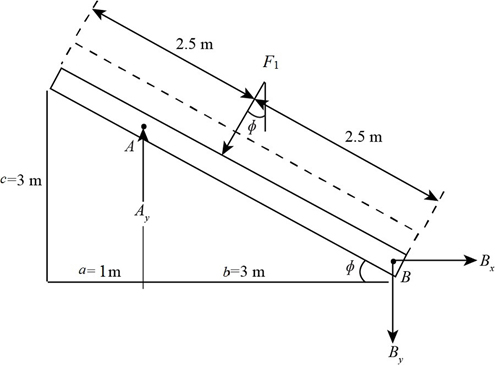
Figure-(1)
Step 6
Find the reaction at point $A$ from equation moment at point $B$ to zero using the following relation.
\[ - {A_y} \times b + {F_1} \times \left( {\frac{L}{2}} \right) = 0\]Substitute the known values in the above expression.
\[\begin{array}{c} - {A_y} \times \left( {3\;{\rm{m}}} \right) + \left( {4\;{\rm{kN}}} \right) \times \left( {\frac{{5\;{\rm{m}}}}{2}} \right) = 0\\ {A_y} = 3333.33\;{\rm{N}} \times \frac{{{{10}^{ - 3}}\;{\rm{kN}}}}{{1\;{\rm{N}}}}\\ {A_y} = 3.33\;{\rm{kN}} \end{array}\]Step 8
Find the sum of all the forces acting in $y$ direction using the following relation.
\[{A_y} - {F_1}\cos \phi - {B_y} = 0\]Substitute the known values in the above expression.
\[\begin{array}{c} 3.33\;{\rm{kN}} - \left( {4\;{\rm{kN}}} \right)\cos 36.87^\circ - {B_y} = 0\\ {B_y} = 0.13\;{\rm{kN}} \end{array}\]Step 8
Find the sum of all the forces acting in $x$ direction using the following relation.
\[ - {F_1}\sin \phi + {B_x} = 0\]Substitute the known values in the above expression.
\[\begin{array}{c} - \left( {4\;{\rm{kN}}} \right)\sin 36.87^\circ + {B_x} = 0\\ {B_x} = 2.4\;{\rm{kN}} \end{array}\]