Engineering Mechanics: Statics and Dynamics, 14th Edition
Authors: Russell C. Hibbeler
ISBN-13: 978-0133915426
See our solution for Question 26P from Chapter 5 from Hibbeler's Engineering Mechanics.
Problem 26P
Step-by-Step Solution
We are given the mass of the crane and truck is ${m_{ct}} = 18\;{\rm{Mg}}$, the center of mass of crane and truck is ${G_1}$, the mass of the boom is ${m_b} = 1.8\;{\rm{Mg}}$, the center of mass of boom is ${G_2}$, and the mass of the load is ${m_L} = 1.2\;{\rm{Mg}}$.
We are required to determine the vertical reactions at each of the four outriggers as a function of boom angle, and we need to plot the result measured from $\theta = 0^\circ $ to the critical angle.
Step 2
The equation for the weight of the crane and truck is given by,
\[{w_{ct}} = {m_{ct}} \times g\]Here, $g$ is the acceleration due to gravity, having a standard value of $9.81\;{{\rm{m}} \mathord{\left/ {\vphantom {{\rm{m}} {{{\rm{s}}^2}}}} \right. } {{{\rm{s}}^2}}}$.
Step 3
Substitute all the values in the above equation.
\[\begin{array}{c} {w_{ct}} = \left( {18\;{\rm{Mg}}} \right) \times \left( {\frac{{\left( {{{10}^3}\;{\rm{kg}}} \right)}}{{\left( {1\;{\rm{Mg}}} \right)}}} \right) \times \left( {9.81\;{{\rm{m}} \mathord{\left/ {\vphantom {{\rm{m}} {{{\rm{s}}^2}}}} \right. } {{{\rm{s}}^2}}}} \right)\\ = \left( {176.5 \times {{10}^3}\;{{{\rm{kg}} \cdot {\rm{m}}} \mathord{\left/ {\vphantom {{{\rm{kg}} \cdot {\rm{m}}} {{{\rm{s}}^2}}}} \right. } {{{\rm{s}}^2}}}} \right) \times \left( {\frac{{1\;{\rm{N}}}}{{1\;{{{\rm{kg}} \cdot {\rm{m}}} \mathord{\left/ {\vphantom {{{\rm{kg}} \cdot {\rm{m}}} {{{\rm{s}}^2}}}} \right. } {{{\rm{s}}^2}}}}}} \right)\\ = 176.5 \times {10^3}\;{\rm{N}} \end{array}\]Step 4
The equation for the weight of the boom is given by,
\[{w_b} = {m_b} \times g\]Step 5
Substitute all the values in the above equation.
\[\begin{array}{c} {w_b} = \left( {1.8\;{\rm{Mg}}} \right) \times \left( {\frac{{\left( {{{10}^3}\;{\rm{kg}}} \right)}}{{\left( {1\;{\rm{Mg}}} \right)}}} \right) \times \left( {9.81\;{{\rm{m}} \mathord{\left/ {\vphantom {{\rm{m}} {{{\rm{s}}^2}}}} \right. } {{{\rm{s}}^2}}}} \right)\\ = \left( {17.65 \times {{10}^3}\;{{{\rm{kg}} \cdot {\rm{m}}} \mathord{\left/ {\vphantom {{{\rm{kg}} \cdot {\rm{m}}} {{{\rm{s}}^2}}}} \right. } {{{\rm{s}}^2}}}} \right) \times \left( {\frac{{1\;{\rm{N}}}}{{1\;{{{\rm{kg}} \cdot {\rm{m}}} \mathord{\left/ {\vphantom {{{\rm{kg}} \cdot {\rm{m}}} {{{\rm{s}}^2}}}} \right. } {{{\rm{s}}^2}}}}}} \right)\\ = 17.65 \times {10^3}\;{\rm{N}} \end{array}\]Step 6
The equation for the weight of the load is given by,
\[{w_L} = {m_L} \times g\]Step 7
Substitute all the values in the above equation.
\[\begin{array}{c} {w_L} = \left( {1.2\;{\rm{Mg}}} \right) \times \left( {\frac{{\left( {{{10}^3}\;{\rm{kg}}} \right)}}{{\left( {1\;{\rm{Mg}}} \right)}}} \right) \times \left( {9.81\;{{\rm{m}} \mathord{\left/ {\vphantom {{\rm{m}} {{{\rm{s}}^2}}}} \right. } {{{\rm{s}}^2}}}} \right)\\ = \left( {11.77 \times {{10}^3}\;{{{\rm{kg}} \cdot {\rm{m}}} \mathord{\left/ {\vphantom {{{\rm{kg}} \cdot {\rm{m}}} {{{\rm{s}}^2}}}} \right. } {{{\rm{s}}^2}}}} \right) \times \left( {\frac{{1\;{\rm{N}}}}{{1\;{{{\rm{kg}} \cdot {\rm{m}}} \mathord{\left/ {\vphantom {{{\rm{kg}} \cdot {\rm{m}}} {{{\rm{s}}^2}}}} \right. } {{{\rm{s}}^2}}}}}} \right)\\ = 11.77 \times {10^3}\;{\rm{N}} \end{array}\]Step 8
The equation for the moment about outrigger $B$ is given by,
\[{R_A} \times x = {w_{ct}} \times {x_1} + {w_b} \times {x_2} + {w_L} \times {x_3}\]Here, $x$ is the perpendicular distance between the outrigger $B$ and point of reaction at outrigger $A$, ${x_1}$ is the perpendicular distance between the outrigger $B$ and weight due to center of mass ${G_1}$, ${x_2}$ is the perpendicular distance between the outrigger $B$ and weight due to center of mass ${G_2}$, and ${x_3}$ is the perpendicular distance between the outrigger $B$ and load.
Step 9
Substitute all the values in the above equation.
\[\begin{array}{c} {R_A} \times \left( {4\;{\rm{m}}} \right) = \left( \begin{array}{l} \left( {176.5 \times {{10}^3}\;{\rm{N}}} \right) \times \left( {1\;{\rm{m}}} \right) + \left( {17.65 \times {{10}^3}\;{\rm{N}}} \right) \times \left( {2\;{\rm{m}} - \left( {6\;{\rm{m}}} \right) \times \sin \theta } \right)\\ + \left( {11.77 \times {{10}^3}\;{\rm{N}}} \right) \times \left( {2\;{\rm{m}} - \left( {12.25\;{\rm{m}}} \right) \times \sin \theta } \right) \end{array} \right)\\ {R_A} = \frac{{\left( \begin{array}{l} \left( {176.5 \times {{10}^3}\;{\rm{N}}} \right) \times \left( {1\;{\rm{m}}} \right) + \left( {17.65 \times {{10}^3}\;{\rm{N}}} \right) \times \left( {2\;{\rm{m}} - \left( {6\;{\rm{m}}} \right) \times \sin \theta } \right)\\ + \left( {11.77 \times {{10}^3}\;{\rm{N}}} \right) \times \left( {2\;{\rm{m}} - \left( {12.25\;{\rm{m}}} \right) \times \sin \theta } \right) \end{array} \right)}}{{\left( {4\;{\rm{m}}} \right)}}\\ {R_A} = \frac{{\left( {235.44 \times {{10}^3} - 250.12 \times {{10}^3}\sin \theta } \right)\;{\rm{N}} \cdot {\rm{m}}}}{{\left( {4\;{\rm{m}}} \right)}}\\ {R_A} = \left( {58.86 \times {{10}^3} - 62.53 \times {{10}^3}\sin \theta } \right)\;{\rm{N}} \end{array}\]Step 10
The tipping takes place when the reaction at outrigger $A$ is zero. Hence substitute ${R_A} = 0$ in the above equation.
\[\begin{array}{c} 0 = \left( {58.86 \times {{10}^3} - 62.53 \times {{10}^3}\sin \theta } \right)\\ 62.53 \times {10^3}\sin \theta = 58.86 \times {10^3}\\ \sin \theta = \frac{{58.86 \times {{10}^3}}}{{62.53 \times {{10}^3}}}\\ \theta = 70.27^\circ \end{array}\]Step 11
Now, equate the forces action in vertical direction.
\[{R_B} + {R_A} = {w_{ct}} + {w_b} + {w_L}\]Step 12
Substitute all the values in the above equation.
\[\begin{array}{c} {R_B} + \left( {58.86 \times {{10}^3} - 62.53 \times {{10}^3}\sin \theta } \right)\;{\rm{N}} = \left( {176.5 \times {{10}^3}\;{\rm{N}}} \right) + \left( {17.65 \times {{10}^3}\;{\rm{N}}} \right) + \left( {11.77 \times {{10}^3}\;{\rm{N}}} \right)\\ {R_B} = \left( {147.06 \times {{10}^3} + 62.53 \times {{10}^3}\sin \theta } \right)\;{\rm{N}} \end{array}\]Step 13
Since there are two outriggers on the each side of the crane, therefore the reaction on outrigger $A$ of the one side can be given as,
\[\begin{array}{c} R_A' = \frac{{{R_A}}}{2}\\ = \frac{{\left( {58.86 \times {{10}^3} - 62.53 \times {{10}^3}\sin \theta } \right)\;{\rm{N}}}}{2}\\ = \left( {29.43 \times {{10}^3} - 31.26 \times {{10}^3}\sin \theta } \right)\;{\rm{N}} \end{array}\]Step 14
The reaction on outrigger $B$ of the one side can be calculated as,
\[\begin{array}{c} R_B' = \frac{{{R_B}}}{2}\\ = \frac{{\left( {147.06 \times {{10}^3} + 62.53 \times {{10}^3}\sin \theta } \right)\;{\rm{N}}}}{2}\\ = \left( {73.53 \times {{10}^3} + 31.26 \times {{10}^3}\sin \theta } \right)\;{\rm{N}} \end{array}\]Step 15
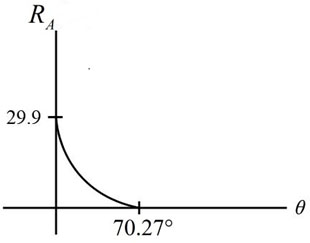
The critical angle is $\theta = 70.27^\circ $. Substitute the different value of $\theta$ between $0^\circ $ to $70.27^\circ $.
| $\theta $ | $0^\circ $ | $30^\circ $ | $45^\circ $ | $60^\circ $ | $70.27^\circ $ |
| ${R_A}\left( {\rm{N}} \right)$ | $29.43 \times {10^3}$ | $13.8 \times {10^3}$ | $7.32 \times {10^3}$ | $2.35 \times {10^3}$ | $o$ |
Step 16
Based on the above results, the plot can be made as shown below.
Step 17
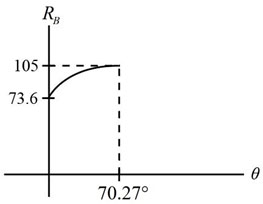
The critical angle is $\theta = 70.27^\circ $. Substitute the different value of $\theta$ between $0^\circ $ to $70.27^\circ $.
| $\theta $ | $0^\circ $ | $30^\circ $ | $45^\circ $ | $60^\circ $ | $70.27^\circ $ |
| ${R_A}\left( {\rm{N}} \right)$ | $73.53 \times {10^3}$ | $89.16 \times {10^3}$ | $95.63 \times {10^3}$ | $100.6 \times {10^3}$ | $102.95 \times {10^3}$ |
Step 18
Based on the above results, the plot can be made as shown below.